5-Day Uzbekistan Itinerary: Tashkent, Samarkand & Bukhara
A realistic 5-day Uzbekistan itinerary: Tashkent, two nights in Samarkand and two in Bukhara, built around real Afrosiyob train times and fares.

Five days is the length of trip most people actually take to Uzbekistan. It is what a week of annual leave leaves you after the flights, and it is the natural shape of a stopover from Istanbul, Dubai or Seoul. The good news is that five days is genuinely enough to see the country’s two greatest cities properly. The bad news is that it is not enough for four cities, and the most common planning mistake is trying to squeeze Khiva into a five-day frame and spending half the trip in transit.
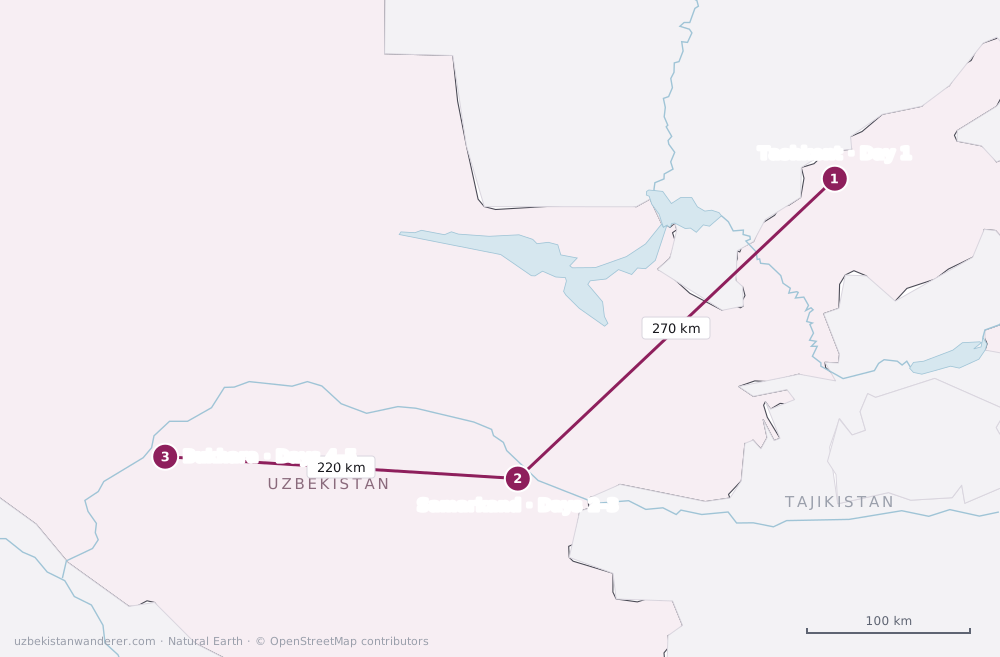
The itinerary below is the version we recommend: land in Tashkent, ride the Afrosiyob high-speed train to Samarkand, give Samarkand two full days, move on to Bukhara, and fly or train home from there. It is a straight line, not a loop, which means no backtracking and no wasted hours. Every travel leg is a train you can book online, and no day involves more than two and a half hours of movement.
We have built it around real 2026 timetables and real opening hours, with honest notes on what gets cut. If you have more time, our 7-day Uzbekistan itinerary adds a slower Bukhara, the 10-day version adds Khiva, and the 14-day route adds the Fergana Valley and a desert night.
Is five days enough for Uzbekistan?
For the Silk Road highlights, yes. Uzbekistan’s headline sights are concentrated along a single railway corridor, and the Afrosiyob covers Tashkent to Samarkand in about 2 hours 10 minutes to 2 hours 30 minutes, depending on the departure, and Samarkand to Bukhara in about 1 hour 40 minutes to 2 hours. That compression is what makes a short trip viable here in a way it would not be in, say, Iran or western China.
What five days is not enough for: Khiva, which sits 450 km beyond Bukhara across the Kyzylkum desert; the Fergana Valley, which is a separate branch of the country entirely; and the Aral Sea region, which needs three days on its own. Accept those omissions cheerfully. Two cities seen slowly beats four cities seen from a taxi window, and Samarkand and Bukhara are, by a wide margin, the two you came for. Our comparison of Samarkand versus Bukhara explains why both earn their place rather than just one.
The five-day route at a glance
| Day | Base | Main focus | Travel that day |
|---|---|---|---|
| 1 | Tashkent | Arrive, Khast Imam, Chorsu Bazaar, metro stations | Airport transfer only |
| 2 | Samarkand | Morning train, Registan, Gur-e-Amir at dusk | Afrosiyob, ~2h10–2h30 |
| 3 | Samarkand | Shah-i-Zinda, Ulugh Beg Observatory, Bibi-Khanym, Siyob Bazaar | None |
| 4 | Bukhara | Midday train, Lyabi-Hauz, Po-i-Kalyan, trading domes | Afrosiyob, ~1h40–2h |
| 5 | Bukhara | Ark fortress, Ismail Samani, Chor Minor, depart | Flight or train home |
Three decisions to make before you book anything
Which airports to use
Tashkent (TAS) has by far the most international routes and is the logical arrival point. For the return, Bukhara (BHK) has domestic flights to Tashkent plus a handful of seasonal international services, and Samarkand (SKD) now has direct links to Istanbul, Dubai and several Gulf and CIS cities. An open-jaw ticket into Tashkent and out of Samarkand or Bukhara removes a dead travel day. If your ticket forces a Tashkent departure, take the evening Afrosiyob from Bukhara back to the capital on day 5 (roughly four hours) and fly out late or the next morning. Our Tashkent airport guide covers arrival logistics, SIM cards and taxis.
Book the trains before the hotels
This is the one piece of advance planning that matters. Afrosiyob seats go on sale about 60 days before departure (Seat61; some older guides still say 45) and the popular morning and midday departures sell out in peak season (April–May and September–October). Book at the official Uzbekistan Railways site, eticket.uzrailpass.uz (foreign cards are processed by Trainhub, so your statement shows TRAINHUB.IO), or through the Uzbekistan Railways app; foreign cards work most of the time but not always, so have a backup. Mark Smith’s rail reference at Seat 61 is the best independent source for current schedules. If online payment fails, any hotel will book tickets for a small fee, and there are ticket offices at every station.
Resist adding Khiva
The fast Bukhara–Khiva train (752) takes about 3 hours 40 minutes but runs only on Tuesdays, Thursdays and Saturdays; by road it is five to six hours, and the return adds the same again. On a five-day trip that is two of your five days gone. Khiva deserves an overnight, not a smash-and-grab. Save it for a longer trip, or build your next visit around it using our Khiva travel guide.
Day 1: Tashkent: land, adjust, eat well
Most flights from Europe and the Gulf land in Tashkent in the early hours or mid-morning. Do not over-programme this day; treat it as a soft landing. Tashkent is a green, Soviet-planned capital with wide boulevards, and it rewards a slow half-day rather than a checklist. The full sight list is in our Tashkent travel guide, but these four are the ones that fit a jet-lagged afternoon.
- Khast Imam Complex, the city’s religious heart, quiet, shaded and free to enter. The Uthman Quran, one of the oldest Quranic manuscripts in existence, moved in November 2025 to the Center of Islamic Civilization next door, which runs ticketed, timed visits with an audio guide.
- Chorsu Bazaar, the great blue-domed market. Go for the spice and dried-fruit rows and the non bread stacked in towers.
- The metro: Kosmonavtlar, Alisher Navoi and Pakhtakor stations are genuine attractions. Photography is now permitted. See our Tashkent metro guide.
- Amir Timur Square, a short walk that sums up the city’s two architectural moods, Timurid revival and late Soviet monumentalism.
Eat plov for lunch rather than dinner: Uzbeks consider it a midday dish, and by evening the good cauldrons at the Central Asian Plov Centre are scraped clean. Our plov guide explains the regional variations, and the broader Uzbek food guide covers what else to order in your first 24 hours.
Day 2: Afrosiyob to Samarkand and the Registan at night
Take a morning Afrosiyob from Tashkent. Departures cluster in the early morning and again around the middle of the day; anything leaving before about 09:00 gets you to Samarkand in time for lunch and a full afternoon. Arrive at the station 30–40 minutes early. There is an airport-style security check and your passport is matched to the ticket.
Samarkand station is a few kilometres from the old town; a taxi via the Yandex Go app costs a couple of dollars. Drop bags, then walk to the Registan. Three madrasahs face a single plaza, and the sheer scale of the tiled facades is the moment most people realise the photographs undersold it. Buy the combined ticket, climb a minaret if the guardian offers (an unofficial tip is expected), and then leave. You will come back.
Spend late afternoon at the Gur-e-Amir, Timur’s mausoleum, when low sun sets the ribbed dome glowing. Then return to the Registan after dark. The evening floodlighting is theatrical and the square empties out; from roughly April to October there is a seated sound-and-light show on many evenings (150,000 som, or watch free from outside the seating), and even without it the after-dinner hour produces the best photograph you will take in Uzbekistan.
Day 3: Samarkand’s second act
A full day with no travel. Start early at Shah-i-Zinda, the avenue of tombs, which opens around 07:00 and is transformed by being empty, the corridor of turquoise mosaic is narrow, and by 10:00 it is a queue. From there it is a short ride to the Ulugh Beg Observatory, where the surviving arc of a 15th-century sextant is still cut into the hillside; the small museum explains why his star catalogue mattered for two centuries afterwards.
Work back through the Bibi-Khanym Mosque (Timur’s over-ambitious congregational mosque, partly rebuilt, still enormous) and straight into Siyob Bazaar next door for lunch, dried apricots and a lesson in how many kinds of non there are. Afternoon options, pick one: the Afrosiyob Museum for the seventh-century ambassadors’ fresco; the Hazrat Khizr mosque terrace for the best free view over the old city; or simply a long tea break, which after two hard days is not a wasted choice.
If crafts appeal more than ruins, swap the afternoon for the Konigil paper mill outside town, where mulberry-bark paper is still made by watermill. Where you sleep matters more than usual on a short trip, see where to stay in Samarkand for the neighbourhoods within walking distance of the Registan.
Day 4: On to Bukhara
Take a late-morning or midday Afrosiyob; the run to Bukhara is about 1 hour 40 minutes to 2 hours through irrigated cotton country. Note that Bukhara’s main station, Bukhara-1, is in Kagan, roughly 12 km from the old town, so budget 20 minutes and a cheap taxi at the far end.
Bukhara asks for a different pace than Samarkand. Where Samarkand is a set of monuments inside a modern city, Bukhara’s old town is an intact medieval quarter you walk through rather than visit. Start at Lyabi-Hauz, the pool square shaded by mulberry trees, then thread west through the covered trading domes (Toqi Zargaron for jewellers, Toqi Telpak Furushon for hats) to Po-i-Kalyan, where the Kalyan minaret, about 45.6 metres tall (some sources say up to 47), has stood since 1127 and, by tradition, impressed Genghis Khan enough that he spared it.
Eat dinner on a terrace overlooking the minaret if you can get a table; several of the boutique hotels around the square open their rooftops to non-guests. The Bukhara travel guide has the full sight list if you want to reshuffle the order.
Day 5: Bukhara morning, then home
How much you fit in depends on your departure. With a morning until roughly 13:00, do the Ark fortress when it opens, walk ten minutes to the Ismail Samani Mausoleum in its park, a small brick cube from the 10th century that is arguably the most architecturally important building in Central Asia, and finish at Chor Minor, the four-turreted gatehouse tucked into the residential lanes east of Lyabi-Hauz.
With a full day before an evening train, add the Sitorai Mokhi-Khosa summer palace on the edge of town, a genuinely strange fusion of Russian imperial and Bukharan taste, and leave an hour for the trading domes: Bukhara is the best place in the country to buy suzani embroidery, ceramics and carpets.
Only four days? What to cut
Four days still covers Samarkand and Bukhara, but something has to give, and it should be Tashkent, not either of the two cities you came for. The trick is to treat arrival day as a travel day and get out of the capital the same afternoon.
| Day | Plan | Travel |
|---|---|---|
| 1 | Land in Tashkent, straight to the station, afternoon Afrosiyob to Samarkand, Registan after dark | Airport to station, then ~2h10–2h30 |
| 2 | Samarkand: Shah-i-Zinda early, Bibi-Khanym, Siyob Bazaar, Gur-e-Amir late | None |
| 3 | Morning train to Bukhara, Lyabi-Hauz, Po-i-Kalyan, trading domes | ~1h40–2h |
| 4 | Ark at opening, Ismail Samani, then fly out of Bukhara or take the Afrosiyob back to Tashkent | ~4h by train if you return to Tashkent |
What goes, in order of how little you will miss it:
- Tashkent sightseeing. Khast Imam, Chorsu and the metro are good, but they are the part of the five-day plan built for jet lag. If your return flight leaves from Tashkent, you can pick up a station or two on the metro on the way back.
- Samarkand’s second-tier sights. The Ulugh Beg Observatory, the Afrosiyob Museum and the Konigil paper mill all drop out. The Registan, Shah-i-Zinda and Gur-e-Amir stay.
- Bukhara’s outskirts. Sitorai Mokhi-Khosa and the long afternoon in the domes go. The old town on foot stays, because walking it is the point.
Two things make or break the four-day version. First, arrival time: if your flight lands after mid-afternoon, an evening train may not exist or may be sold out, so check the Tashkent–Samarkand timetable on eticket.uzrailpass.uz for your exact date before you buy the flight. Second, the exit: a ticket home from Bukhara or Samarkand saves you the four-hour train back to the capital, which on a four-day trip is a full half-day.
If the train times won’t line up, the simpler alternative is two cities instead of three: two nights in Samarkand and one each side in Tashkent, with Bukhara saved for another trip. You lose Bukhara’s old town, which hurts, but you gain an unhurried pace and a guaranteed flight connection.
Is four days worth the flight?
From Istanbul, the Gulf, South Asia, Seoul or Almaty, yes: the flights are short enough that four days on the ground is a proper trip. Visa rules differ by passport across that list, so check our visa guide before booking. From Western Europe it is still a good long weekend if you add a day of leave. From North America or Australia, four days is hard to justify against the journey, and we would add at least a day or follow the 7-day plan instead. And if you really only have three days, our three-day Uzbekistan itinerary picks one city and does it properly.
Trains, times and fares
One-way fares in economy class (last checked: September 2026, per Seat61 and the February 2026 fare rise). Fares are fixed rather than demand-priced, but they are revised periodically, and business and VIP classes run roughly 40–130% higher.
| Route | Train | Time | Economy fare (approx.) |
|---|---|---|---|
| Tashkent → Samarkand | Afrosiyob | 2h10–2h30 | 311,000 UZS (US$26) |
| Tashkent → Samarkand | Sharq (classic) | ~3h10 | ~200,000 UZS (US$16) |
| Samarkand → Bukhara | Afrosiyob | 1h40–2h | ~165,000–200,000 UZS (US$14–17); not listed by Seat61, check when booking |
| Bukhara → Tashkent | Afrosiyob | ~4h | 509,000 UZS (US$43) |
| Bukhara → Khiva | Train 752 (Jaloliddin Manguberdi), Tue/Thu/Sat only | ~3h40 (dep. 10:54, arr. 14:31) | Check eticket.uzrailpass.uz (Seat61 lists 780,000 UZS for the full Tashkent–Khiva run) |
Shared taxis run all these routes for a similar price and leave when full; they are a fallback if the trains are sold out, but slower than the Afrosiyob on the Samarkand–Bukhara leg even counting the transfer from Kagan, and noticeably less comfortable. Shared taxis, domestic flights and city transport each get fuller treatment in the full transport rundown.
What five days costs
Excluding international flights, a comfortable mid-range version of this trip runs roughly US$60–90 per person per day: US$35–55 for a good boutique or family-run hotel, US$15–20 for meals, US$10–15 for entry tickets, plus the trains on top. Budget travellers using guesthouses and shared taxis manage on US$30–40 a day. Entry fees have risen sharply in recent years, the Registan ticket for foreigners is 100,000 UZS in 2026 and Shah-i-Zinda about 80,000 UZS in 2026 visitor reports (last checked: September 2026), so carry cash in som. Full numbers are in our Uzbekistan travel costs breakdown.
Practical notes that save time
- Visas: more than 90 nationalities, including EU, UK, US, Canadian, Australian, Japanese and Korean passport holders, enter visa-free for 30 days. Others use the US$20 e-visa. Check the current list in our Uzbekistan visa guide.
- Registration: hotels register you automatically and issue a slip. Keep every slip until you leave the country.
- Cash: cards are widely accepted in hotels and better restaurants, rarely at monuments, bazaars or in taxis. ATMs dispensing som are common in all three cities.
- Timing: April–May and September–October are ideal. July and August regularly exceed 40°C, which will halve what you can do in a day, see the best time to visit.
- Dress: nothing strict, but shoulders and knees covered at religious sites; women are not required to cover their hair. Our packing list has the seasonal detail.
Frequently Asked Questions
Should I skip Tashkent entirely and give Samarkand three days?
It is a reasonable trade if you land early enough to take an afternoon train straight out of Tashkent. Samarkand genuinely fills three days once you add the Konigil paper mill and a half-day to Shakhrisabz. But most long-haul arrivals land jet-lagged, and Tashkent is a gentler place to lose your first afternoon than a monument-dense old town.
Can I do this itinerary in reverse?
Yes, and it works well if you fly into Bukhara or Urgench. Running Bukhara → Samarkand → Tashkent means you finish in the capital with the widest choice of outbound flights. The only downside is ending on Tashkent rather than on Bukhara’s old town, which is the more memorable last impression.
Do I need a guide?
Not for logistics, trains, taxis and hotels are all easy to arrange independently, and English is common in the tourism trade. A guide is worth hiring for a half-day in Samarkand, where the Timurid history is dense and largely unexplained by on-site signage. Expect roughly US$30–50 for a licensed half-day guide.
Is five days enough to include Khiva if I fly?
Technically yes (there are domestic flights to Urgench, 35 km from Khiva) but you would be adding two transfer half-days to see one walled town in a rush. If Khiva is non-negotiable, drop Tashkent and Bukhara, fly Tashkent–Urgench on arrival, and do Khiva and Samarkand only.
What if the Afrosiyob is sold out on my dates?
Take the Sharq, a comfortable conventional train that covers Tashkent–Samarkand in about three hours ten minutes for less money. Shared taxis from the station forecourts are the other fallback: roughly three hours to Samarkand, departing whenever four passengers have gathered. Neither will derail the itinerary.
Is Uzbekistan easy for a first visit to Central Asia?
It is the easiest country in the region by a distance: visa-free for most nationalities, a fast rail spine linking the main sights, good hotels at every price level, and very low crime. The main friction points are cash-heavy payments and Cyrillic or Latin-Uzbek signage outside tourist areas, both of them minor.
Five days in Uzbekistan is a short trip with an unusually high return, precisely because the country’s greatest sights sit in a line along a fast railway. Give Samarkand two nights, Bukhara two nights, and Tashkent whatever your flights leave over, and you will come home having seen the Silk Road properly rather than glimpsed it. Book the train tickets first, then read our best things to do in Uzbekistan to decide what fills your one flexible afternoon.