The Ultimate 2-Week Uzbekistan Itinerary (14 Days)
A slower, deeper 14-day Uzbekistan route: the Silk Road classics plus Fergana Valley, Nukus and the Aral Sea, and Shakhrisabz or a desert yurt night.

Two weeks changes what kind of trip Uzbekistan can be. It is long enough to slow down between the Silk Road heavyweights of Samarkand, Bukhara, and Khiva, and still add the places that shorter trips have to skip: the artisan towns of the Fergana Valley, the Aral Sea catastrophe near Nukus, and either Timur’s home city of Shakhrisabz or a night in a desert yurt under a very dark sky. This route is built for travellers who would rather see fewer things properly than tick off a list at a sprint. If you only have a week or ten days, our 7-day Uzbekistan itinerary and 10-day Uzbekistan itinerary cover the core loop and this guide picks up where they leave off.
Below you will find a day-by-day plan, the train and flight logistics that actually make it work, honest notes on pacing, and a rough budget. The route uses rail wherever possible because the trains are comfortable, punctual, and genuinely part of the fun.
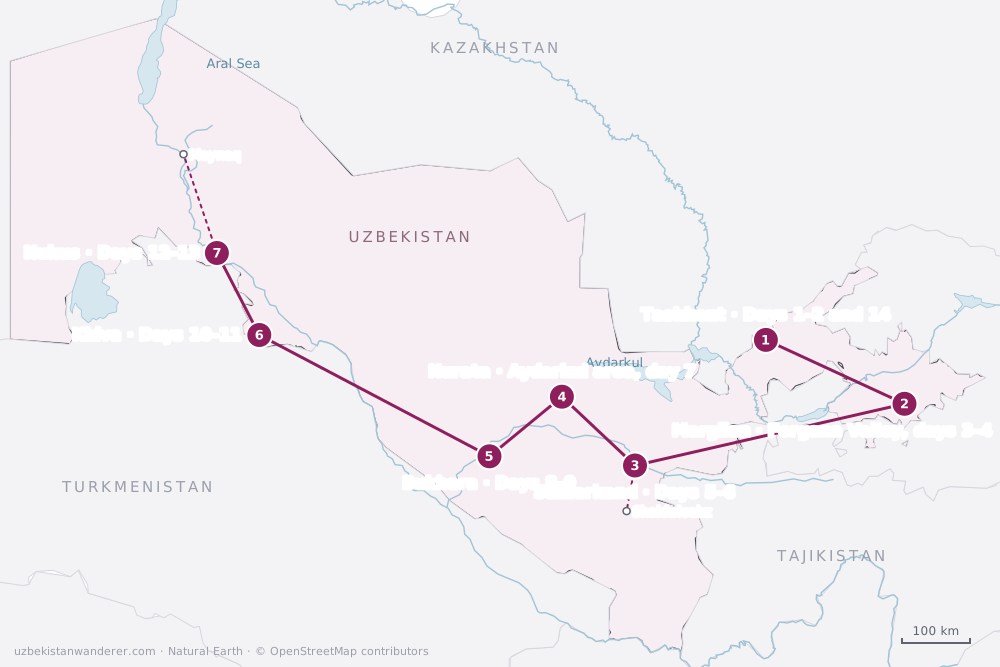
Itinerary at a Glance
| Days | Base | Focus | How you get there |
|---|---|---|---|
| 1–2 | Tashkent | Arrival, metro, bazaars, old city | Fly in |
| 3–4 | Fergana Valley | Kokand, Rishtan pottery, Margilan silk | Train or shared taxi |
| 5–6 | Samarkand | Travel day, then Registan, Shah-i-Zinda | Afrosiyob train |
| 7 | Aydarkul (desert) | Yurt stay, camel ride, Nurata | Private car |
| 8–9 | Bukhara | Old town, Lyabi-Hauz, day at leisure | Car then train |
| 10–11 | Khiva | Walled Ichan-Kala, sunset from the walls | Train |
| 12–13 | Nukus & Aral Sea | Savitsky Museum, Moynaq ship cemetery | Car or flight |
| 14 | Tashkent | Departure buffer | Domestic flight |
Prefer to swap the Aral Sea for something in the south? We flag a Termez alternative further down. First, the day-by-day. With a third week you don’t have to choose: three weeks in Uzbekistan fits both, plus Boysun, Shakhrisabz overnight and the Nuratau homestays.
Days 1–2: Tashkent, Ease In
Most international flights land in Tashkent, so give the capital two nights rather than rushing straight out. It is a green, spread-out, Soviet-modern city that rewards a gentle start after a long-haul flight.
What to do
- Ride the metro purely for the stations, which are among the most ornate in the world and now legal to photograph.
- Wander Chorsu Bazaar under its blue dome for spices, dried fruit, and non bread straight from the tandoor.
- See the Hazrati Imam complex, then the 7th-century Uthman Quran in the Quran Hall of the Center of Islamic Civilization next door (ticketed; it moved there in November 2025 and the Center opened to visitors in March 2026).
Practical notes
Buy an eSIM or a local Ucell/Beeline SIM at the airport. Register on eticket.uzrailpass.uz, the official Uzbekistan Railways booking site, early, because the best trains sell out. Sales open about 60 days before departure, so if your dates are fixed, reserve the Afrosiyob legs and the Khiva train the moment the window opens (last checked: September 2026). How the network hangs together, from Afrosiyob trains to shared taxis and domestic flights, is set out in the overview of rail and road options.
Days 3–4: The Fergana Valley
This is the leg that shorter itineraries drop, and it is the reason to give Uzbekistan two weeks. The Fergana Valley is the country’s craft heartland: silk, ceramics, and knives, all still made by hand in workshops you can walk into.
Getting there
You have two ways in. Uzbekistan Railways runs several trains a day from Tashkent to Andijan, stopping at Kokand and Margilan (the station for Fergana city), a smooth ride through a tunnel under the mountains. The scenic alternative is a shared taxi over the Kamchik Pass, roughly four to six hours depending on snow, usually 150,000–200,000 UZS per person from the Qo’yliq lot in eastern Tashkent (last checked: July 2026). The taxi lets you stop along the way; the train is more reliable in winter.
What to see
- Kokand, the Khan’s Palace (Khudayar Khan) with its dazzling tiled facade, a good first stop off the pass.
- Rishtan: Uzbekistan’s ceramics capital, where potters work the distinctive turquoise-and-blue glaze; workshop visits are easy to arrange.
- Margilan, the Yodgorlik Silk Factory, where you can follow ikat from cocoon to loom, plus the buzzing Kumtepa Bazaar (busiest Thursday and Sunday).
Base yourself in Fergana city or Margilan for two nights. Our Fergana Valley travel guide breaks down the towns, workshops, and where to sleep in detail.
Days 5–6: Samarkand (Shakhrisabz Optional)
Return to Tashkent and take the high-speed Afrosiyob to Samarkand, a comfortable 2 hours 10 minutes to 2 hours 30 minutes depending on the departure, at up to 250 km/h, with airline-style seating and a snack. Economy is 311,000 som (about US$26) since the February 2026 rise (last checked: September 2026). Samarkand is the postcard everyone comes for, and it earns two nights.
Day 5: the travel day
Be realistic: day 5 is mostly lost to travel. A morning car or shared taxi back over the pass to Tashkent (four to six hours) plus an afternoon Afrosiyob gets you to Samarkand in time for dinner and the Registan lit up at night. The express train back from Margilan is more comfortable but leaves at 16:13 and reaches Tashkent at 19:53, so on that option you sleep in Tashkent and take an early Afrosiyob on day 6.
Day 6: the classics
Spend your first full day on the Registan, the Bibi-Khanym Mosque, the Shah-i-Zinda avenue of mausoleums (go early for light and quiet), and Gur-e-Amir, Timur’s tomb. Our Samarkand travel guide covers ticketing, timings, and the best hours for photographs.
Optional: Shakhrisabz
If you would rather skip the desert night on day 7, use that day for a trip south over the mountains to Shakhrisabz, Timur’s birthplace. The colossal ruined arch of the Ak-Saray Palace and the Dorut Tilovat complex make the drive worthwhile, and it is a change of pace from the crowds. A private car for the day, split between travellers, is the simplest option; shared taxis also run from Samarkand’s southern taxi stand.
Day 7: A Night in the Desert at Aydarkul
Break up the Silk Road cities with one night in the Kyzylkum desert. Yurt camps near Lake Aydarkul, in the Nurata region, offer a simple but memorable stop: a camel ride at dusk, dinner around a fire, live dombra music, and a sky full of stars far from any town.
- Arrange it as a transfer between Samarkand and Bukhara so you lose no travel time, usually by private car with a stop at the Nurata fortress and spring.
- Camps typically close from November to mid-March, so this leg is a spring-to-autumn add-on.
- Facilities are basic (shared bathrooms, thin mattresses), so pack a head torch and warm layers for the night.
If desert camping is not for you, skip this day and give the extra night to Bukhara or Khiva instead.
Days 8–9: Bukhara
From the yurt camp it is about four hours by road to Bukhara (or a car to Navoi and the Afrosiyob from there), or if you skipped the desert, the Afrosiyob covers Samarkand to Bukhara in about 1 hour 40 minutes to 2 hours (economy roughly 165,000–200,000 som), arriving at Bukhara-1 station in Kagan, about 12 km from the old town. Bukhara’s old town is the most complete medieval city in Central Asia, and it is best enjoyed slowly on foot.
What not to miss
- The Poi Kalyan ensemble, with its towering minaret that Genghis Khan reportedly spared.
- The Ark fortress, the Bolo Hauz Mosque, and the compact Chor Minor with its four turquoise domes.
- Tea and people-watching at Lyabi-Hauz, the shaded pool at the town’s heart.
Use the second day for the covered trading domes, a hammam, or a slow lunch, rather than more monuments. Full details are in our Bukhara travel guide.
Days 10–11: Khiva
Khiva is the smallest and most concentrated of the three Silk Road cities: a walled inner town, the Ichan-Kala, that you can cross in fifteen minutes and never tire of. The Bukhara-to-Khiva leg is the long one on any Uzbekistan trip.
Getting there
The fast option is train 752, the Jaloliddin Manguberdi, which leaves Bukhara-1 at 10:54 and reaches Khiva at 14:31, about 3 hours 40 minutes across the Kyzylkum. It runs only on Tuesdays, Thursdays and Saturdays, and the slower day train isn’t daily either, so make sure Day 10 lands on one of those days (last checked: September 2026, per Seat61). Seat61 lists 780,000 som in economy for the full Tashkent–Khiva run; check the Bukhara–Khiva fare and current times on eticket.uzrailpass.uz before you commit, because schedules change. On other days a shared car (about five to six hours) is the backup.
In Khiva
A single combined ticket covers most sites inside the walls. Climb the Islam Khoja minaret for the rooftops, admire the stumpy blue Kalta Minor, and stay for sunset from the city walls when the day-trippers have gone and the mud-brick glows. Our Khiva travel guide has the ticketing and timing specifics.
Days 12–13: Nukus and the Aral Sea
Khiva sits close to Karakalpakstan, which makes the Aral Sea a natural extension rather than a detour. This is the most sobering, and for some the most memorable, part of the trip.
Nukus
It is about three hours by road from Khiva to Nukus. The reason to come is the Savitsky Museum, which holds one of the world’s great collections of banned Soviet avant-garde art alongside Karakalpak folk pieces. It is a genuinely world-class museum in an unlikely place.
Moynaq and the ship cemetery
From Nukus it is a further two to three hours to Moynaq, once a busy fishing port and now stranded tens of kilometres from any water. Rusting trawlers sit on the dry seabed, a stark monument to the Aral Sea’s collapse. Serious travellers push on with an overnight 4×4 tour to the current shoreline and a yurt camp, which needs a full extra day and a booked operator. Our Nukus and Aral Sea guide lays out the tour options and what to expect.
Southern alternative: Termez
If the Aral Sea feels too bleak or too far, swap these two days for Termez on the Afghan border, reached by domestic flight or overnight train from Tashkent. It offers a very different Uzbekistan: Buddhist stupas at Fayaz-Tepe, ancient Bactrian ruins, and a frontier atmosphere few tourists reach. It slots in as an out-and-back from Tashkent at the end of the trip.
Day 14: Back to Tashkent and Home
Nukus has a domestic airport with frequent Uzbekistan Airways flights back to Tashkent, roughly an hour and a half in the air versus a very long drive (last checked: July 2026). Fly back the evening of day 13 or the morning of day 14, and keep a buffer before your international departure. If you have a few daytime hours in Tashkent, use them for last-minute souvenirs at Chorsu or a plov lunch at the Central Asian Plov Centre.
Budget Snapshot
Uzbekistan is affordable by any standard. As a rough per-person guide for two weeks, excluding international flights:
- Budget: roughly 45–65 USD a day, guesthouses, shared taxis and second-class trains, bazaar food.
- Mid-range: roughly 80–120 USD a day, boutique stays, Afrosiyob business class, a couple of private drivers and the yurt night.
- Comfortable: 150 USD and up, the best heritage hotels, private transfers throughout, the overnight Aral Sea tour.
The biggest variable costs are the desert yurt night, the multi-day Aral Sea 4×4, and how often you take private cars versus trains and shared taxis. Everything else (food, museum tickets, city transport) is cheap.
Frequently Asked Questions
Is 14 days too long for Uzbekistan?
Not if you use the extra time to go beyond the core cities. Ten days is enough for Tashkent, Samarkand, Bukhara, and Khiva at a comfortable pace, which is exactly what our 10-day itinerary does. The four extra days in this route are what let you add the Fergana Valley, a desert night, and the Aral Sea without feeling rushed. If you cannot spare a fortnight, trim the Aral Sea or the yurt stay first.
Should I book trains before I arrive?
Yes for the Afrosiyob and the long Khiva legs, especially in the April–May and September–October high seasons. Booking opens about 60 days ahead and popular trains sell out, so reserve those seats as soon as the window opens through the official Uzbekistan Railways channels. Shared taxis and slower regional trains can safely be left until you are on the ground.
When is the best time to do this route?
Spring (April to early June) and autumn (September to October) are ideal: warm days, cool evenings, and open desert yurt camps. Summer is punishingly hot in Bukhara, Khiva, and Karakalpakstan, and the yurt camps close in winter. See our full breakdown of the best time to visit Uzbekistan before you lock in dates.
Is the Fergana Valley worth the detour?
If you care about craft and everyday life over monuments, absolutely. It is where Uzbekistan’s silk and ceramics are actually made, and it sees a fraction of Samarkand’s crowds. If your interest is purely the great Timurid architecture, you could cut it and shift those two days to Bukhara and the Aral Sea instead.
Can I do the Aral Sea without an overnight tour?
You can reach Moynaq and its ship cemetery on a long day trip from Nukus and still get the emotional weight of the place. Reaching the current shoreline of the shrunken sea, however, requires an overnight 4×4 expedition with a yurt camp and a booked operator. Decide which version you want before you plan days 12 and 13.
How does this compare to your shorter itineraries?
Our 7-day itinerary is a focused Silk Road highlights run, and the 10-day itinerary adds breathing room to the same core loop. This 14-day plan keeps that backbone but layers on the regions most trips never reach. Read all three together and you can right-size the trip to the time you actually have.
Final Thoughts
Two weeks turns Uzbekistan from a monument tour into a proper journey: silk looms in Margilan, stars over the Kyzylkum, sunset on the Khiva walls, and a rusting fleet on a vanished sea. Build the route around the fast trains, keep a little slack in each city, and let the country set the pace. Have your dates and just need the nuts and bolts? Start with our guides to getting around Uzbekistan and the best time to visit, and verify the latest train times on the official Uzbekistan Railways site before you book.