Getting Around Uzbekistan: Trains, Taxis & Flights (2026)
How to get around Uzbekistan in 2026: Afrosiyob train prices and booking, night trains, domestic flights, Yandex Go taxis, metro and shared taxis.

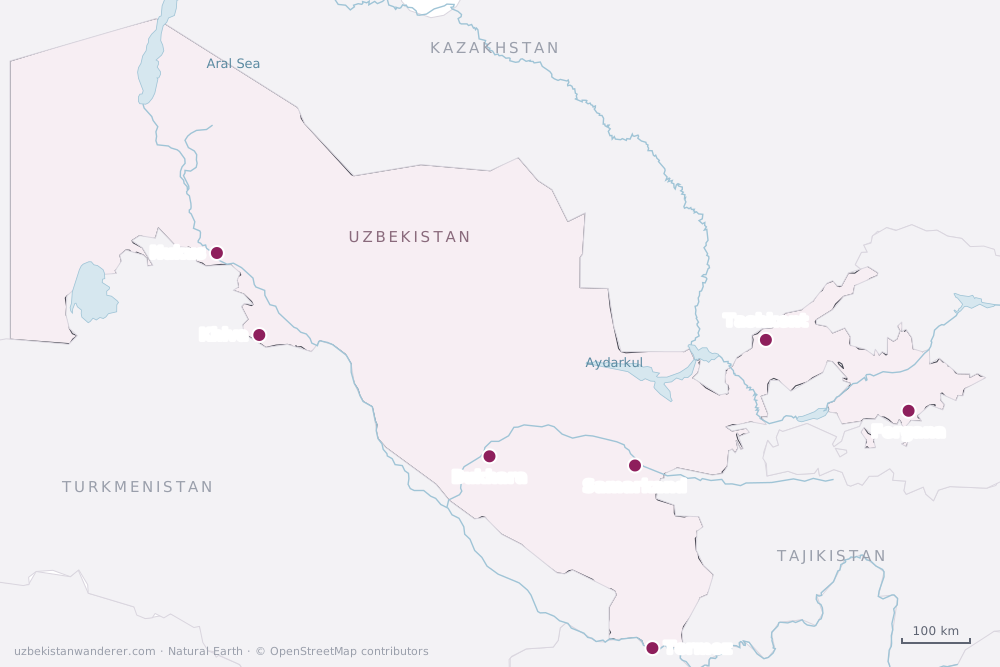
Getting around Uzbekistan is easier than most of Central Asia, and the reason is simple: the trains actually work. A Spanish-built high-speed train links the three big Silk Road cities, sleeper trains cover the long desert hauls, domestic flights are cheap, and Yandex Go makes taxis in every major city a two-tap affair. This guide covers every practical option, what each one costs, how long it takes, and exactly how to book, so you can stitch together an itinerary without guesswork. If you’re still deciding where to go, our 10-day Uzbekistan itinerary shows how these transport links fit together in practice.
Trains: The Backbone of Uzbek Travel
Uzbekistan Railways (O’zbekiston Temir Yo’llari) runs a genuinely good network. Tashkent, Samarkand, Bukhara and, since the Jaloliddin Manguberdi launched in May 2026, Khiva are all connected by fast, air-conditioned trains, and for most travellers the railway is the default way to move between cities. Trains are punctual, stations are central, and security is airport-style but quick: arrive 30–40 minutes before departure with your passport, because ID checks are mandatory and your name is printed on the ticket.
The Afrosiyob High-Speed Train
The Afrosiyob is the star of the network: a 250 km/h Talgo trainset that covers Tashkent–Samarkand in about 2 hours 10 minutes and Tashkent–Bukhara in around 4 hours, with several departures a day. It carries three classes. Economy is perfectly comfortable, airline-style seats, plenty of legroom, a trolley service. Business adds wider seats and a snack; VIP gets you 2+1 leather seating and a meal. Honestly, Economy is fine for almost everyone; the journey to Samarkand is short enough that the upgrade buys little.
Indicative one-way fares (last checked: July 2026): Tashkent–Samarkand costs 311,000 som (about $25) in Economy, 455,000 som (~$36) in Business and 709,000 som (~$56) in VIP. Tashkent–Bukhara runs 509,000 som (~$40) Economy, 760,000 som (~$60) Business and 1,138,000 som (~$90) VIP. The Samarkand–Bukhara leg is shorter and correspondingly cheaper. Fares fluctuate slightly with exchange rates and demand, so treat these as ballpark figures.
There’s also a newer high-speed service worth knowing about: the Jaloliddin Manguberdi, a Hyundai-built trainset that runs Tashkent–Khiva in about seven and a half hours, half the time of the old overnight route. Economy on this train is around 780,000 som (~$62). It has transformed Khiva from the awkward outlier of the classic circuit into a straightforward add-on.
| Route | Train | Time | Economy fare (July 2026) |
|---|---|---|---|
| Tashkent – Samarkand | Afrosiyob | ~2h 10m | 311,000 som (~$25) |
| Tashkent – Bukhara | Afrosiyob | ~4h | 509,000 som (~$40) |
| Samarkand – Bukhara | Afrosiyob | ~1h 40m–2h | ~165,000 som (~$14), check eticket.uzrailpass.uz |
| Tashkent – Khiva | Jaloliddin Manguberdi | ~7h 30m | 780,000 som (~$62) |
| Tashkent – Bukhara (overnight) | Sleeper from Tashkent South (e.g. 21:45) | ~7.5–8h | Kupe ~244,000 som (~$19) |
| Bukhara – Khiva | Train 752 (Tue/Thu/Sat) | ~3h 40m | Check eticket.uzrailpass.uz |
Sharq and Night Trains
Not every departure is high-speed, and that isn’t a bad thing. The Sharq is a conventional daytime express covering the Tashkent–Samarkand–Bukhara corridor at roughly half to two-thirds of the Afrosiyob’s price, taking about an hour longer on each leg. If the Afrosiyob is sold out, common in April–May and September–October, the Sharq is a perfectly good fallback.
Night trains are the budget traveller’s friend and, frankly, an experience in their own right: tea from the samovar at the end of the carriage, bedding included, desert scrolling past at dawn. Overnight sleepers leave Tashkent South at about 21:45–22:35 and reach Bukhara around 05:15–06:30, and sleeper services also link Bukhara and Khiva/Urgench. Three classes exist: platskart (open-plan bunks, ~178,000 som Tashkent–Bukhara), kupe (four-berth lockable compartment, ~244,000 som, the choice most travellers make) and SV (two-berth, ~431,000 som). A night train saves you a hotel night, which matters if you’re watching your Uzbekistan travel budget.
How to Book Uzbek Train Tickets
Book through the official Uzbekistan Railways site, eticket.uzrailpass.uz (the old eticket.railway.uz address redirects there), or the “Uzrailway tickets” app. Tickets open about 60 days ahead, popular spring and autumn Afrosiyob departures go early, and foreign cards are processed by Trainhub, so your statement will show TRAINHUB.IO. Set up an account and add each traveller’s passport before you need it, because seats are only held for a few minutes at checkout. The full walkthrough, including what to do when a card is declined, is in our step-by-step railway booking guide.
If online payment defeats you, every station has ticket windows where you can buy in person with cash or card. Bring your passport. Timetables are also published on the parent site, railway.uz.
Domestic Flights
Flying makes sense for one thing above all: the far west. Tashkent–Urgench (the airport for Khiva, 35 km away) and Tashkent–Nukus (gateway to the Aral Sea and the Savitsky Museum) are both daily routes on Uzbekistan Airways, taking about 1 hour 40 minutes. Since April 2026 the airline uses branded fares on domestic routes, with the cheapest “Lite” fares on both routes starting from around 484,000 som (~$38) one-way (last checked: July 2026). Book directly on the airline’s site, it accepts foreign cards without drama, and note that Lite fares are hand-luggage-only and restrictive on changes.
The classic move is to fly one way and take the train the other: rail out to Khiva, then fly back from Urgench to Tashkent, or fly out to Nukus and work your way back east overland through Khiva and Bukhara. Flights between other domestic city pairs exist but are less useful, since the train usually beats the total door-to-door time once you factor in airport transfers.
Taxis, Yandex Go and Shared Taxis
Within cities, download Yandex Go before you arrive, it’s the single most useful app in Uzbekistan. It works in Tashkent, Samarkand, Bukhara and a growing list of other cities, shows a fixed price before you confirm, and eliminates every negotiation. Rides are startlingly cheap: a 10-minute hop across central Tashkent runs 18,000–30,000 som ($1.50–2.50), airport to city centre rarely tops 55,000 som, and short rides in Samarkand or Bukhara are often under $2 (last checked: July 2026). Foreign cards often fail to link to the app, so expect to pay the driver in cash; every driver is used to it. Register with your home number before you fly, while it can still receive the SMS code; you’ll still want local data on arrival. Our Yandex Go explainer covers the app in detail.
Between cities, three flavours of taxi exist. Classic shared taxis leave from designated lots on the edge of each city and depart when four passengers fill the car, dirt cheap (a few dollars per seat on shorter routes), fast in a way that will occasionally alarm you, and zero schedule certainty. Private intercity transfers can be arranged through any hotel for roughly $40–70 between the main cities, which is reasonable split among three or four people and lets you stop at sights en route, such as the Gijduvan ceramics workshops between Samarkand and Bukhara. Yandex Go also added an intercity category in May 2026; the shared taxi guide explains how it compares with the bazaar stands. Where the train runs, though, the train is still cheaper, safer and usually faster.
Car hire deserves an honest word. Rental desks operate in Tashkent, and self-driving is legal with an international driving permit; rates vary by company and season, so compare quotes rather than trusting a single figure. Our driving guide covers the rules. But the reality is that driving standards are loose, police checkpoints dot intercity roads, fuel stations can be queue-prone (many cars run on methane) and have been card or app only since 1 April 2026, and rental cars can’t cross borders. Given how cheap drivers and trains are, we would only recommend self-driving for specific missions, the Nuratau mountains, say, or Aral Sea approaches, and even then, hiring a car with a driver usually costs about the same and spares you every headache.
Getting Around Within Cities
The Tashkent metro is reason enough to linger a day in the capital, chandeliers, cosmonaut mosaics and marble platforms that double as an art gallery (photography has been legal since 2018). It’s also absurdly good value: tap a contactless bank card or phone at the turnstile and the fare is 2,500 som by card or app from 1 October 2026 (about 21 cents; it was 1,700 before that); cash or a paper QR ticket costs 3,000 som, and a second ride within the hour costs 1,500. It’s a flat fare, however far you go. If you’re staying longer, the ATTO transport card works across the metro and city buses. Three lines plus the newer above-ground ring line cover most places a visitor wants to go, and the Tashkent metro guide picks out the stations worth getting off at. For rail trips beyond the city limits, there is a separate rundown of Tashkent's elektrichka lines.
Elsewhere, cities are walkable in the ways that matter. Bukhara’s old town and Khiva’s walled Itchan Kala are compact enough that you’ll barely need wheels; Samarkand’s sights are more spread out, but Yandex Go fills the gaps for pocket change. City buses exist everywhere and cost pennies, though routes take deciphering; between a cheap taxi and your own feet, most travellers never bother.
Frequently Asked Questions
How far in advance should I book the Afrosiyob?
Tickets open about 60 days ahead, and in high season (April–May, September–October) the best departures sell out well before travel week. Book three to four weeks ahead as a minimum for spring and autumn; in winter and high summer you can often buy a few days before, or even same-day at the station. If Economy is gone, check Business, it frequently has seats when Economy is sold out, and the premium is modest.
Can I pay for train tickets with a foreign card?
Yes, usually, Visa and Mastercard both work on eticket.uzrailpass.uz (payments go through Trainhub), but the payment gateway is the flakiest part of the process. Cards issued by fintech banks like Revolut and Wise tend to succeed where some traditional banks fail. If payment keeps bouncing, try the app instead of the website, try again a few hours later, or simply buy at any station ticket office once you’re in the country, provided your dates allow the gamble.
Is the night train safe and comfortable?
Safe, yes, carriages have attendants, compartments in kupe and SV lock from inside, and theft is rare. Comfort is honest Soviet-lineage sleeper stock: clean bedding is provided, air conditioning varies by carriage, and toilets are basic. Kupe is the sensible choice for most travellers; solo women who want more control over compartment-mates can book SV or buy out spare kupe berths cheaply. Bring water, snacks and small som notes for tea.
What is the best way to reach Khiva?
Three good options: the Jaloliddin Manguberdi high-speed train from Tashkent (~7.5 hours), a 1h40m flight to Urgench followed by a 35 km taxi or trolleybus ride, or overland from Bukhara through the Kyzylkum desert, either on train 752 (about 3.5 hours, Tue/Thu/Sat in June 2026, so check eticket.uzrailpass.uz for current days) or by shared taxi (about 6–7 hours). Most itineraries fly one direction and go overland the other, which avoids backtracking.
How do land border crossings work?
Uzbekistan’s borders with Kazakhstan, Kyrgyzstan and Tajikistan are far easier than their old reputation suggests. The standard pattern: take a taxi or Yandex to the border post, walk across on foot (crossings are pedestrian-friendly and formalities typically take 30–90 minutes), then pick up onward transport on the far side. The Samarkand–Panjakent (Jartepa) crossing into Tajikistan is the smoothest for tourists. For Kazakhstan, note that Gishtkuprik, the big Tashkent–Shymkent crossing, has been shut for rebuilding since February 2025 and was still closed at the end of September 2026 (the latest official target is the fourth quarter of 2026); use Kaplanbek (Zangiota) instead, as our Uzbekistan to Kazakhstan guide explains. Check your entry requirements first in our Uzbekistan visa guide, most Western passports now enter visa-free.
Do I need cash for transport?
Increasingly no, but carry some anyway. The metro takes contactless cards, trains and flights are booked online, and Yandex Go can charge a card, but foreign cards often fail to link, so expect to pay cash. Shared taxis, market-lot transfers, station kiosks and some Yandex drivers remain cash-only, so keep a stash of som in small denominations. ATMs dispensing som (and sometimes dollars) are plentiful in Tashkent, Samarkand and Bukhara.
The Short Version
Take the train wherever it goes: Afrosiyob between Tashkent, Samarkand and Bukhara, the new fast train or a flight for Khiva and Nukus, and a night train when you fancy saving a hotel bill. Use Yandex Go inside cities, ride the Tashkent metro at least once for its own sake, and leave the driving to someone else. Book trains the moment your dates are fixed, and the rest of Uzbekistan’s logistics will take care of themselves.