The Perfect 10-Day Uzbekistan Itinerary (2026)
A realistic 10-day Uzbekistan itinerary: Tashkent, Samarkand, Bukhara and Khiva by train, with 7-day and 14-day variations, costs and timing tips.

Ten days is the length that works best for Uzbekistan. It is enough time to cover all four of the classic Silk Road cities (Tashkent, Samarkand, Bukhara and Khiva) without turning the trip into a checklist sprint, and the country’s excellent rail network means you can do the whole route without a single internal flight. This itinerary is the one we recommend to most first-time visitors, and in this guide we break it down day by day, with train logistics, honest pacing advice, a budget table, and adjustments for 7-day and 14-day trips.
One planning note before we start: the route runs west in a straight line, so it works equally well in reverse. Flying into Tashkent and out of Urgench (the airport serving Khiva) saves a long backtrack; on a round trip to Tashkent, cheap daily flights from Urgench close the loop.
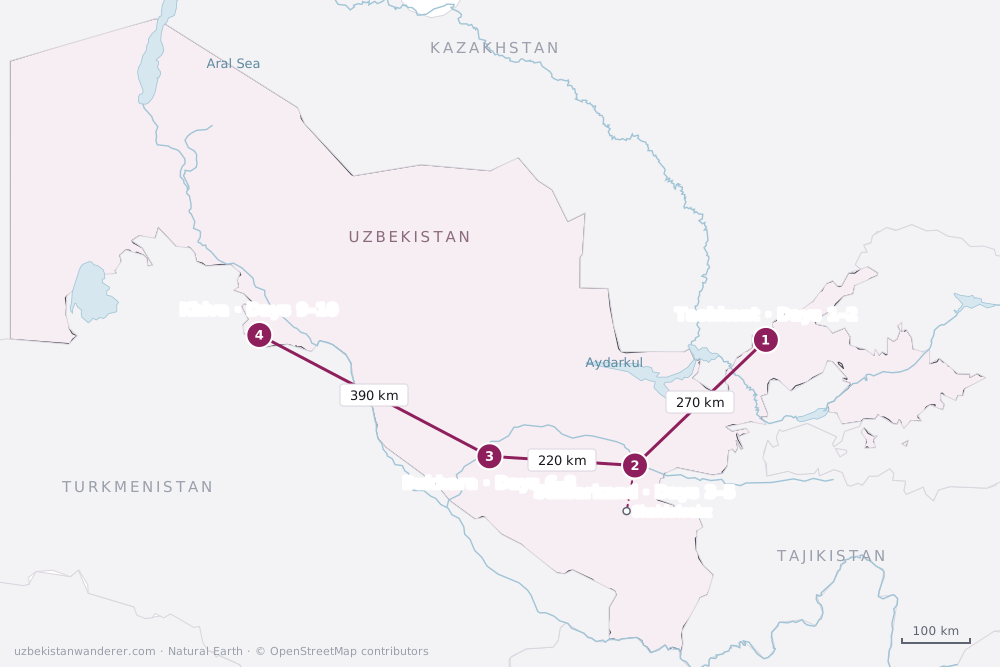
Itinerary at a Glance
| Days | City | Highlights | Transport to next stop |
|---|---|---|---|
| 1–2 | Tashkent | Chorsu Bazaar, metro stations, Hazrati Imam complex | Afrosiyob train, ~2h 10m–2h 30m |
| 3–5 | Samarkand | Registan, Shah-i-Zinda, Shakhrisabz day trip | Afrosiyob train, ~1h 40m to 2h |
| 6–8 | Bukhara | Old town, Kalyan minaret, Ark fortress, slow evenings | Train 752 to Khiva, ~3h 40m (Tue/Thu/Sat) |
| 9–10 | Khiva | Itchan Kala walled city, sunset from the walls | Fly or train back from Urgench |
Days 1–2: Tashkent
Most international flights land in Tashkent in the early hours, so treat Day 1 as a recovery-and-orientation day. The capital gets unfairly skipped by travellers racing to Samarkand, but two days here is time well spent: it is the only place on this route where you see modern Uzbek life at full scale rather than a restored old town. Our full Tashkent travel guide goes deeper, but here is how we would split the two days.
Day 1: Old Tashkent
Start at Chorsu Bazaar, the blue-domed market that has anchored the old town for centuries. Go hungry and graze your way through the bread, dried fruit and samsa stalls. From there it is a short taxi ride to the Hazrati Imam complex and, next door, the new Center of Islamic Civilization, where the 7th-century Uthman Quran has been on display since the Center opened in March 2026 (it was moved there in November 2025; ticketed, timed visits with an audio guide), then the surrounding mahalla lanes of old Tashkent. At lunch, eat plov at the Central Asian Plov Centre (Besh Qozon) near the TV tower, and arrive by about 12:30, because the best kazans are scraped clean by early afternoon.
Day 2: Metro art and museums
Spend the morning riding the Tashkent metro, which doubles as an underground art gallery: Kosmonavtlar, Alisher Navoi and Pakhtakor are the standout stations, and a ride costs pennies. Add the State Museum of Applied Arts or the History Museum, then the Tashkent City park area for the capital’s glossy new side. Keep the evening low-key: you have an early train tomorrow.
Getting to Samarkand
The Afrosiyob high-speed train covers Tashkent to Samarkand in about 2 hours 10 minutes to 2 hours 30 minutes, depending on the departure. Economy class costs 311,000 som (roughly US$26) since the February 2026 fare rise, whenever you book, and it is perfectly comfortable (last checked: September 2026). Book on the official Uzbekistan Railways site at eticket.uzrailpass.uz as soon as sales open, about 60 days before departure, because Afrosiyob seats genuinely sell out, especially in spring and autumn. The first departure is 06:10 (Fridays to Sundays) or 06:33 daily (arriving 08:46) and several more follow through the morning, so a mid-morning train still gets you to Samarkand by lunch.
Days 3–5: Samarkand
Three days in Samarkand sounds generous until you are standing in front of the Registan wondering where the afternoon went. This is the headline act of Uzbekistan, and rushing it in a single day is the most common itinerary mistake we see. Our Samarkand travel guide covers every site in detail; here is the shape of three well-paced days.
Day 3: The Registan and Gur-e-Amir
Check in, drop your bags, and head straight to the Registan. Visit once in the afternoon light, then come back after dark when the three madrasahs are floodlit. It is a completely different experience and included in nothing but the walk. Fit in Gur-e-Amir, Timur’s surprisingly intimate mausoleum, either before sunset or first thing the next morning when tour groups have not yet arrived.
Day 4: Shah-i-Zinda, Bibi-Khanym and the Siyob Bazaar
Shah-i-Zinda, the avenue of tiled mausoleums climbing the hillside, is for many visitors the most beautiful single place in the country. Arrive at opening time and you may have the upper terraces to yourself. Continue to the vast Bibi-Khanym Mosque and the Siyob Bazaar next door, then spend the afternoon at Ulugh Beg’s Observatory and the Afrasiyab museum if ancient history is your thing, or simply wandering the Russian-era new town with its cafés and wine houses.
Day 5: Shakhrisabz day trip (or a slow day)
Timur’s birthplace, Shakhrisabz, sits about 90 minutes south of Samarkand across the scenic Takhtakaracha Pass. The ruined gateway of his Ak-Saray palace and the Dorut Tilavat complex justify the trip, and the mountain drive is a highlight in itself. A shared taxi from the Suzangaran stand near the Registan costs only a few dollars a seat; a private return taxi with waiting time runs roughly US$30–40 (last checked: July 2026). Note that the pass can close after snowfall between January and March. If day trips are not your style, use Day 5 to revisit favourites, shop for ceramics and suzani, or visit the paper-making workshop at Konigil village.
Getting to Bukhara
The Afrosiyob continues from Samarkand to Bukhara in about 1 hour 40 minutes to 2 hours (economy is roughly 165,000–200,000 som; check the exact fare when you book), arriving at Bukhara-1 station in Kagan, about 12 km outside the old town (a 15-minute taxi, agree on around 30,000–50,000 som or use the Yandex Go app). Take an early evening departure on Day 5 and wake up in Bukhara, or leave on the morning of Day 6, both work with this itinerary.
Days 6–8: Bukhara
Bukhara is the city where you should slow down. Unlike Samarkand, where the monuments are scattered across a modern city, Bukhara’s old town is a continuous, walkable whole: you step out of your guesthouse into the 16th century. Two full days covers the sights; the third day is what makes it feel like a holiday. If you need to cut a day from this itinerary, this is the flexible one, but we would argue for keeping it (our Bukhara travel guide makes the full case).
Day 6: The old town core
Start at the Lyabi-Hauz pool, the social heart of the old town, and work outward through the trading domes to the Poi-Kalyan complex, where the Kalyan minaret, about 45.6 metres tall (some sources say up to 47), has stood since 1127: Genghis Khan famously spared it. The Mir-i-Arab madrasah opposite is still a working seminary. End the day with dinner in a courtyard restaurant; Bukhara’s evenings, when the day-trippers leave, are the best part.
Day 7: The Ark and beyond the walls
The Ark fortress, the royal residence for over a millennium, takes a solid morning with its museums. Continue to the Bolo Hauz Mosque with its slender wooden columns, the Ismail Samani mausoleum, the oldest monument in the city, from around 905, and the Chor Minor with its four turquoise-capped towers. In the afternoon, consider the short taxi ride to Sitorai Mokhi-Khosa, the last emir’s delightfully odd summer palace.
Day 8: Slow morning, afternoon options
Use Day 8 for whatever fell through the cracks: a hammam (Bozori Kord is the historic option), miniature-painting and gold-embroidery workshops, or simply tea on a rooftop. Some travellers use this day for the Naqshbandi memorial complex outside town. Before you lock in the dates, check that Day 9 falls on a Tuesday, Thursday or Saturday, the only days the fast train to Khiva runs; if it doesn’t, swap a Bukhara day or plan on a shared taxi.
Getting to Khiva
Khiva has been connected to the national rail network since 2018. The fast option is train 752, the Jaloliddin Manguberdi, which starts in Tashkent at 07:00, calls at Bukhara-1 (in Kagan) at 10:54 and reaches Khiva at 14:31, about 3 hours 40 minutes across the Kyzylkum desert. It runs only on Tuesdays, Thursdays and Saturdays, and the slower day train isn’t daily either (last checked: September 2026, per Seat61’s Uzbekistan page, which is also the best independent explainer of the booking system). Seat61 lists 780,000 som in economy for the full Tashkent–Khiva run; check the Bukhara–Khiva fare, and confirm the timetable, on eticket.uzrailpass.uz, because schedules change. On other days the alternative is a shared or private taxi, about 5–6 hours by road. Trains, taxis and domestic flights are compared side by side in the travel logistics page.
Days 9–10: Khiva
Khiva’s walled inner city, the Itchan Kala, is tiny. You can cross it in ten minutes, which leads some people to dismiss it as a day-trip stop. We disagree. The magic of Khiva is atmospheric, not architectural sightseeing volume: staying overnight inside or beside the walls means you get the lanes at dawn and dusk when they are empty and golden. Our Khiva travel guide has the full rundown.
Day 9: Inside the Itchan Kala
Arrive early afternoon, check in, and buy the combined ticket that covers most museums and monuments inside the walls. Climb the Islam Khodja minaret for the classic rooftop view, visit the Juma Mosque with its forest of 200-plus carved wooden columns, and tour the Kunya Ark and Tash Hauli palace harems. At sunset, walk the section of city wall near the north gate, the view over the mud-brick skyline is the image you came to Uzbekistan for.
Day 10: Dawn walk and departure
Get up for one last lap of the empty lanes, have a slow breakfast, then head for Urgench, 35 minutes away by taxi. Daily flights connect Urgench to Tashkent in about 1 hour 40 minutes and are usually US$40–70 if booked ahead (last checked: July 2026). Alternatively, take the overnight train back to Tashkent and save a hotel night.
7-Day and 14-Day Variations
If you only have 7 days
Drop Khiva and the Shakhrisabz day trip, and give the week to Tashkent, Samarkand and Bukhara: that three-city plan, with train times and fares, is laid out day by day in our 7-day Uzbekistan itinerary. A three-city week is a calmer, better trip than a four-city dash.
If you have 14 days
Four extra days buy the Fergana Valley, a yurt night near Aydarkul lake and a run out to Nukus and the Aral Sea; our 14-day Uzbekistan itinerary fits them around this route. For other add-ons, the best things to do in Uzbekistan list has more ideas.
Best Time to Do This Itinerary
Uzbekistan is a desert country with real seasons. April to early June and September to early November are the two best windows: warm, dry days in the 20s°C and comfortable sightseeing weather. These are also peak season, so book trains and the better guesthouses well ahead. July and August regularly exceed 40°C. The itinerary is still doable, but you will be sightseeing at 7 am and hiding from 1 pm to 5 pm, and Khiva in particular becomes an oven. Winter (December–February) is cold but atmospheric and blissfully empty, with the caveat that the Takhtakaracha Pass to Shakhrisabz may close and some mountain add-ons are off the table.
Budget Summary
Uzbekistan remains one of the best-value destinations anywhere. Figures below are per person, assuming double occupancy, excluding international flights (last checked: July 2026). For the full breakdown, see our Uzbekistan travel costs guide.
| Expense | Budget | Mid-range | Comfort |
|---|---|---|---|
| Accommodation (per night) | $12–25 | $30–60 | $80–150 |
| Food (per day) | $8–15 | $15–30 | $35–60 |
| All trains on this route | $55–70 | $70–100 | $120+ (VIP class) |
| Entry fees & activities (total) | $40–60 | $60–100 | $150+ (with guides) |
| 10-day total (approx.) | $350–550 | $700–1,100 | $1,600+ |
Frequently Asked Questions
Do I need a visa for Uzbekistan?
Citizens of about 90 countries, including the UK, all EU states, Canada, Australia, Japan and most of Latin America, currently enter visa-free, most for up to 30 days. US citizens have entered visa-free for up to 30 days since 1 January 2026 (last checked: September 2026). Rules change, so verify your nationality’s status before booking; our Uzbekistan visa guide is kept up to date.
Should I do this itinerary in reverse?
If you can fly into Urgench and out of Tashkent (or vice versa), yes, the route works identically in either direction, and some travellers prefer starting in Khiva so the cities build in scale toward Samarkand’s grand finale. On a round-trip ticket to Tashkent, the west-bound order we describe is the standard choice, with a cheap flight back at the end.
How far in advance should I book trains?
Uzbekistan Railways opens sales about 60 days before departure, and Afrosiyob economy seats on the Tashkent–Samarkand–Bukhara corridor can sell out days or even weeks ahead in April, May, September and October. Book online the day sales open if you are travelling in peak season; in winter you can usually buy a few days out, but never gamble on same-day high-speed tickets.
Is Uzbekistan safe for independent travellers?
Yes. It is one of the safest countries we cover. Violent crime against tourists is extremely rare, solo travellers (including women) routinely report feeling more comfortable than in much of Europe, and there is a visible tourist police presence in the main cities. The main practical annoyance is occasional taxi overcharging: use the Yandex Go app (foreign cards often fail to link, so expect to pay the driver cash).
Can I do this trip without any Russian or Uzbek?
Comfortably. English is now common in hotels, restaurants and ticket offices across the four main cities, and translation apps cover the gaps. Learning hello (salom) and thank you (rahmat) in Uzbek earns disproportionate goodwill; a few Russian numbers help with bargaining in bazaars and shared taxis.
Is 10 days too long for Uzbekistan?
The opposite complaint is far more common, most travellers leave wishing they had added the Fergana Valley or the desert fortresses. The monuments could be crammed into a week, but Uzbekistan’s charm lives in the unhurried moments between them: tea in a chaikhana, a second sunset at the Registan. Ten days lets those happen.
Final Thoughts
Tashkent for context, Samarkand for spectacle, Bukhara for atmosphere, Khiva for time travel. Ten days, four cities, three train rides, and one of the most rewarding trips in Asia for the money. Book your Afrosiyob seats the day sales open, travel in spring or autumn if you can, and leave slack in the schedule for the tea houses. The Silk Road rewards travellers who move a little slower than the trains do.