Bukhara to Khiva: The Desert Route
Train, shared taxi or private car across the Kyzylkum? Times, fares, the Khiva railway, and the desert fortresses only a road trip can reach.

Three hours and thirty-seven minutes. That is the fastest scheduled run between Bukhara and Khiva, and it did not exist a decade ago. Before the railway reached Khiva in December 2018, this leg meant a full day in a shared car across the Kyzylkum: roughly 500 kilometres of sand, heat haze and a single ribbon of asphalt with almost nothing on either side of it.
That history matters because most of the advice still circulating online was written for the old reality. You will read that the Bukhara–Khiva crossing is a grim seven-hour endurance test, that you should break it in Urgench, that there is no train. None of that is true now. There is a train, it terminates a ten-minute walk from the walls of Itchan Kala, and for many travellers it is the obvious choice.
But it is not the only good choice, and on this particular route the slow option has an argument in its favour that no other leg in Uzbekistan can match: the desert between the two cities is not empty. Scattered across it are the crumbling mud-brick fortresses of ancient Khorezm, some of them two thousand years old, and you can only reach them by road. Here is how each option actually works, what it costs, and how to decide.
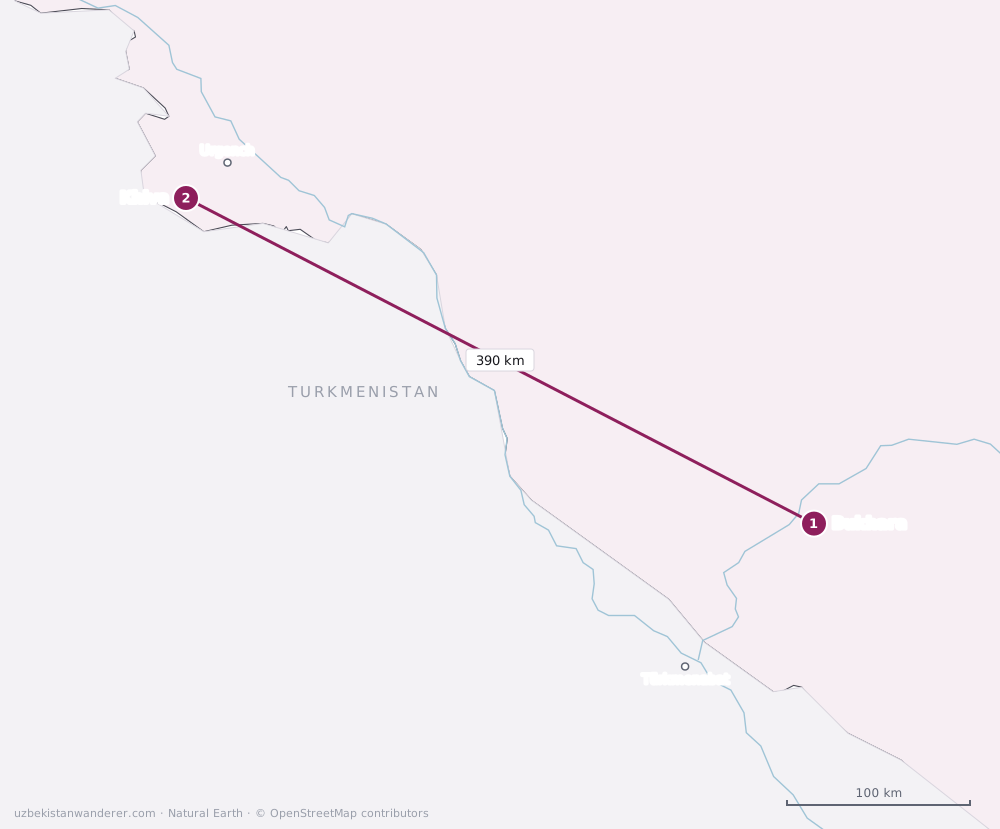
The four ways to make the crossing
Bukhara and Khiva sit at opposite ends of the Kyzylkum. Whichever way you go, you are crossing desert. The difference is how long you sit still and what you see out of the window.
| Option | Time | Rough cost per person | Best for |
|---|---|---|---|
| Train (direct to Khiva) | About 3h 40m – 6h 40m | $7–$25 | Almost everyone. Cheapest, coolest, most comfortable. |
| Shared taxi via Urgench | 6–8h total | $8–$15 | Days with no train, or last-minute travel. |
| Private car with fortress stops | 8–10h | $100–$200 per car | Travellers who want the Khorezm fortresses on the way. |
| Flying | Not practical | n/a | Nobody: there is no direct Bukhara–Urgench flight. |
Prices last checked: August 2026. Uzbek fares move with the soum, so treat these as ranges rather than quotes.
By train: the answer for most people
Khiva has its own station now. It sits 1–1.5 kilometres northeast of the North Gate of Itchan Kala, close enough to walk with a small bag, and a 10,000-soum taxi ride if you are not travelling light. That single piece of infrastructure changed this route completely.
Trains do not run every day in both directions, and the timetable shifts with the season, so the first thing to do is check dates before you lock in your hotel nights in Bukhara. Seat61’s timetable (updated June 2026) gives this picture; schedules change, so confirm your date on eticket.uzrailpass.uz (last checked: September 2026):
| Train | Depart Bukhara | Arrive Khiva | Duration | Days |
|---|---|---|---|---|
| 752 (Jaloliddin Manguberdi) | 10:54 | 14:31 | 3h 37m | Tue, Thu, Sat |
| 56 (Tashkent–Khiva) | About 05:12 | Around 11:50 | About 6h 40m | A few days a week; check your date |
| 125 (Andijan–Khiva) | Early morning | Check ticket | About 5–6h | Selected days only, not daily |
The 752 is the one to aim for. It is the modern service, it leaves at a civilised hour, and it puts you in Khiva in time for a late lunch and a full afternoon inside the walls, which, given that Itchan Kala is at its best in low light, is exactly when you want to arrive. The catch is that it runs three days a week (the return, 751, leaves Khiva at 07:20 on Wednesday, Friday and Sunday). Build your itinerary around it if you can.
Trains 56 and 125 are overnight services from further east that happen to pass through Bukhara at dawn. You board at an unpleasant hour, but they are cheap. Neither runs every day, so if your dates do not line up with the 752, check which of them runs on your date before you count on it as a fallback.
Do not expect drama from the window. The Kyzylkum here is flat scrub and pale sand, broken by irrigation channels as you approach the Amu Darya and then by the sudden green of the Khorezm oasis: cotton fields, poplars, canals, a landscape that looks like it belongs to a different country entirely. That transition, roughly twenty minutes before Urgench, is the best part of the ride. Everything before it is a long meditation on the colour beige, which is precisely why we suggest taking a book.
One thing to know about “Bukhara” station
Bukhara-1, the main station, is not in Bukhara. It is in Kagan, about 12 kilometres southeast of the old town, and you need to allow 20–30 minutes plus a taxi to reach it. Drivers know it well and the fare is small, but travellers miss trains over this every season. Leave earlier than feels necessary; there is no useful station closer to the old town.
Which class to book
On the older trains you will be choosing between platskart (open-plan bunks, no compartment door) and kupe (four-berth compartment). For a daytime run of five hours, platskart is genuinely fine and costs about half as much. You are not sleeping; you are watching sand go past and drinking tea. Save the kupe upgrade for a genuine overnight journey.
The 752 is seated rather than berthed, with Economy and VIP classes. Economy is comfortable and air-conditioned. VIP buys you more legroom and a slightly quieter carriage, which on a three-hour hop is a marginal gain unless you are tall.
Buying tickets
Book through the official Uzbekistan Railways site at eticket.uzrailpass.uz (the old eticket.railway.uz address now redirects there) or the Uzrailways tickets app. Booking opens about 60 days ahead, and popular services in April, May, September and October genuinely do sell out. Foreign cards work; they are processed by Trainhub, so your statement will show TRAINHUB.IO. The payment page can be temperamental, and if it fails, try a different browser before assuming your card is the problem. Mark Smith’s Seat 61 page on Uzbekistan remains the best independent walkthrough of the booking system if you get stuck.
Failing all that, any hotel or travel agency in Bukhara will buy tickets for you for a commission of a few dollars, and station ticket windows sell for cash. Carry your passport: you need it to buy, to enter the station, and to board.
By shared taxi: the old road, still running
Shared taxis remain the backbone of intercity travel here, and they still cover this route every day regardless of what the railway is doing. The important structural fact: there is generally no direct Bukhara–Khiva shared taxi. Drivers run Bukhara to Urgench, the regional hub, and you make a short second hop from there.
Finding a car in Bukhara
Head to Karvon Bazaar on the eastern edge of the city. Cars for Urgench gather there and leave when full: four passengers, sometimes five if the driver is optimistic about his back seat. Expect roughly 70,000–150,000 soum for a seat, depending on season, fuel prices and how obviously new you are to the country; Caravanistan lists 70,000 for Karvon Bazar to Urgench (last checked: September 2026). Agree the figure before you get in, confirm it is per seat and not per car, and say up front if you want to buy out the front seat for comfort.
Go early. Morning is when cars fill fastest; by mid-afternoon you may wait an hour for a fourth passenger or end up paying to cover the empty seats yourself. If you want the whole car, that is normally about four times the seat price and worth considering for two people with luggage.
What the drive is like
Better than its reputation, mostly. The desert section is one of the best stretches of road in Uzbekistan: long, flat, straight, well surfaced. You will stop once or twice at roadside chaikhanas where the tea is strong and the toilet is a hole in the ground, and you will see camels, gas flares and the occasional shepherd. Those teahouses are also the only dependable water on the road, which shapes any plan for riding a bicycle from Bukhara to Khiva. Then, near Urgench, the surface deteriorates sharply. The last stretch is the slow, bumpy part, and it is where most of the horror stories come from.
Budget six to eight hours door to door. Uzbek drivers are fast; that is not always reassuring, and it is entirely acceptable to ask someone to slow down. The word is sekinroq.
The last leg into Khiva
Urgench to Khiva is 35 kilometres. A taxi does it in half an hour for 50,000–80,000 soum. But there is a far better option, and it is one of the small pleasures of a trip to Khorezm: the Urgench trolleybus. Line 2 runs from Urgench to Khiva on overhead wires strung across open country, reputedly the longest interurban trolleybus route in Central Asia. It takes about an hour, costs the price of a bottle of water, and it is a genuinely strange and lovely way to arrive. Catch it near the central market.
By private car: the case for taking the slow road anyway
If you take the train, you cross the Kyzylkum without stopping. That is efficient. It is also the reason we think a hired car deserves serious consideration on this specific leg, and on almost no other leg in the country.
North of the road, in the old delta of the Amu Darya, stand the ruins of ancient Khorezm, a chain of mud-brick desert fortresses known collectively as Elliq Qala, the Fifty Fortresses. Toprak Kala was a royal city with painted halls. Ayaz Kala sits on a ridge above a yurt camp with a view that runs to the horizon in every direction. Kyzyl Kala is a compact, thick-walled block that has been partly restored. Some of these date to the fourth century BCE. Almost nobody visits them, and no train or shared taxi will take you.
A private car from Bukhara to Khiva with two or three fortress stops runs roughly $130–$200 for the vehicle, and takes eight to ten hours with the stops built in. Split between three or four people that is competitive with buying individual train tickets, and you get a day of sightseeing rather than a transfer. Arrange it through your Bukhara guesthouse the day before (they all know drivers) and confirm the exact list of stops in writing, because “fortresses” can quietly become “one fortress” if you leave it vague.
There is a version of this that is better still, if you have the time. Ayaz Kala has a yurt camp at the foot of its ridge, and staying the night breaks the crossing into two easy halves: Bukhara to the desert on day one, fortresses and a night under canvas, then an easy morning run into Khiva. Dinner is usually plov or shurpa, the bedding is thick, and the silence after dark is total. It is the same idea as the yurt stays out at Aydarkul in the eastern Kyzylkum, transplanted to the Khorezm side of the desert.
The alternative, if you would rather take the train and not lose a day: skip the stops on the way and do the fortresses as a day trip out of Khiva later. Half-day and full-day tours from Khiva or Urgench run $80–$130 per car, or around $30–$50 per person in a small group. Same ruins, less efficient, but it keeps your travel day short.
Flying: why it does not work here
Khiva has no airport. The nearest is Urgench International (UGC), 35 kilometres away, and it is well connected, but almost entirely to Tashkent, with around twenty flights a week on Uzbekistan Airways and Centrum Air. There is no useful direct service from Bukhara.
So flying this leg means backtracking to Tashkent, connecting, and flying west again: two flights, an airport transfer and most of a day, to cover a distance the train handles in three hours. It makes no sense. Flying to Urgench is an excellent idea, just not from Bukhara. It is how you should get to or from Khiva at the start or end of a trip, or if you are continuing north to Nukus and the Aral Sea. If that is your plan, our guide to Nukus and the Aral Sea covers the onward route.
From UGC into Khiva, a taxi costs 70,000–100,000 soum and takes 40–50 minutes. Agree the price at the curb, not in the terminal, and expect the first quote to be optimistic.
So which should you take?
Take the 752 train if your dates allow it. It is fast, cheap, comfortable and it drops you at the edge of the old city with the afternoon still ahead of you. Nothing else on this route competes on those terms.
Take one of the early trains (56 or 125) if the 752 is not running on your day and one of them is, and you would rather not spend six hours in a car. The early start is the only real cost.
Hire a car if the Khorezm fortresses appeal, if you are travelling as a group of three or four, or if the trains are sold out. It turns a transfer day into a sightseeing day, which is a better trade than it sounds.
Take a shared taxi if you are travelling on short notice, on a tight budget, or you simply enjoy the improvisation of Central Asian road travel. It works. It always has. Just leave in the morning.
Practical notes for the desert crossing
- Water. Two litres per person minimum in a car, even in spring. Trains have hot water for tea and vendors on the platform, but do not count on cold drinks being available when you want them.
- Heat. July and August routinely hit 42–45°C on this stretch. A shared taxi with a struggling air conditioner in that heat is genuinely unpleasant, and it is the strongest single argument for taking the train in summer. Our notes on when to visit Uzbekistan go into the seasonal detail.
- Cash. Drivers, trolleybus conductors and roadside chaikhanas want soum in cash. Draw money in Bukhara; ATMs in Urgench and Khiva exist but are fewer and occasionally empty.
- Luggage. Shared-taxi boots are small and already half full of the driver’s things. Two large suitcases between four passengers will be a problem. If you are carrying a lot, buy out an extra seat or take the train.
- Registration slips. You need proof of accommodation for every night in the country. A daytime crossing is not an issue, but if you take an overnight train you will have a night with no hotel slip. Keep the ticket; it serves as the record.
- Direction. All of the above runs identically in reverse. Khiva to Bukhara uses the same trains, the same road and the same Urgench hub.
Where this fits in a wider trip
Bukhara to Khiva is normally the third leg of the classic westward run (Tashkent, Samarkand, Bukhara, Khiva), and it is the longest hop of the three. If you have already made the shorter jump described in our Samarkand to Bukhara transport guide, this one will feel like a different order of journey: fewer trains, more desert, less margin for winging it.
Two nights in Khiva is the usual recommendation and it holds up. Itchan Kala is small enough to walk in an afternoon but rewards a second morning, before the day-trip buses arrive from Urgench, when the light is low and the lanes are empty. Our Khiva travel guide lays out what to see; the Bukhara guide covers what you should not leave undone before you go.
The short version: check whether train 752 runs on your day, and if it does, book it the moment tickets open. If it does not, decide whether you would rather save the time or spend it, because the desert between Bukhara and Khiva is one of the few places in Uzbekistan where the journey is genuinely worth more than the hours it takes.