Fergana Valley Travel Guide: Silk & Ceramics
A practical guide to Uzbekistan’s Fergana Valley: Margilan silk, Rishtan ceramics, Kokand’s Khan’s Palace, plus transport, itineraries and where to stay.

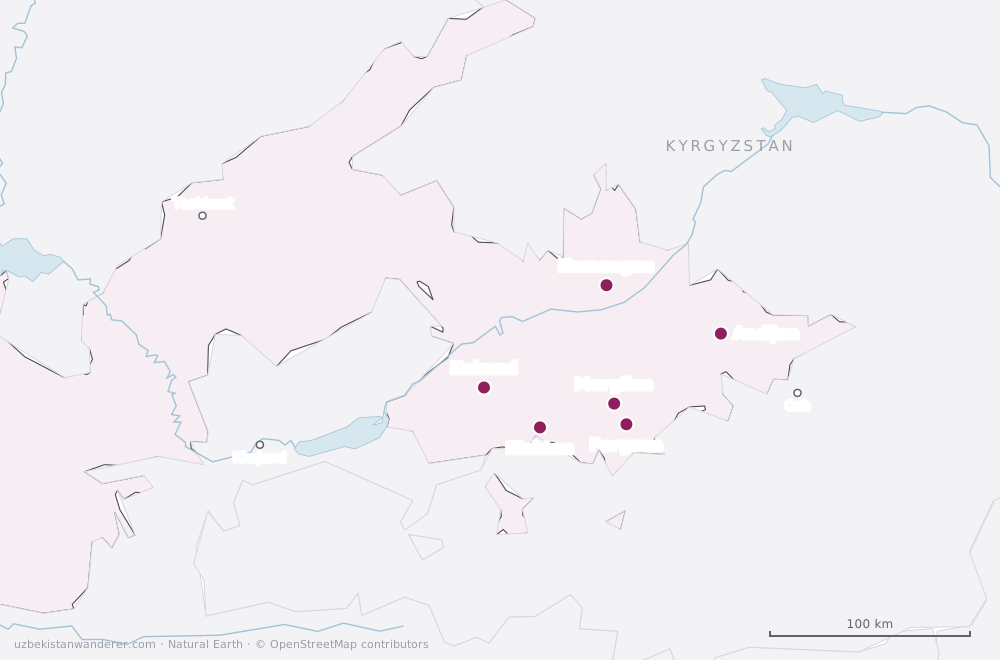
A 19.2 km railway tunnel under the Kamchik range is all that separates Tashkent from the Fergana Valley, and yet far fewer visitors make that trip than the Samarkand–Bukhara run. The valley, tucked into the country’s far eastern arm and ringed by the Tian Shan and Pamir-Alay ranges, is where the crafts that made the Silk Road famous are still made by hand every day: shimmering ikat silk in Margilan, cobalt-blue ceramics in Rishtan, and the last royal palace of a vanished khanate in Kokand.
It is also the least touristed corner of the country’s classic circuit, which is exactly the point. There are no crowds at the workshops, prices are lower, and the encounters feel unstaged. The trade-off is distance and a mountain pass between you and the valley. In this guide we cover how to get there, how many days you need, the towns worth your time, and the honest practicalities of travelling in Uzbekistan’s craft heartland.
Getting to the Fergana Valley
The valley is separated from the rest of Uzbekistan by the Qurama Mountains, and every overland route crosses them. The classic road route runs from Tashkent over the Kamchik Pass (Qamchiq), which peaks at 2,268 metres. It is roughly 320–360 km to Fergana city, and the drive takes about four to five hours depending on traffic and whether there is snow up top (last checked: July 2026).
Most independent travellers do this by shared taxi. Cars leave when full from Tashkent’s Kuyluk bazaar and the Northern (Severniy) area, and a single seat typically costs around 150,000–200,000 UZS, with more if you want extra luggage room or to buy out the whole car (last checked: July 2026). Drivers know the switchbacks intimately; the ride can feel fast, but locals do it daily. For a calmer experience you can arrange a private transfer through your guesthouse.
The more comfortable option is the train. The Angren–Pap line, opened in 2016, tunnels 19.2 km straight through the Kamchik range and carries trains from Tashkent to Kokand, Margilan, Andijan and Pap. It removes the mountain-road anxiety entirely. Since 10 September 2026 the fastest service is express train 730, which leaves Tashkent at 09:20 and reaches Kokand at 12:28, Margilan at 13:00 and Andijan at 13:35; the return, train 729, leaves Andijan at 15:38 and gets to Tashkent at 19:53 (last checked: September 2026). Slower trains still run, the valley timetable was reshuffled in mid-September, and tickets open about 60 days ahead on eticket.uzrailpass.uz. There are also short flights from Tashkent to Fergana and Namangan if you are short on time. Train classes, domestic flights and shared-taxi etiquette are compared in the nationwide transport overview.
One historical note worth knowing: the Fergana Valley was long treated as a sensitive border region, and older guidebooks mention permits and checkpoints. Tourism is now firmly open and straightforward, though you should still carry your passport, expect the occasional roadside police check, and take normal care near the Kyrgyz and Tajik frontiers. The one bit of paperwork that does apply here, as everywhere, is registration: hotels and guesthouses handle it, and the rules for homestays are in the tourist registration explainer.
Margilan: the silk capital
Margilan has spun silk for well over a thousand years, and it is still the centre of Uzbek hand-weaving. The town’s most rewarding stop is the Yodgorlik Silk Factory, founded in 1972 and still working almost entirely by hand. Uzbekistan's official tourism portal has an overview of the Fergana region and its craft towns. “Yodgorlik” means “souvenir” in Uzbek, and a walk through it is a live demonstration of the whole chain: boiling silkworm cocoons, drawing and spinning the thread, dyeing it with plant and mineral colours, and weaving on wooden looms. For silk in the valley long before the factories, there's the Munchaktepa burial site near Pap.
This is where you learn the difference between the fabrics you will see everywhere in Uzbekistan. Atlas is pure silk with a high, liquid sheen; adras is a silk-and-cotton blend that is heavier and more matte. Both are woven in the ikat technique, in which the threads are tie-dyed before weaving so the pattern emerges with soft, feathered edges, a painstaking process that explains the price of a good scarf. Arrive early, ideally between 8 and 9 am, to catch every stage in motion; tours are informal and you can buy directly at the end (last checked: July 2026).
Margilan is also home to the lively Kumtepa Bazaar, busiest on Thursdays and Sundays, where bolts of atlas and adras are sold alongside everything else a valley town needs. If silk and the wider Silk Road story are what pulled you east, our feature on Silk Road history in Uzbekistan gives the context behind the looms.
Rishtan: blue ceramics
About 50 km west of Fergana city, 45 minutes to an hour by car, the small town of Rishtan has been making pottery for centuries and is the undisputed capital of Uzbek ceramics. Its signature is instantly recognisable: intricate ornament in every shade of blue, turquoise and aquamarine on a white or cream ground. The pieces are thrown from local red clay and finished with ishkor, a mineral-and-ash glaze that gives the colours their depth.
You can visit individual master workshops, the Usmanov family workshop is among the best known, or head to the International Ceramics Centre, opened in 2021, which gathers around twenty craftsmen’s houses, shops and a small museum in one place. Many masters will let you sit at the wheel and shape a piyala (tea bowl) or plate under guidance; hands-on sessions generally run a couple of hours and cost roughly $30–80 per person including your finished piece (last checked: July 2026). It is the kind of souvenir that beats anything off a shelf.
Rishtan sits conveniently between Fergana and Kokand, so it slots neatly into a day of moving between the two. How the valley's crafts rank against the rest of the country's sights is weighed up in the nationwide shortlist.
Kokand: the khan’s city
Kokand was the capital of a powerful khanate that ruled much of the valley and beyond until Russian conquest in the 1870s, and it wears that history openly. The showpiece is the Palace of Khudayar Khan, completed in 1873 for the last powerful ruler of Kokand just three years before Tsarist troops arrived and abolished the khanate. It originally held 113 rooms (some sources say 119) across about four hectares; only 19 rooms and two courtyards survive, wrapped in a spectacular tiled façade of geometric and floral patterns.
Beyond the palace, the Juma (Friday) Mosque with its long wooden-columned aivan, the Modari Khan Mausoleum and the Dakhma-i-Shohon royal tombs make Kokand the most historically layered town in the valley. It is compact enough to see the highlights in half a day on foot, and its position at the western edge makes it a natural first or last stop when travelling to or from Tashkent.
Andijan and around
At the eastern end of the valley, Andijan is the valley’s second city after Namangan and the birthplace of Babur, the founder of India’s Mughal dynasty, who was born here in 1483. It is more workaday than Kokand or Margilan, but the Babur memorial complex, Jome mosque and madrasa, and a big, unpretentious bazaar reward travellers who want to see a valley city getting on with ordinary life rather than performing for tourists. Nearby Namangan, across the Syr Darya, adds another market town and more workshops if you have time to linger. Most short-trip visitors skip these in favour of Margilan, Rishtan and Kokand, and that is a reasonable call.
How many days and how to plan it
The valley works as either a fast loop or an unhurried immersion. Here is how the common options break down.
| Time | What you can realistically see |
|---|---|
| 1 day (rushed) | Kokand palace on the way in, quick stop in Rishtan, better as a day trip only if you fly |
| 2 days | Kokand + Rishtan + Margilan silk factory, based one night in Fergana city |
| 3 days | The above at a relaxed pace, plus Kumtepa Bazaar and a hands-on ceramics or weaving session |
| 4+ days | Add Andijan, Namangan and slow shopping; good if you love crafts or are crossing to Kyrgyzstan |
Two to three days suits most people. Base yourself in Fergana city (leafy, calm and central to Margilan and Rishtan) and use Kokand as a stop on the journey in or out. If you are fitting the valley into a larger route, see how it slots into our 10-day Uzbekistan itinerary.
Where to stay
Fergana city has the widest choice of rooms and is the most sensible base; Margilan and Kokand work for one night at either end. Named hotels, prices and the case for each town are in the Fergana Valley accommodation guide.
Practical tips
- When to go: spring (April–May) and autumn (September–October) are ideal. Summers regularly top 40°C, which makes workshop visits and bazaar-walking hard going.
- Cash: carry Uzbek som in cash for workshops, taxis and bazaars. ATMs exist in Fergana and Kokand but are unreliable in smaller towns.
- Getting between towns: shared taxis and marshrutkas link Fergana, Margilan, Rishtan and Kokand cheaply and frequently. Agree the fare before you set off.
- Buying crafts: prices are already low, but polite bargaining is expected at bazaars. Factory and workshop prices are usually fixed and fair.
- Language: Uzbek and Russian dominate; English is limited outside hotels. A translation app and a few phrases go a long way.
- Budget: the valley is one of the cheapest regions in the country. For planning spending, the figures in our daily-spend breakdown are a useful baseline.
Frequently Asked Questions
Is the Fergana Valley worth visiting?
Yes, if living crafts and everyday culture interest you more than headline monuments. Margilan’s silk, Rishtan’s ceramics and Kokand’s palace are unique to the valley, and you will see them with a fraction of the crowds of Samarkand or Bukhara. If your trip is very short and monument-focused, it is the fairest thing to skip.
How do I get from Tashkent to the Fergana Valley?
Three ways: shared taxi over the Kamchik Pass (about four to five hours), the train through the Kamchik tunnel to Kokand, Margilan and Andijan, or a short domestic flight to Fergana or Namangan. The train is the most comfortable; the taxi is the most flexible.
Do I need a permit to visit the Fergana Valley?
No. The valley was historically a restricted border zone, and older guides mention permits, but tourism is now open and normal. Carry your passport, expect occasional police checks on the road, and take standard care near the Kyrgyz and Tajik borders (last checked: July 2026).
How many days do I need in the Fergana Valley?
Two to three days covers the highlights (Kokand, Rishtan and Margilan) at a comfortable pace, based in Fergana city. One day is only realistic if you fly in and out. Four or more lets you add Andijan and Namangan or shop and take craft workshops slowly.
Can I try weaving or pottery myself?
Yes. Rishtan’s masters and ceramics centre offer hands-on sessions where you shape and sometimes glaze your own piece, typically a couple of hours for around $30–80 including the item. Margilan’s silk factory is more a guided tour than a workshop, but you can watch every stage up close.
When is the best time to visit?
Spring and autumn. April–May and September–October bring mild weather ideal for workshops and bazaars. Summer heat above 40°C is punishing, and winter can bring snow to the Kamchik Pass that slows the road route.
Final thoughts
The Fergana Valley rewards travellers who care how things are made. Two or three days is enough to buy a scarf a few metres from the loom it came off, shape a tea bowl in Rishtan and walk the khan’s palace in Kokand. With the express train, it also bolts onto the end of a Samarkand–Bukhara route more easily than it did a year ago.