Accommodation is one of the pleasant surprises of travelling in Uzbekistan. For a country that only recently opened up to mass tourism, the range is remarkable: family-run guesthouses inside UNESCO-listed old towns, hotels built into 19th-century madrasahs, Soviet-era towers dripping with retro atmosphere, sociable hostels, and yurt camps out in the Kyzylkum desert. Prices are low by international standards, and in Bukhara and Khiva you can sleep within a two-minute walk of monuments that most visitors cross continents to see.
The catch is that location matters enormously: each of the big four cities has a clearly “right” area to base yourself. This guide covers the best areas in each city, named properties across budget tiers, and the practical details — registration slips, cash, Booking.com quirks — that catch first-time visitors out.
The Types of Accommodation You’ll Find
Uzbekistan’s accommodation categories don’t map neatly onto Western ones, so here’s what you’re actually choosing between.
- Boutique guesthouses and B&Bs — the sweet spot for most travellers. Usually a restored courtyard house in the old town, run by a family, with carved wooden pillars, suzani textiles on the walls and a generous home-cooked breakfast. Expect roughly $25–70 per double (last checked: July 2026).
- Madrasah-conversion hotels — former Islamic schools where the student cells (hujras) have been turned into guest rooms. Rooms are small and windows face the courtyard, but the atmosphere is unbeatable. Khiva’s Orient Star is the famous example.
- Soviet-era hotels — hulking Intourist-era landmarks like Hotel Uzbekistan in Tashkent. Renovation quality varies wildly room to room, but for architecture nerds the brutalist nostalgia is part of the trip.
- Hostels — a small but solid scene in Tashkent and Samarkand, with dorm beds from around $8–15 (last checked: July 2026). Great for meeting share-taxi partners for onward travel.
- International chains — Hilton, Hyatt, Mercure, Mövenpick and friends have arrived in force since 2018, mainly in Tashkent and Samarkand. Reliable, but you sacrifice character and usually location.
- Yurt camps — seasonal desert camps near Lake Aydarkul, typically visited between Bukhara and Samarkand. More on these below.
Tashkent: Stay Central, Near the Metro
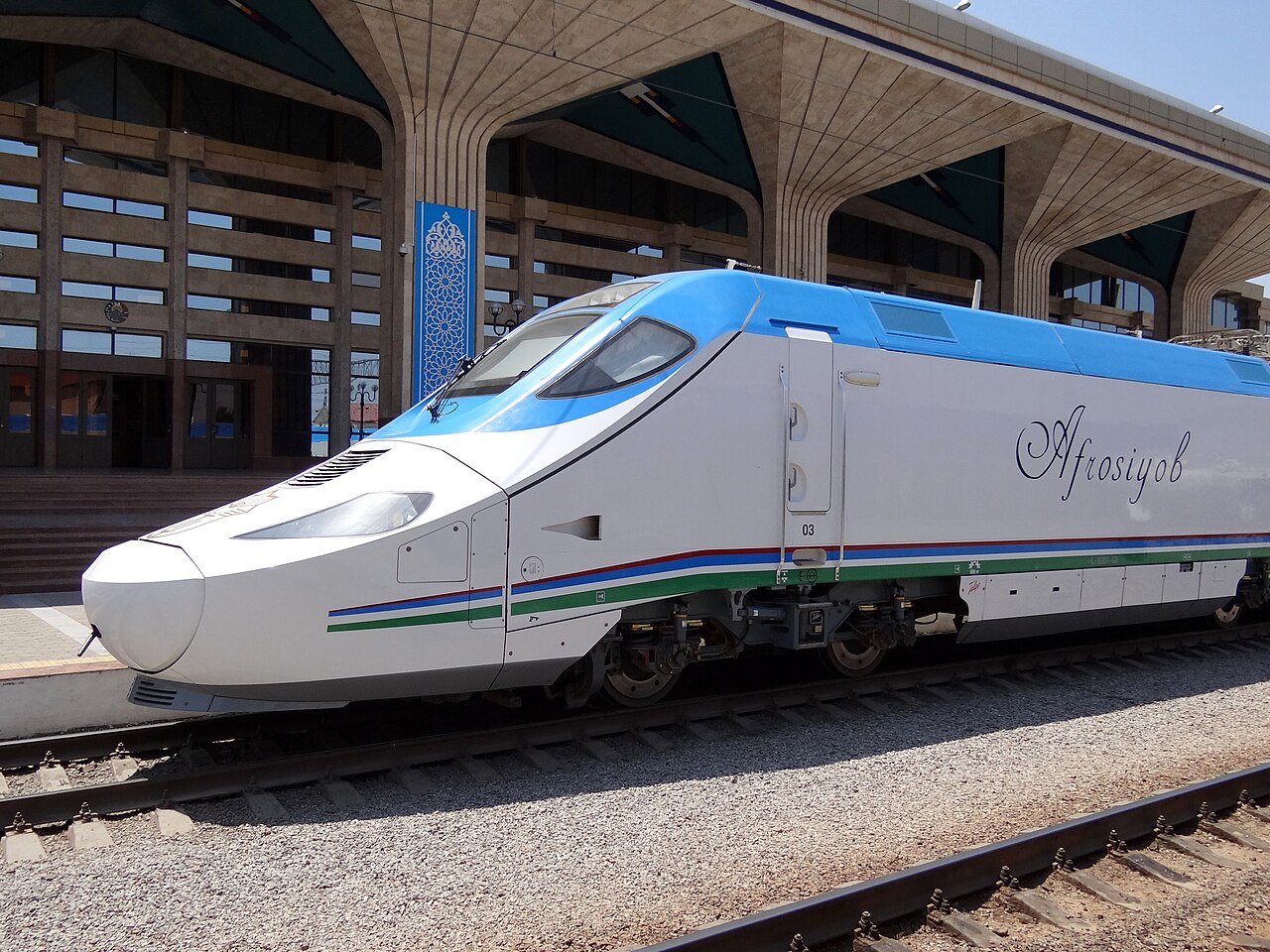
Tashkent is a sprawling, low-density capital, so proximity to a metro station matters more than any single neighbourhood. The best base is the area around Amir Timur Square and Broadway, walking distance from museums, restaurants and three metro lines. The leafy Mirobod district, just south of the centre near the train station, is a good second choice — quieter, full of cafés, and convenient for early Afrosiyob departures. Our Tashkent travel guide covers how the districts fit together.
Budget: Topchan Hostel
Tashkent’s long-running backpacker institution, in the Mirobod area with dorms, private rooms, a garden with traditional topchan platforms, laundry and breakfast included. It’s the single best place in the country to find travel partners for sharing drivers to the Fergana Valley or Nukus. Dorm beds from around $10–14 (last checked: July 2026).
Mid-range with history: Hotel Uzbekistan
The colossal 1974 Soviet slab overlooking Amir Timur Square is a monument in its own right — its concrete lattice façade appears on half the postcards in town. Rooms are hit-and-miss depending on renovation, so temper expectations, but the location is unbeatable and doubles typically run $60–90 (last checked: July 2026). Stay here for the story, not the plumbing.
Upscale: Hyatt Regency or Hilton Tashkent City
Tashkent’s international five-stars are genuinely good value compared with equivalents elsewhere — expect $140–250 per night (last checked: July 2026). The Hyatt Regency sits centrally near the Navoi Opera area, while the Hilton anchors the modern Tashkent City park development. Both deliver the pool-gym-buffet package flawlessly.
Samarkand: The Old Town, Within Walking Distance of the Registan
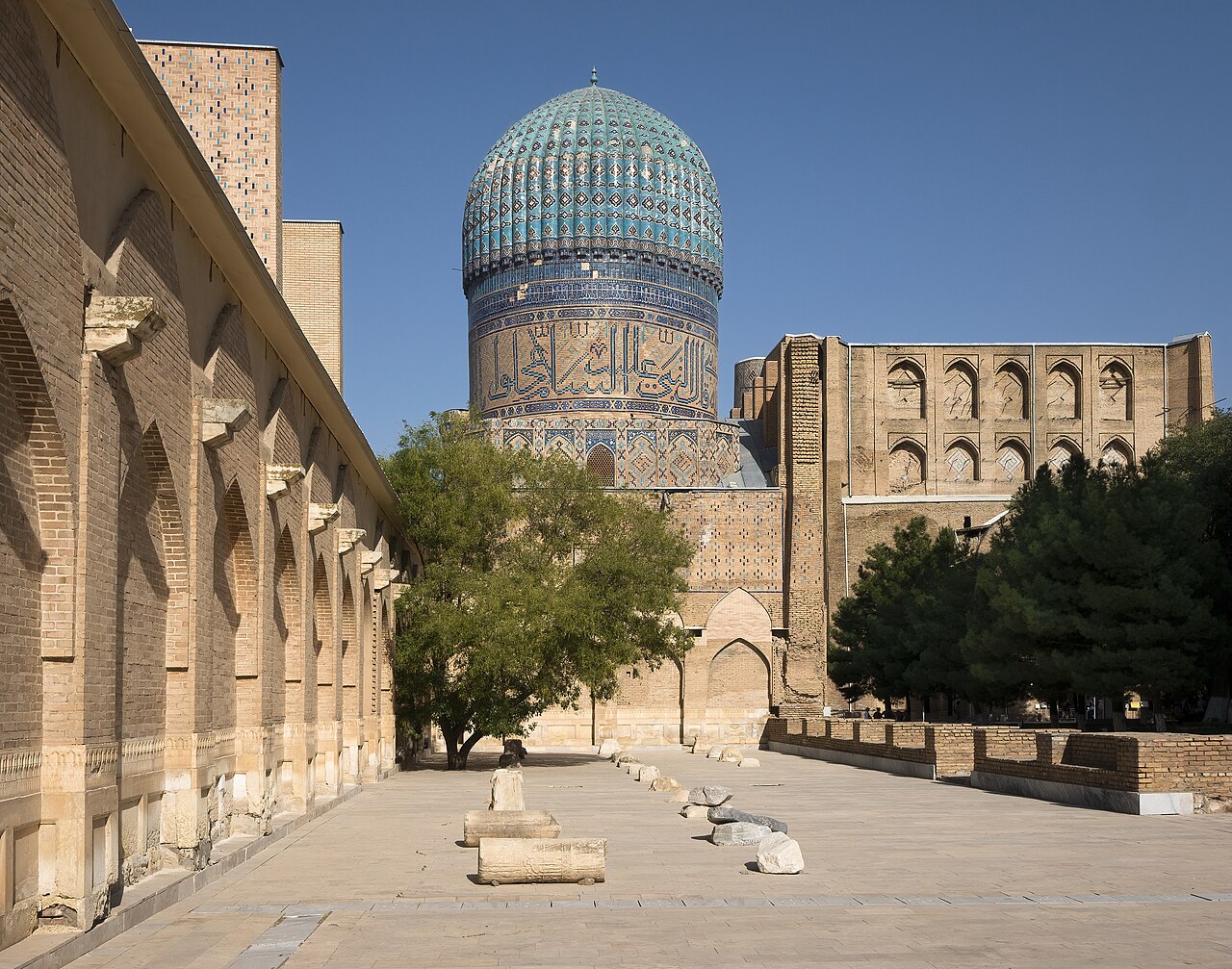
Samarkand splits into the Russian-built new town (leafy boulevards, restaurants, the university) and the old town around the Registan, Bibi-Khanym Mosque and the Siab Bazaar. Stay in the old town within a 10–15 minute walk of the Registan — ideally in the lanes between the Registan and Gur-e-Amir. You’ll walk to every major sight and catch the Registan at dawn before the crowds arrive. See our Samarkand travel guide for how the sights cluster.
Budget: Jahongir B&B
A long-standing family-run guesthouse about a five-minute walk from the Registan, with rooms around a courtyard trimmed in carved wood and bright Uzbek fabrics, and a proper homemade breakfast. Doubles from roughly $30–45 (last checked: July 2026) — consistently one of the best value-for-money stays in the country.
Boutique: Kosh Havuz Boutique Hotel or Sangzor Boutique Hotel
Both sit in the historic quarter near the Registan and blend traditional courtyard architecture with modern bathrooms and air-conditioning that actually works. Expect $50–90 per double (last checked: July 2026). Book early for September and October — Samarkand’s boutique stock sells out weeks ahead in peak season.
Upscale: Mövenpick Samarkand or Hilton Garden Inn
Samarkand’s chain hotels cluster a couple of kilometres from the Registan, many around the new Silk Road Samarkand resort zone east of the centre. The Mövenpick and the Hilton Garden Inn are the safest picks for full-service comfort at $100–180 per night (last checked: July 2026), with the trade-off that you’ll take a short taxi to the old town each day.
Bukhara: Around Lyabi-Hauz in the Old Town
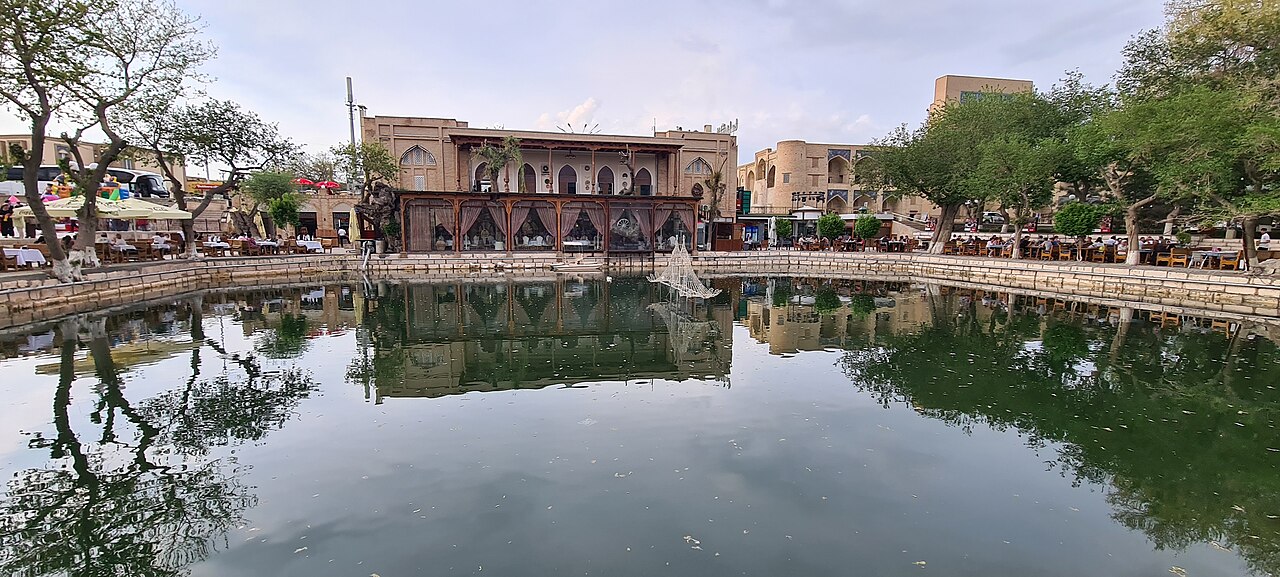
Bukhara has the best old-town accommodation scene in Central Asia, and there is only one sensible answer to where to stay: inside the historic centre, within a few minutes of the Lyabi-Hauz pool complex. From here everything — the trading domes, Poi-Kalyan, the Ark fortress — is walkable through pedestrian lanes, and evenings around the pond are the social heart of the city. Anything requiring a taxi into the old town defeats the point of Bukhara. Our Bukhara travel guide maps the walking routes.
Budget: Meros Hotel and old-town guesthouses
Bukhara’s budget scene is guesthouse-based rather than hostel-based. Small family-run spots like Meros Hotel offer clean doubles with breakfast from around $25–40 (last checked: July 2026) in the lanes off the main tourist drag. Filter Booking.com by review score above 9.0 and distance under 500 m from Lyabi-Hauz — there are dozens of good options.
Mid-range classic: Lyabi House Hotel
Set in a 19th-century merchant’s house two minutes from Lyabi-Hauz, with antique furnishings, a courtyard breakfast and around 40 traditionally decorated rooms. Doubles typically $60–90 (last checked: July 2026). It’s been hosting travellers for decades and remains the benchmark Bukhara stay.
Boutique and upscale: Alexia Suite Hotel or Mercure Bukhara Old Town
Alexia Suite occupies a restored 1805 residence steps from Lyabi-Hauz, with a rooftop terrace looking over the old city. The Mercure Bukhara Old Town is the pick if you want chain-hotel consistency without leaving the historic centre, near the Magoki-Attari Mosque and the trade domes. Both land in the $90–160 range (last checked: July 2026).
Khiva: Sleep Inside the Itchan Kala Walls
Khiva is tiny, and the decision is binary: inside or outside the mudbrick walls of the Itchan Kala. Stay inside. The walled city empties of day-trippers by early evening, and having the minarets to yourself at sunset and sunrise is the single best accommodation experience in Uzbekistan. Details on timing your visit are in our Khiva travel guide.
Budget: Meros B&B
A genuine family home inside the walls with richly decorated rooms, English-speaking owners and a rooftop terrace overlooking the old city — one of the best breakfast-and-sunset combinations in the country. Doubles from around $35–50 (last checked: July 2026).
The madrasah stay: Orient Star Khiva
The Muhammad Amin Khan Madrasah (1855), directly facing the stub of the turquoise Kalta Minor minaret, now operates as the Orient Star Khiva. Rooms are converted student cells — small, atmospheric, simply furnished — and breakfast is served in the old dining hall. Around $70–110 per double (last checked: July 2026). Don’t expect luxury; do expect to sleep inside a monument.
Mid-range comfort: Khiva Siyovush Hotel
A family-owned hotel inside the Itchan Kala offering larger, more modern rooms than the madrasah conversions while keeping the inside-the-walls location, generally $50–80 per double (last checked: July 2026).
Yurt Stays at Lake Aydarkul
Between Samarkand and Bukhara, a detour north through Nurata brings you to the edge of the Kyzylkum desert and Lake Aydarkul, where a handful of seasonal yurt camps — Safari Yurt Camp and Aydar Yurt Camp are the established names — offer a night under serious stars. Expect shared Kazakh-style yurts, dinner and breakfast, a campfire with folk songs, and optional camel rides (about $20 per hour). A night typically costs $30–45 per person including meals (last checked: July 2026).
Be realistic about what this is: a well-oiled tourist experience rather than a wilderness expedition, with camps running electricity and proper showers. It’s still a highlight for most travellers, especially with kids. Camps operate roughly April to October and are usually booked as a one-night stop on a Samarkand–Bukhara transfer — see our 10-day Uzbekistan itinerary for where it fits.
Booking and Registration Tips
- Booking.com dominates. Coverage in Uzbekistan is excellent, and most guesthouses manage their availability there. Note that many small properties can’t take your card online — the booking guarantees the room, and you pay on arrival.
- Carry cash for guesthouses. Cards are now widely accepted in cities, but family-run places often prefer cash in Uzbek som, and some quote in US dollars. Small-denomination dollars are useful backup. Budget details are in our Uzbekistan travel costs guide.
- Registration is your hotel’s job — but keep the proof. Foreigners must be registered within three days of arrival, and licensed accommodation does this automatically through the digital E-mehmon system. Ask each property for a printed or QR-coded registration slip and keep them until you’ve left the country; border officers rarely ask these days, but a paper trail is cheap insurance. Caravanistan’s registration guide tracks the current rules.
- Yurt camps and homestays handle registration too — legitimate ones will register you or issue a voucher covering the night. If you wild camp or sleep on a night train, that night is generally excused, but don’t leave multi-night gaps.
- Book early for spring and autumn. April–May and September–October are peak; the best old-town rooms in Bukhara and Khiva sell out a month or more ahead.
Frequently Asked Questions
How much should I budget per night for accommodation in Uzbekistan?
Roughly $10–15 for a hostel dorm, $30–50 for a good double in a family guesthouse, $60–100 for a boutique hotel in an old town, and $120–250 for international five-stars (last checked: July 2026). Prices rise 20–30 percent in peak spring and autumn months and drop noticeably in July, August and winter.
Is Booking.com reliable in Uzbekistan?
Yes — it has the deepest inventory of any platform and nearly every guesthouse we recommend is listed there. The main quirk is payment: many small properties take the reservation online but collect cash at checkout, so read each listing’s payment conditions. Reconfirm arrival time directly if you’re arriving late — family-run places don’t staff a 24-hour desk.
Do I still need hotel registration slips?
Registration is still legally required, but licensed hotels and guesthouses handle it digitally via the E-mehmon system, so there’s nothing for you to actively do. We still recommend collecting a printed slip or QR receipt from each property: departure checks have become rare, but paper slips resolve any gap in the digital record on the spot.
Are madrasah hotels comfortable, or just atmospheric?
Mostly atmospheric. Rooms converted from student cells are small, ceilings can be low, and windows open onto the courtyard, so they can feel dark; bathrooms are modern but compact. We’d happily spend a night or two in one — the Orient Star Khiva especially — then switch to a courtyard guesthouse.
Is a yurt stay at Aydarkul worth it with limited time?
With ten days or more, yes — it breaks up the Samarkand–Bukhara run and the desert night sky is spectacular. On a tight seven-day itinerary we’d skip it and put that time into an extra night in Bukhara instead.
Should I stay inside Khiva’s walls even though it costs more?
Yes, without hesitation. The Itchan Kala after the tour groups leave is a different city, and that experience is only available to people sleeping inside the walls — usually for a premium of just $10–20 per night.
Final Thoughts
The pattern is simple: in the historic cities, pay the small premium to sleep inside the old town — near Lyabi-Hauz in Bukhara, within the walls in Khiva, walking distance from the Registan in Samarkand — and save the chain hotels for Tashkent. Book spring and autumn early, keep your registration slips, and carry cash for the family-run places. Get those right and accommodation becomes a highlight of the trip rather than a logistical footnote.
Featured image: BeshevI (CC BY-SA 4.0) via Wikimedia Commons.