Itchan Kala covers about 26 hectares. You can walk it corner to corner in twenty minutes, and roughly two dozen hotels and guesthouses operate inside those walls. That one fact reshapes the accommodation question in Khiva. In most Silk Road cities, “staying in the old town” means staying near it — a five-minute walk from the monuments, on a normal street, in a normal building. In Khiva it can mean sleeping inside a UNESCO World Heritage site, behind gates that were built to keep armies out, on lanes that empty almost completely once the day-trip buses leave for Urgench.
The catch is that the walls constrain the buildings too. Several of the most atmospheric hotels are converted madrasahs, which means your room was originally a student cell: thick walls, a low door, and often no proper window — just a slot near the ceiling. Some travellers call that the best night of their trip. Others spend it wishing for daylight and a working extractor fan. Both reactions are reasonable, and knowing which one you’ll have is most of the decision.
The Short Version
Stay inside Itchan Kala. For most visitors it is not a close call. Khiva’s appeal is concentrated almost entirely within the walls, the town outside is unremarkable, and the two hours that make the place — dawn and the hour after sunset — only work if you can step out of your door into them. Paying an extra $20 a night for that is the best-value upgrade in Uzbek travel.
Stay outside if you have heavy luggage and no patience for cobbles, if you need a lift, a car park or a full-service hotel, or if you are on a genuinely tight budget. The walk from the nearest streets to the west gate is five to ten minutes. Nobody is stranded.
Inside the Walls: Itchan Kala
The inner town is a rectangle enclosed by crenellated mud-brick walls around 10 metres high and about 2.2 kilometres in circuit, with gates at the four cardinal points. Most people arrive through the west gate, Ota Darvoza, where the ticket booths and the main road are. Two main streets cross between the gates; everything else is a lane. Our full orientation to the monuments, tickets and timings lives in the Khiva travel guide, but for accommodation purposes the geography is simple: nowhere inside the walls is far from anywhere else inside the walls.
What Sleeping Inside Is Actually Like
Quiet. Genuinely, unusually quiet. Vehicle access is restricted, so there is no traffic noise, and once the groups clear out around 5pm the lanes belong to residents, cats and a handful of guests. Families still live inside Itchan Kala, which keeps it from feeling like a museum after hours — children on bicycles, washing on lines, someone’s television through an open window.
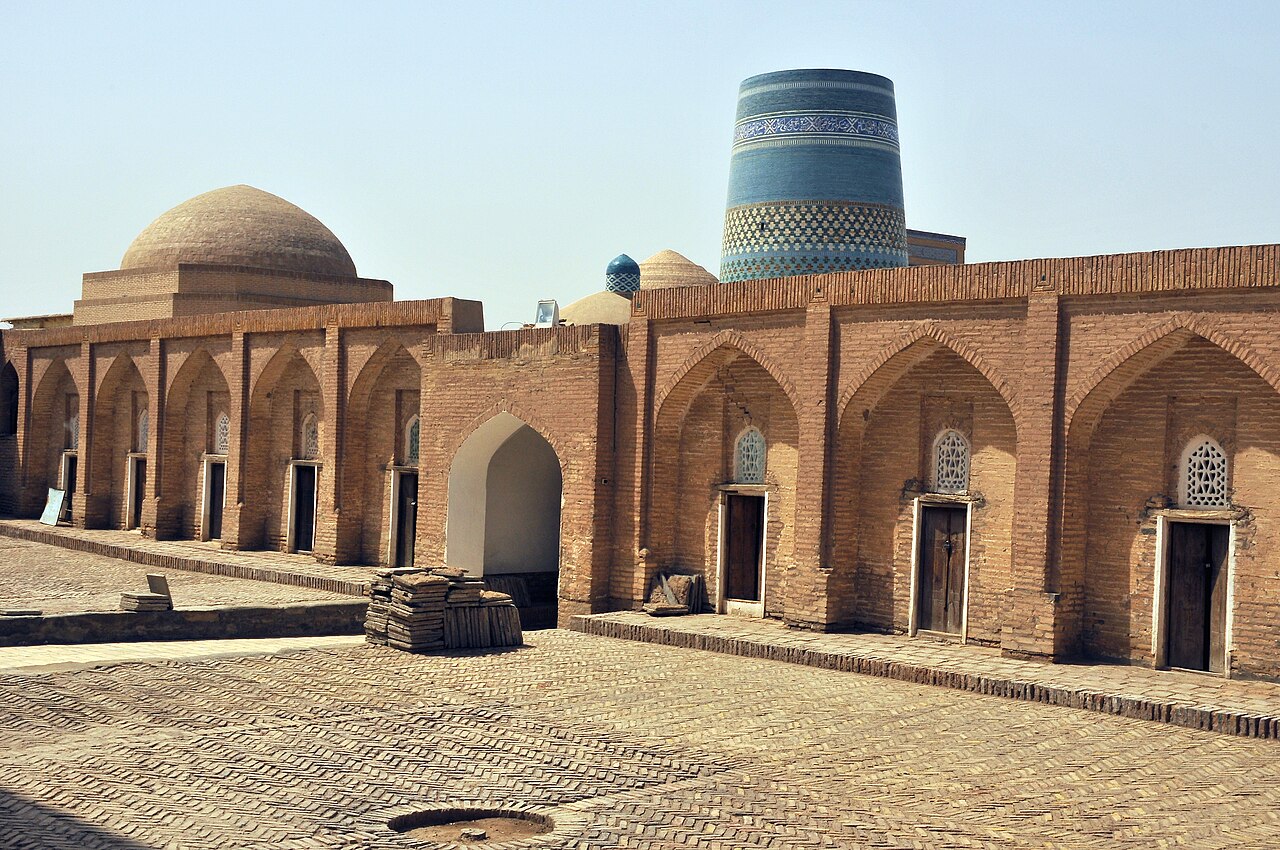
The morning is the real prize. Coaches from Urgench and Bukhara typically arrive between 9am and 10am, so at 6.30 you have Kalta Minor’s turquoise tiles catching first light with nobody in the frame.
The Madrasah Hotels
Two of the best-known properties inside the walls are former religious colleges. The Orient Star occupies the Muhammad Amin Khan madrasah of 1851–1853 — once the largest in Khiva, housing some 250 students — right beside Kalta Minor. Feruzkhan occupies the Muhammad Rakhim Khan madrasah of 1871, across from the Kunya-Ark. Both put you inside monuments that other visitors pay to photograph, and both arrange rooms around large, tree-shaded courtyards that are lovely places to drink tea at nine at night.
Be clear-eyed about the rooms. They are converted hujra — student cells — small, and many with no window at all, only a vent near the ceiling. Ground-floor rooms can be dim at midday, ventilation is limited, and wi-fi tends to work in the courtyard rather than the room. Reviews are polarised, and the split is almost always about this rather than about service. If you sleep badly without daylight, book a courtyard guesthouse instead.
Family Guesthouses and Small Boutiques
This is the best-value corner of the market, and where we would send most people. Purpose-built or converted family houses inside the walls give you a proper window, a hot shower, a rooftop or courtyard, and breakfast made by the owners — usually non straight from a neighbourhood tandyr, eggs, jam, tomato and cucumber, and green tea that keeps arriving. Names worth searching: Zarafshon Boutique Hotel and Arkanchi at the smarter end, Nazira Boutique Hotel & Terrace, Ulli Oy, Khiva Siyovush and Boyjon Ota Guesthouse in the middle. Rooftops matter here more than in other Uzbek cities; a terrace with a view of Islam Khoja minaret at sunset is worth choosing a hotel for.
Outside the Walls: Dishan Kala and Beyond
Dishan Kala is the outer town — historically the second walled ring, now the ordinary modern town wrapped around the monument. The strip immediately west and north of Ota Darvoza is where most outside-the-walls hotels sit, and from there you are three to ten minutes on foot from the gate. Khiva Tosh Darvoza, Shaherezada and Islambek all fall in this band. Further out, along the road towards Urgench, you find larger properties like Farovon Khiva that trade atmosphere for lifts, parking, generous breakfasts and reliable climate control — a fair trade in a July heatwave or with a family in tow.
What you lose is the evening — though the loss is small in distance terms, and plenty of travellers staying outside simply walk in after dinner. What you gain, apart from money, is a taxi that can pull up to the door.
What You’ll Pay
Khiva is inexpensive by any international standard, and the gap between “cheap” and “the nicest room in town” is narrower than in Samarkand or Bukhara. Rates below are typical booking-site prices for a double in shoulder season (last checked: August 2026). Expect 25–40% more in the peak weeks of late April, May, September and early October, and less in July, August and midwinter.
| Where | Typical double, per night | Walk to Kalta Minor | Best for |
|---|---|---|---|
| Hostel dorm bed (inside or just outside) | $10–15 | 2–10 min | Solo backpackers |
| Family guesthouse, inside the walls | $25–45 | 2–8 min | Most travellers |
| Boutique or madrasah hotel, inside the walls | $60–130 | 1–6 min | Atmosphere, short trips |
| Guesthouse just outside the gates (Dishan Kala) | $20–40 | 5–12 min | Budget travellers, drivers |
| Larger 3–4 star hotel, outer town | $35–70 | 15–25 min or short taxi | Families, groups, comfort |
Breakfast is almost always included, even at the cheapest guesthouses. Card payment is now normal at hotels but not universal at the smallest family places; carry som as backup. Prices for the rest of the country, city by city, are laid out in our overview of accommodation across Uzbekistan.
Picking by Budget
Under $30
Aim for a family guesthouse inside the walls rather than a hostel outside — at these prices the difference is a few dollars, and the location is the whole point. Boyjon Ota Guesthouse and the smaller family houses along the lanes off the main street are the type to look for. Expect a clean simple room, a working en-suite, a shared courtyard, and a host who calls you a taxi at 6am without being asked.
$40–70
The best value band in Khiva. Nazira Boutique Hotel & Terrace, Ulli Oy and Khiva Siyovush sit around here, and this is where you get a rooftop, decent air conditioning, a proper window and a breakfast that goes beyond bread and jam. If you only have one night, spend it here rather than reaching for the top tier.
$90 and Up
Zarafshon Boutique Hotel and Arkanchi are the names that come up repeatedly at the smarter end inside the walls, both with interiors built to sit alongside the surrounding madrasahs rather than fight them. The Orient Star belongs here on price, though it is bought for the building rather than the bedroom. One honest note: Khiva’s ceiling is lower than Bukhara’s or Samarkand’s. Nothing here is a five-star international hotel.
Practical Things Worth Knowing Before You Book
- Luggage and cobbles. Vehicles are restricted inside Itchan Kala, so a taxi usually drops you at a gate and you walk the last 100–500 metres over uneven stone. Wheeled suitcases hate it. Message your hotel ahead — many will meet you at the gate with a handcart.
- You do not need a ticket to reach your hotel. Walking the streets of Itchan Kala is free. The 250,000 som combined ticket (about US$19, valid two full days) covers the museums and monuments only.
- Arrival points. Khiva’s own railway station is roughly 1.5 km from the walls, a short taxi ride. Urgench airport is 30–35 km away, about 35–45 minutes by road. Yandex Go works in Urgench and undercuts the airport touts.
- Winter is cold. Sub-zero January nights are normal in Khorezm, and thick historic walls hold cold well. Check that heating is described as central or electric, not “available on request”.
- Book ahead for spring and autumn. Stock inside the walls is small and tour operators buy much of it for the April–May and September–October peaks. Two months’ notice is not excessive; check our notes on seasons and when to travel first.
- Two nights, not one. One night gets you the monuments. Two gets you a sunset and a dawn, which is the reason to come at all.
If Khiva follows Bukhara on your route, note that the desert leg is long enough to eat a day, and where you sleep on either side of it matters more than usual — we break the options down in our guide to the Bukhara to Khiva crossing, and the equivalent decision at the other end is covered in choosing a base in Bukhara. Timings for onward trains are published by Uzbekistan Railways, and the boundaries of the protected zone you’ll be sleeping inside are set out on the UNESCO listing for Itchan Kala.
Frequently Asked Questions
Is it worth paying more to stay inside Itchan Kala?
Yes, and the premium is usually small — often $10 to $20 a night over an equivalent room outside. The value is not the room; it is access to the walled city in the hours when it is empty. If money is tight, cut the tier rather than the location.
Can a taxi drive to my hotel inside the walls?
Usually not all the way. Vehicle access to Itchan Kala is restricted and enforcement varies by gate and time of day. Assume you will be dropped at Ota Darvoza or another gate and will walk the rest over cobbles. Tell your hotel your arrival time and they will normally send someone with a cart.
Are the madrasah hotels uncomfortable?
Unusual rather than bad. Rooms are former student cells: small, often windowless, with a vent instead of glass. People who love the idea of sleeping in a 170-year-old college rate them highly; people who need daylight and air movement often do not. Read recent reviews for the specific room type before booking.
How many nights should I book in Khiva?
Two nights, giving you one and a half days. That covers the main monuments comfortably and buys you both a sunset and an early morning inside the walls. Three nights suits photographers and anyone using Khiva as a rest stop; one night is enough only if you are passing through on a tight schedule.
Should I stay in Urgench instead?
Only if a flight schedule forces it. Urgench has the airport and the rail connections but nothing to see, and you would be commuting 30–35 km each way. With an early flight, book the last night in Khiva anyway and leave at 5am — regional connections are covered in our rundown of transport within Uzbekistan.
Khiva rewards patience more than money. The best night here is not the most expensive room in town — it is any room inside the walls that puts you out on the stones at six in the morning, while the coaches are still an hour down the Urgench road.
Featured image: LBM1948 (CC BY-SA 4.0) via Wikimedia Commons.