Uzbekistan is one of the easier countries in Central Asia to travel without the local language, and one of the most rewarding places to learn thirty words of it anyway. Hotel staff in Tashkent, Samarkand and Bukhara often speak workable English. Everyone else — the taxi driver in Margilan, the woman selling dried apricots at a produce market, the guesthouse grandmother refilling your bowl, will meet you somewhere between Uzbek and Russian, and will be visibly pleased when you try.
The complication is that “the local language” is really two languages plus two alphabets. Uzbek is the state language and the mother tongue of roughly 85 percent of the population. Russian remains the second language of the cities, the older generation and much of the country’s paperwork. And Uzbek itself is written in both Latin and Cyrillic, sometimes on the same street. None of this is a problem if you know what to expect.
This guide covers where each language is genuinely more useful, how to read the signs, how to pronounce Uzbek without agonising over it, and then the phrases themselves, grouped by situation. Everything is in Uzbek Latin script with a rough English pronunciation, because Latin is what you’ll mostly see on menus and tourist signage in 2026.
Uzbek or Russian? Where each one helps
If you only have room in your head for one language, learn Uzbek greetings and Russian numbers: that covers the opening of a conversation and the agreeing of a price. The balance shifts noticeably as you move around the country.
Tashkent
The capital is the most Russian-speaking part of Uzbekistan. Plenty of Tashkentis are more comfortable in Russian than in Uzbek, particularly in business, medicine and the older bureaucracy, and you’ll hear both in the same metro carriage. It’s also where English is most widely spoken — hotels, the newer cafés around Amir Timur Square, and under-30s generally. Our Tashkent travel guide covers how the city fits together.
Samarkand and Bukhara
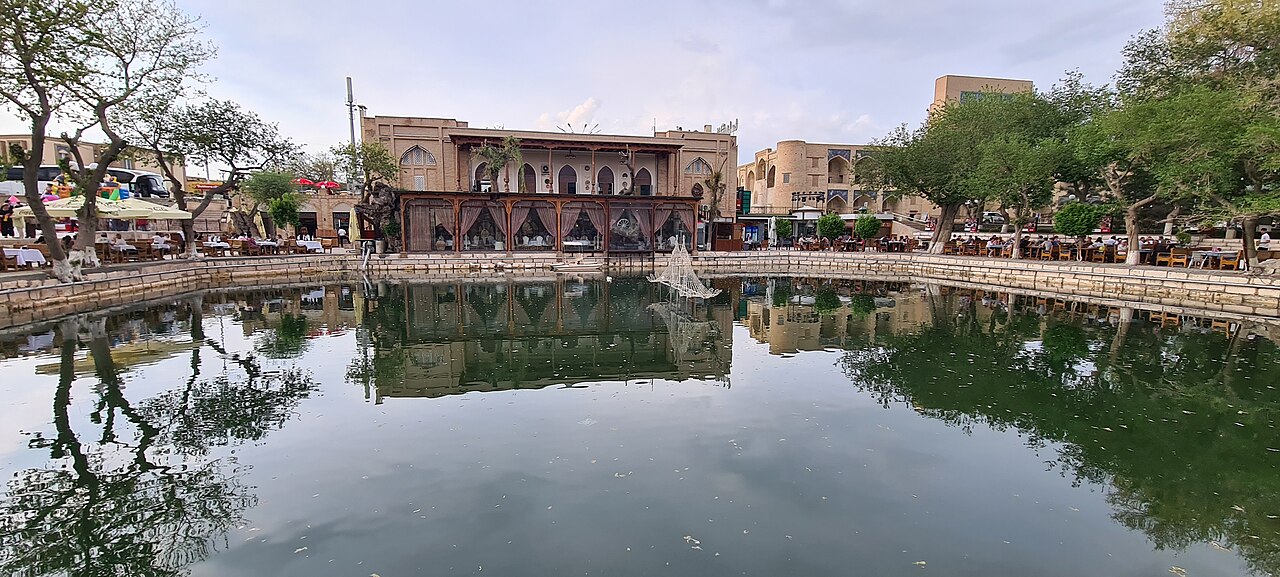
Both cities have large Tajik-speaking populations, so the street language you overhear is often Tajik, a Persian variety — rather than Uzbek. Everyone also functions in Uzbek, and Russian is widely understood. As the two heaviest tourism cities, they have plenty of English inside the tourist economy: guides, hotel reception, the shops around the Registan and Lyabi-Hauz. Two streets away it thins out fast.
The Fergana Valley and rural Uzbekistan
This is where Uzbek dominates and Russian recedes, especially among younger people who grew up entirely post-Soviet. In Margilan, Rishtan, Kokand and the villages between them, your Uzbek phrases stop being a courtesy and start being useful. English is scarce. See our Fergana Valley travel guide and expect to do more pointing than talking.
Karakalpakstan and Nukus
The autonomous republic in the northwest has its own official language, Karakalpak, closer to Kazakh than to Uzbek, though speakers of each can broadly follow the other. Russian carries more weight in Nukus than in provincial towns elsewhere. Your Uzbek phrases still work here; just expect the reply to sound different from Samarkand.
Latin or Cyrillic? The script situation (last checked: August 2026)
Uzbekistan legislated a move from Cyrillic to a Latin alphabet in 1993 and has been transitioning ever since. A 2021 decree set 1 January 2023 as the date by which official documents, signage, media and advertising should all have converted. That deadline passed without the switch being complete. As of our latest check in August 2026, both alphabets remain in daily parallel use: newer government sites, textbooks, packaging and most tourist-facing signage are Latin, while much newspaper text, neighbourhood shop signage and social media stays stubbornly Cyrillic.
Practically: metro station names, museum labels and restaurant menus in the tourist cities are usually Latin, so you can read them straight off the wall. Older local signs may not be, and Russian is always Cyrillic. Spending twenty minutes learning to sound out Cyrillic before you fly is one of the highest-return preparations for Central Asia — it turns “аптека” into “apteka” (pharmacy) and “ресторан” into “restoran” with no vocabulary at all.
Pronouncing Uzbek without overthinking it
Uzbek is refreshingly phonetic. Words are pronounced broadly as spelled, stress usually falls on the final syllable, and there are no tones and no grammatical gender. Only a handful of letters differ from English.
| Letter | Sound | Example |
|---|---|---|
| x | throaty “kh”, as in Scottish loch | xona (room) — KHO-na |
| q | a “k” made further back in the throat | qancha (how much) — KAN-cha |
| oʻ (o’) | somewhere between “oh” and “uh” | yoʻq (no) — yoke |
| gʻ (g’) | a soft gargled “g”, close to a French r | togʻ (mountain) — togh |
| j | usually “j” as in jam | jigar (liver) — jee-GAR |
| ʼ (apostrophe) | a small catch in the voice, or lengthens the vowel | maʼno (meaning) — ma-NO |
Nobody expects a visitor to get q and x right. Say them as an ordinary “k” and “h” and you’ll still be understood everywhere in the country.
Greetings and politeness
Start here. Assalomu alaykum is the universal greeting across every region and age group, and the standard reply is Vaalaykum assalom. Note that Uzbek has no everyday word mapping neatly onto English “please”: iltimos sounds like a plea, while marhamat is closer to “go ahead” or “help yourself”. Politeness rides on the verb ending and the tone instead.
| English | Uzbek | Rough pronunciation |
|---|---|---|
| Hello (formal, universal) | Assalomu alaykum | ah-sah-LO-mu ah-lay-KOOM |
| Reply to the above | Vaalaykum assalom | va-ah-lay-KOOM ah-sah-LOM |
| Hi (casual) | Salom | sah-LOM |
| How are you? | Qalaysiz? | ka-LAY-siz |
| Good, thank you | Yaxshi, rahmat | YAKH-shi, rah-MAT |
| Thank you | Rahmat | rah-MAT |
| Thank you very much | Katta rahmat | kat-TA rah-MAT |
| You’re welcome | Arzimaydi | ar-zi-MAY-di |
| Yes | Ha | ha |
| No | Yoʻq | yoke |
| Excuse me / sorry | Kechirasiz | ke-chi-ra-SIZ |
| Goodbye | Xayr | khayr |
| My name is… | Mening ismim… | me-NING is-MIM |
| Do you speak English? | Ingliz tilida gaplashasizmi? | in-GLIZ ti-li-DA gap-la-sha-SIZ-mi |
| I don’t understand | Tushunmadim | tu-shun-ma-DIM |
| I don’t speak Uzbek | Men oʻzbekcha bilmayman | men uz-BEK-cha bil-MAY-man |
Numbers and money
Uzbek numbers are built logically: 11 is oʻn bir (ten-one), 25 is yigirma besh. Because the som runs to large figures, prices are spoken in thousands, a fare quoted as “yigirma ming” means 20,000 som. Many vendors default to Russian numbers regardless, so recognising dvadtsat, tridtsat, pyatdesyat and sto helps too.
| Number | Uzbek | Rough pronunciation |
|---|---|---|
| 1 / 2 / 3 | bir / ikki / uch | beer / IK-ki / ooch |
| 4 / 5 / 6 | toʻrt / besh / olti | turt / besh / ol-TI |
| 7 / 8 / 9 | yetti / sakkiz / toʻqqiz | YET-ti / sak-KIZ / tok-KIZ |
| 10 / 20 / 30 | oʻn / yigirma / oʻttiz | on / yi-gir-MA / ot-TIZ |
| 40 / 50 / 100 | qirq / ellik / yuz | kirk / el-LIK / yuz |
| 1,000 / 10,000 | ming / oʻn ming | ming / on ming |
| Money / som | pul / soʻm | pool / sum |
At the bazaar: shopping and bargaining
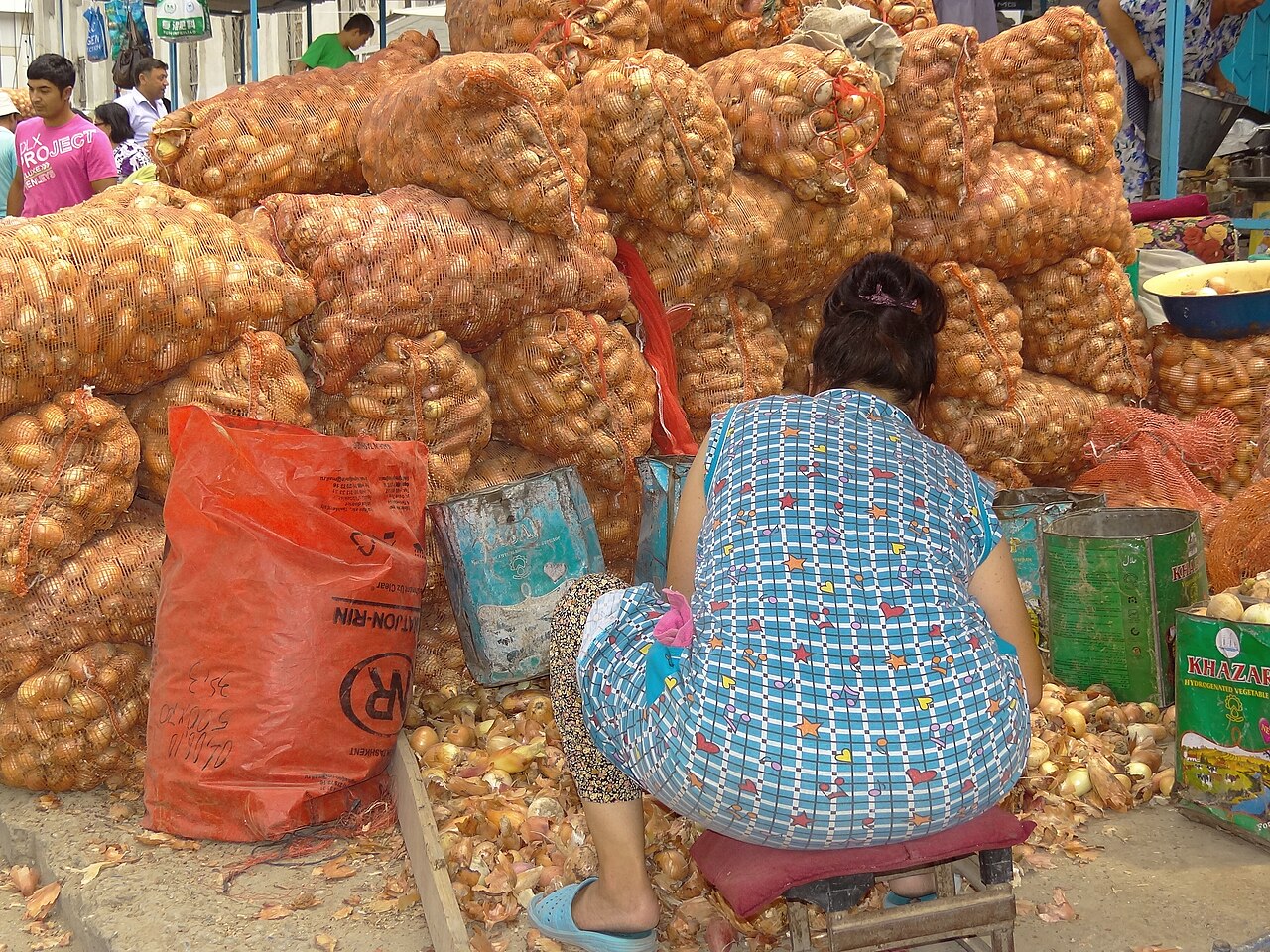
Bargaining here is gentle and unhurried rather than theatrical. Fresh food is usually fixed, or close enough that haggling looks mean; crafts, carpets, ceramics and suzani have real room in them. Ask the price, look thoughtful, name around 70 percent of it, settle in the middle — smiling throughout. Our guides to Chorsu Bazaar and what is worth buying in Uzbekistan cover what things should cost.
| English | Uzbek | Rough pronunciation |
|---|---|---|
| How much does it cost? | Qancha turadi? | KAN-cha tu-RA-di |
| How much? (short) | Bu qancha? | boo KAN-cha |
| That’s expensive | Qimmat | kim-MAT |
| Can it be cheaper? | Arzonroq boʻladimi? | ar-zon-ROK bo-la-di-MI |
| Is there a discount? | Chegirma bormi? | che-GIR-ma bor-MI |
| I’ll take it | Olaman | o-la-MAN |
| I’m just looking | Shunchaki qarayapman | shun-cha-KI ka-ra-YAP-man |
| One kilo / half a kilo | Bir kilo / yarim kilo | beer KI-lo / ya-RIM KI-lo |
| Do you take cards? | Karta bilan boʻladimi? | KAR-ta bi-LAN bo-la-di-MI |
| No, thank you | Yoʻq, rahmat | yoke, rah-MAT |
Food and restaurants
Menus in the tourist cities are frequently bilingual; in smaller towns they may be Uzbek or Russian only, or absent entirely. Vegetarians should be specific rather than general, because “no meat” is often heard as “no beef” while the broth is still lamb-based. Our guide to Uzbek food and plov guide cover what to order.
| English | Uzbek | Rough pronunciation |
|---|---|---|
| Menu, please | Menyu bering | MEN-yu be-RING |
| Water / bread / tea | Suv / non / choy | soov / non / choy |
| Green tea / black tea | Koʻk choy / qora choy | kook choy / ko-RA choy |
| I don’t eat meat | Men goʻsht yemayman | men gosht ye-MAY-man |
| Without meat, please | Goʻshtsiz, iltimos | GOSHT-siz, il-ti-MOS |
| I have an allergy to… | Menga … allergiyam bor | men-GA … al-ler-GI-yam bor |
| Delicious | Mazali | ma-za-LI |
| Very delicious | Juda mazali | ju-DA ma-za-LI |
| I’m full, thank you | Toʻydim, rahmat | TOY-dim, rah-MAT |
| The bill, please | Hisobni bering | hi-SOB-ni be-RING |
Transport and directions
Ride-hailing apps have removed most fare negotiation inside the big cities, but shared long-distance cars, marshrutkas and small-town taxis are still arranged verbally. Agree the price before the doors close. Our guide to getting around Uzbekistan covers trains and shared taxis in detail.
| English | Uzbek | Rough pronunciation |
|---|---|---|
| Where is…? | … qayerda? | ka-YER-da |
| Take me to… | Meni …ga olib boring | me-NI …ga o-LIB bo-RING |
| How much to…? | …gacha qancha? | …GA-cha KAN-cha |
| Stop here, please | Shu yerda toʻxtating | shoo YER-da tokh-ta-TING |
| Left / right / straight on | Chap / oʻng / toʻgʻri | chap / ong / TOG-ri |
| Train station | Temir yoʻl vokzali | te-MIR yol vok-za-LI |
| Bus stop | Avtobus bekati | av-TO-bus be-ka-TI |
| Airport | Aeroport | a-e-ro-PORT |
| Is it far? | Uzoqmi? | u-ZOK-mi |
| Toilet | Hojatxona | ho-jat-KHO-na |
At your hotel or guesthouse
| English | Uzbek | Rough pronunciation |
|---|---|---|
| Do you have a free room? | Boʻsh xona bormi? | bosh KHO-na bor-MI |
| For one night / two nights | Bir kecha / ikki kecha | beer KE-cha / IK-ki KE-cha |
| Key | Kalit | ka-LIT |
| What’s the Wi-Fi password? | Wi-Fi paroli nima? | WI-fi pa-ro-LI ni-MA |
| Is breakfast included? | Nonushta narxga kiradimi? | no-nush-TA NARKH-ga ki-ra-di-MI |
| Hot water | Issiq suv | is-SIK soov |
| Towel | Sochiq | so-CHIK |
Emergencies and health
Uzbekistan operates a unified emergency number, 112, rolled out across all regions and still in service (last checked: August 2026). The older direct lines work alongside it: 101 fire, 102 police, 103 ambulance, 104 gas. A tourist police line on 1173 handles non-urgent problems such as disputes, lost documents or overcharging. Operators may not speak English, so keep your hotel address written in Cyrillic to show someone. See our honest assessment of whether Uzbekistan is safe.
| English | Uzbek | Rough pronunciation |
|---|---|---|
| Help! | Yordam bering! | yor-DAM be-RING |
| I need a doctor | Menga shifokor kerak | men-GA shi-fo-KOR ke-RAK |
| Call an ambulance | Tez yordam chaqiring | tez yor-DAM cha-ki-RING |
| Hospital | Kasalxona | ka-sal-KHO-na |
| Pharmacy | Dorixona | do-ri-KHO-na |
| I’m ill | Men kasalman | men ka-sal-MAN |
| It hurts here | Shu yerim ogʻriyapti | shoo YE-rim og-ri-YAP-ti |
| Police | Politsiya | po-LI-tsi-ya |
| I’ve lost my passport | Pasportimni yoʻqotdim | pas-por-TIM-ni yo-kot-DIM |
The phrases that actually make people smile
Beyond the transactional stuff, a handful of set expressions carry real social weight. Learning three of them does more for you than fifty vocabulary words, because they signal that you understand how hospitality works here rather than just how to buy things, territory we cover in our guide to Uzbek culture and etiquette.
| Situation | Uzbek | What it means |
|---|---|---|
| Said to anyone who is eating | Osh boʻlsin! | “May it be a good meal” — the standard thing to say as you pass a table |
| Before eating | Yoqimli ishtaha | Bon appétit |
| Raising a glass | Sogʻligingiz uchun! | To your health — the workhorse toast |
| Thanking a host | Dasturxoningiz doim toʻq boʻlsin | “May your table always be full” — a warm, traditional thank-you |
| Praising a home cook | Qoʻlingizga sogʻlik | “Health to your hands” — the highest compliment you can pay food |
| Welcome / come in | Xush kelibsiz | Welcome, you’ll hear this constantly |
Translation apps and offline options
Mobile data is cheap and coverage across populated areas is good, so offline use is a backup rather than a necessity — see our notes on SIM cards and internet. Signal does drop on the desert road to Khiva, in the Nurata mountains and in pockets of the Fergana Valley, so download what you can before leaving a city.
- Google Translate — supports Uzbek and Russian, handles Latin and Cyrillic input, and its camera mode is genuinely useful for menus and signage. Download the packs over Wi-Fi before you travel, and check inside the app rather than assuming, since which languages are offered offline changes over time (last checked: August 2026).
- Yandex Translate — often better than Google on Russian, and widely used locally. Its Uzbek support is solid online, but its offline packages are more limited, so treat it as an online-first tool.
- Offline maps — a downloaded Google Maps area, or Organic Maps, lets you show a driver exactly where you mean without a word of Uzbek.
- A screenshot folder — save your hotel name and address in Cyrillic, your onward train ticket, and any dietary restriction written out in both Uzbek and Russian. No battery-hungry app required.
Machine translation into Uzbek is decent for nouns and simple requests, unreliable for anything nuanced. Keep sentences short and avoid idioms.
Frequently Asked Questions
Can you travel Uzbekistan speaking only English?
Yes, on the standard Tashkent–Samarkand–Bukhara–Khiva route. Hotels, guides, station help desks and most tourist restaurants have someone who speaks English, and translation apps close the rest of the gap. Away from that corridor you’ll rely on apps, gestures and patience, entirely doable, just slower.
Is Russian still more useful than Uzbek for tourists?
It depends where you’re and who you’re talking to. In Tashkent, and with people over about 40 anywhere, Russian is often smoother. In the Fergana Valley and among younger Uzbeks, Uzbek is clearly ahead. If you already have Russian, use it; from zero, learn Uzbek greetings, because the goodwill is disproportionate to the effort.
Which alphabet will I see on signs?
Both. The official transition to Latin has run since 1993 and a 2021 decree targeted completion by January 2023, but as of August 2026 Cyrillic remains common in newspapers, shopfronts and older signage. Tourist-facing signs, metro stations and most menus are Latin.
How do I say thank you properly in Uzbek?
Rahmat is the standard word and works everywhere. Katta rahmat — “big thanks” — adds warmth. In shops you’ll also hear the Russian spasibo, and nobody minds either way. For a host who has fed you, qoʻlingizga sogʻlik — “health to your hands” — lands far better.
Is Uzbek hard to learn for English speakers?
The pronunciation is easy and consistent, which is what matters for a two-week trip. The grammar is Turkic — agglutinative, with suffixes stacked onto stems and verbs at the end of sentences, so building sentences from scratch takes genuine study. For travel, memorise set phrases as whole units.
Do I need Uzbek to bargain at bazaars?
No. Numbers typed into a phone calculator and passed back and forth is the universal Central Asian bargaining language. But opening with assalomu alaykum and asking qancha turadi? reliably changes the tone, and often the opening price with it.
You don’t need to become a linguist to travel well here. Learn the greeting, the thank-you, the numbers to ten and “how much does it cost”, download an offline map and a translation pack, and let curiosity handle the rest. Uzbekistan is a country where a badly pronounced rahmat earns you a second cup of tea. For more on what catches people out, see our list of first-time mistakes in Uzbekistan.
Two sources worth a look: the Wikivoyage Uzbek phrasebook for a fuller word list, and Gazeta.uz on the nationwide 112 emergency number.
Featured image: Adam Jones from Kelowna, BC, Canada (CC BY-SA 2.0) via Wikimedia Commons.