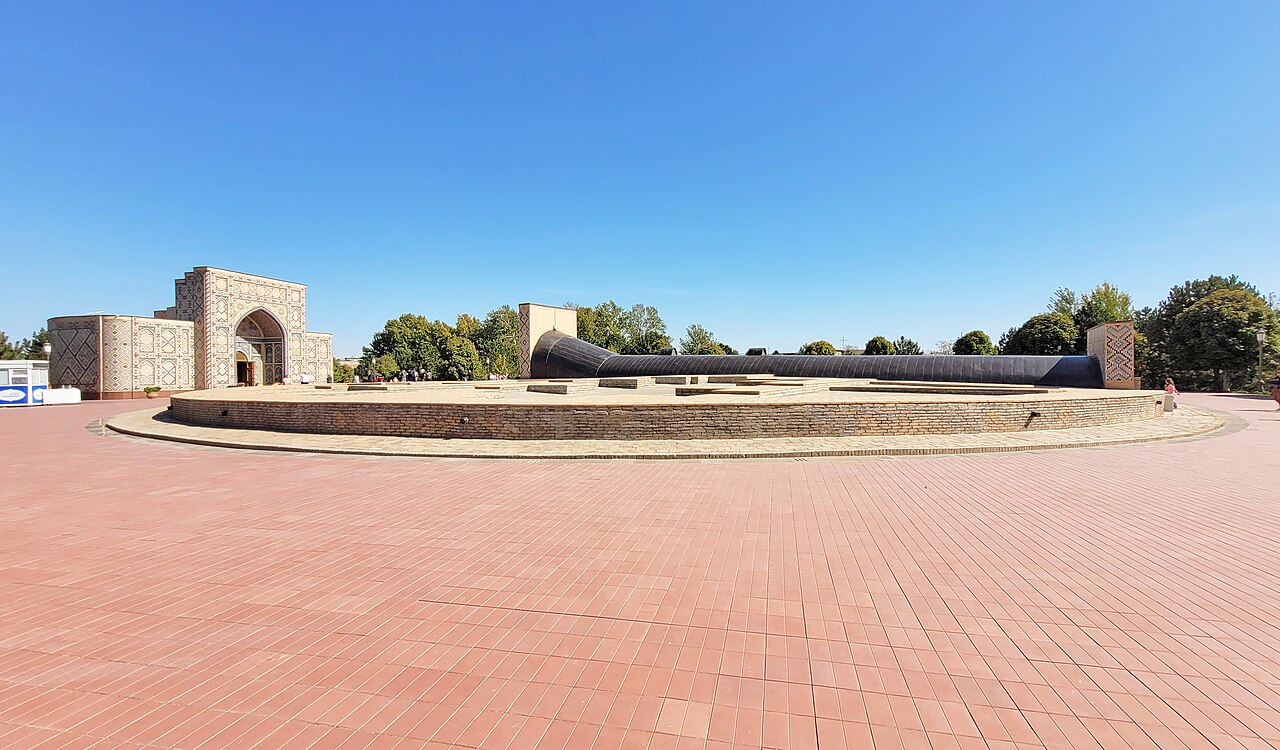
On a low hill on the northern edge of Samarkand, just past the ruins of ancient Afrasiyab, stands one of the most remarkable scientific sites in the medieval world. The Ulugh Beg Observatory was built in the 1420s by a Timurid prince who cared more about the movements of the stars than the movements of armies. What survives today is only a fragment of the original three-storey building, but that fragment is extraordinary: the curved underground track of the Fakhri sextant, an astronomical instrument so large it had to be dug into the bedrock of the hill itself.
For travellers used to the glittering tilework of the Registan and the mausoleums of Shah-i-Zinda, the observatory feels different. It’s quieter, less crowded, and its power lies in the story rather than the decoration. This is the place where astronomers mapped more than a thousand stars with an accuracy that would not be surpassed in Europe for another two hundred years. In this guide the Uzbekistan Wanderer team covers what you actually see on site, who Ulugh Beg was, the museum, and the practical details for fitting the observatory into a Samarkand itinerary.
Who was Ulugh Beg?
Ulugh Beg (1394–1449) was the grandson of Timur, the conqueror who made Samarkand the capital of a vast empire. He came to power as the governor of Samarkand and later ruled as sultan, but he is remembered far more for what he built than for anything he conquered. From a young age he was drawn to mathematics and astronomy, and once in charge of Samarkand he turned the city into a genuine centre of learning, gathering the leading scholars of the age around him.
Alongside the observatory he founded a madrasa on the Registan that still bears his name, where astronomy and mathematics were taught rather than only religious law. Working with astronomers such as Ghiyath al-Din Jamshid al-Kashi and Qadi Zada al-Rumi, and later his student Ali Qushji, Ulugh Beg treated observation and measurement as the heart of science. His story ends unhappily: he was overthrown and assassinated in 1449, reportedly on the orders of his own son, and in the years that followed religious conservatives had the observatory torn down and abandoned. The building vanished so completely that its location was lost for centuries.
The Fakhri sextant: the heart of the observatory
The centrepiece of the site is the Fakhri sextant, and it’s unlike anything else you’ll see in Uzbekistan. The original observatory was a circular three-storey building roughly 46 metres across, and running through the middle of it, aligned precisely along the north–south meridian, was a colossal arc used to measure the height of the Sun, Moon and stars as they crossed the sky.
To achieve accuracy, the astronomers made the instrument enormous. The sextant had a radius of around 40 metres, which made it the largest instrument of its kind ever constructed. The lower part was sunk into a trench cut into the rock of the hill, which kept it perfectly stable and shielded from wind and temperature swings. What you walk down to today is exactly this buried section: two parallel curved marble rails, marked with degrees and minutes, descending into the ground. Standing beside it, it’s easy to grasp how a bigger arc meant finer divisions and therefore more precise readings. This was, in effect, a scientific instrument built at the scale of a piece of architecture.
The rest of the building has not survived, but archaeology has confirmed how sophisticated it was. The foundations were rediscovered in 1908 by the Russian-Uzbek archaeologist Vasily Vyatkin, who was following clues in old land documents that mentioned the observatory’s location. His excavation revealed the intact underground curve of the sextant, and it’s that discovery which made the modern site possible.
The Zij-i Sultani star catalogue
The observatory was not built for its own sake. It existed to produce data, and its great achievement was a set of astronomical tables and a star catalogue known as the Zij-i Sultani, completed in the late 1430s. The catalogue recorded the positions of 1,018 stars, the great majority of them re-measured directly from Samarkand rather than copied from earlier Greek and Arabic sources.
The numbers still impress astronomers. Ulugh Beg and his team calculated the length of the year to within about a minute of the modern value, and measured the tilt of Earth’s axis with striking precision. Their results remained the most accurate produced anywhere until the Danish astronomer Tycho Brahe worked in the late sixteenth century. Copies of the Zij-i Sultani spread across the Islamic world and eventually reached Europe, where it was studied at Oxford in the seventeenth century. When you stand at the site, it helps to remember that the quiet hillside was once the source of the best star data on the planet.
The museum on site
Next to the sextant is a small museum dedicated to Ulugh Beg and his astronomers, and it’s worth the time. The displays walk you through his life, the design of the observatory, and the instruments the team used, with models, illustrations and reproductions of pages from the Zij-i Sultani. There are portraits and murals, some old photographs of Vyatkin’s excavation, and diagrams that make it far easier to picture the original building once you have seen the fragment outside.
The museum is compact and you can see it in twenty to thirty minutes, but reading the panels first genuinely improves the visit. Information at the site itself is limited, so the museum does most of the explaining. If you’re travelling without a guide, budget a little time here before walking down to the sextant so the stone track makes sense.
Tickets, hours and what to expect
The observatory is one of Samarkand’s more affordable major sights, and the whole visit, museum included, usually takes under an hour. The figures below reflect what visitors were reporting in mid-2026, but ticket prices in Uzbekistan are adjusted fairly often, so treat them as a guide rather than a guarantee.
| Detail | Information (last checked: July 2026) |
|---|---|
| Entrance fee | Around 50,000–70,000 UZS per adult (roughly US$4–6) |
| Opening hours | Daily, approximately 08:00–19:00 (some sources list until 20:00) |
| Time needed | 45–60 minutes including the museum |
| Distance from Registan | About 3–4 km, on the northeastern edge of the city |
| Best time to arrive | Early morning or late afternoon to avoid midday heat and coach groups |
A few honest notes. The site is small, and some visitors are surprised that there’s not more to see above ground, so arrive knowing that the sextant and the museum are the whole experience. There’s little shade on the hill, which matters a great deal in the Samarkand summer, so bring water and a hat if you come between June and August. A local guide, or at least a good read beforehand, transforms the visit, because the stones mean little without the story behind them.
How to get to the observatory
The observatory sits on the northeastern side of Samarkand, near the Afrasiyab archaeological area and the Museum of the History of Samarkand, so it pairs naturally with those sites. From the city centre you have a few options.
By taxi or ride app
The simplest way is a taxi. Ride-hailing apps such as Yandex Go and inDrive work well across Samarkand and take about 10–15 minutes from the Registan area, usually for a very modest fare. Using an app is the easiest way to avoid haggling and to get a fair price. For more on moving around the country, see our guide to getting around Uzbekistan.
By public bus
Several city buses pass the observatory, including routes that stop near the site along Tashkent Street. Fares are cheap and paid by card or in cash, but the buses can be crowded and are less convenient if you’re short on time. For most visitors a ride app is the better value once you factor in the walk to and from bus stops.
On foot
It’s possible to walk from the centre in around 45 minutes along a fairly straight road, and the walk takes you past Afrasiyab. In spring or autumn this can be pleasant, but the final approach is uphill and there’s little shade, so we would not recommend it in the heat of summer. Check our advice on the best time to visit Uzbekistan before you plan a walking day.
Combining the observatory with the rest of Samarkand
Because the observatory is compact, it’s best treated as one stop on a broader day rather than a destination in itself. Its location on the northeastern edge of the city means it groups neatly with the Afrasiyab museum and the Shah-i-Zinda necropolis, which are all clustered on the same side of town. A logical half-day is to see Shah-i-Zinda, walk through the Afrasiyab area, and finish at the observatory.
If you have longer, the observatory rounds out the Ulugh Beg story that runs through Samarkand: his madrasa dominates the Registan, and Timur’s family, Ulugh Beg included, lies in the Gur-e-Amir mausoleum across town. Seeing all three in one trip gives you a real sense of the man as both ruler and scientist. For a full picture of the city, our Samarkand travel guide maps out how the sights fit together, and if you’re still shaping your route, the 10-day Uzbekistan itinerary shows where Samarkand sits alongside Bukhara and Khiva.
Frequently Asked Questions
Is the Ulugh Beg Observatory worth visiting?
Yes, if you come for the story rather than for grand architecture. The physical remains are limited to the underground sextant and a small museum, but the site is historically extraordinary and the entry fee is low. Travellers with an interest in science and history tend to find it a highlight, while those expecting more tilework may be underwhelmed.
How long should I spend there?
Plan for about 45 minutes to an hour. That’s enough to read through the museum, walk down to the Fakhri sextant, and take in the views over the city from the hill. It’s not a place where you need to linger, which makes it easy to combine with nearby sights.
How much does it cost to enter?
As of July 2026 the ticket was in the region of 50,000–70,000 UZS per adult, roughly US$4–6. Prices in Uzbekistan change reasonably often, so carry a little cash and expect small variations. A separate charge sometimes applies for photography or for a guide.
Can I visit the observatory and Shah-i-Zinda together?
Yes, and it’s a natural pairing. Both sit on the northeastern side of Samarkand along with the Afrasiyab museum, so a taxi or a short walk links them. Many visitors see all three in a single half-day.
Do I need a guide?
You don’t need one to enter, but the site explains itself poorly and the significance is easy to miss without context. A guide, or reading up beforehand, makes an enormous difference to how much you take away. If you’re visiting independently, spend a few extra minutes in the museum first.
What else is Ulugh Beg known for in Samarkand?
His madrasa on the Registan is one of the three great buildings on that square, and it was a serious centre of scientific teaching in its day. He is also buried in the Gur-e-Amir mausoleum with the rest of Timur’s family. Together with the observatory, these sites trace his life as both a ruler and one of history’s great astronomers.
The Ulugh Beg Observatory is a small site with an outsized place in history. It’s not the most visually spectacular stop in Samarkand, but few places anywhere let you stand beside a genuine piece of world-changing science from six centuries ago. Read a little before you go, pair it with the other Ulugh Beg sights, and it becomes one of the most thought-provoking hours you’ll spend in the city.
Featured image: Bgag (CC0) via Wikimedia Commons.