Three Weeks in Uzbekistan: The Full Country
A 21-day Uzbekistan loop: Fergana, Termez and Boysun, Nuratau homestays, the four Silk Road cities and Nukus, with real train legs and three rest days.

Day 21 finishes at Tashkent airport, off a short hop from Nukus that Flightconnections puts at about 1 hour 20 minutes in the air, with around 14 Uzbekistan Airways departures a week spread from mid-morning to late evening (last checked: September 2026). The last thing you do in the country before that flight is walk round the Savitsky Museum. Everything else in this three-week Uzbekistan itinerary was ordered backward from that one fact.
Here's why. Nukus is the end of the line in the most literal sense. The train from there back to Tashkent runs only a couple of times a week and takes most of a day (timetables currently show roughly 17 to 22 hours depending on the service), so the far west can't sit in the middle of a loop without costing you a day and a half of travel. It has to come last, and a plane has to take you out. Once that's fixed, the rest of the country falls into place behind it: Khiva before Nukus, Bukhara before Khiva, and so on back to the Fergana Valley in week one. Doing it without any road transfers is possible for most of the route; our train-only itinerary shows which stops survive.
This is a route for people with three full weeks inside Uzbekistan and no other country on the ticket. It keeps the four classic cities, adds the Fergana Valley, the deep south around Termez and Boysun, a night in Shakhrisabz, two days walking between Nuratau village homestays, and Karakalpakstan, and it builds in three proper rest days. Train times and fares were last checked in September 2026.
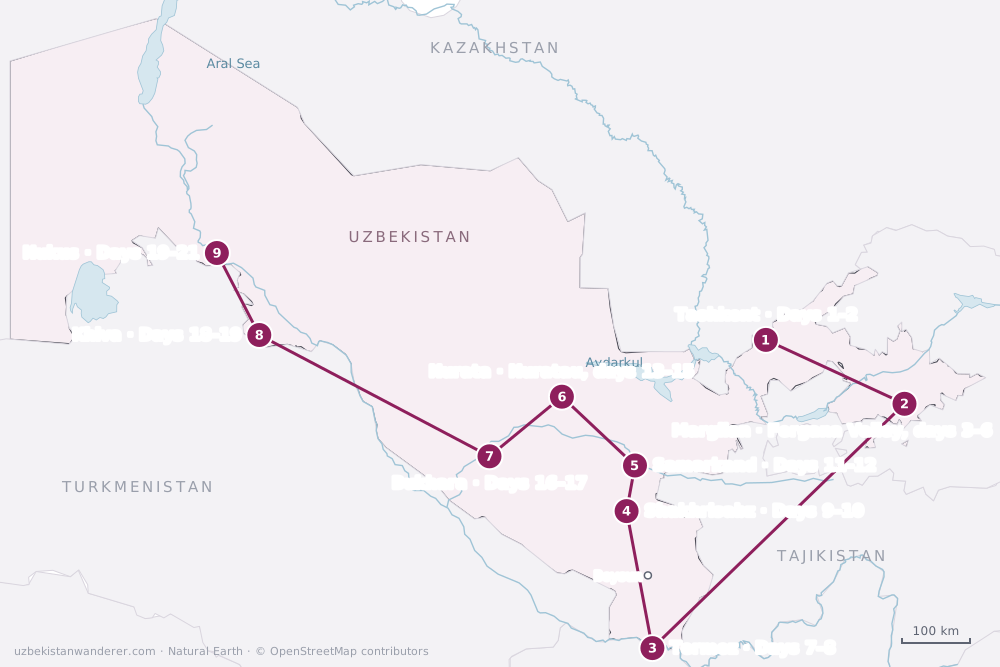
What the extra week actually buys
Our two-week Uzbekistan route already reaches the Fergana Valley, Samarkand, a desert yurt, Bukhara, Khiva and the Aral Sea. So it's fair to ask what seven more days get you. Three things, mainly.
- The south stops being a swap. In the 14-day plan, Termez is offered as an alternative to Nukus. Here you do both, and Surkhandarya becomes a loop rather than an out-and-back: overnight train down, road north through Boysun to Shakhrisabz, then over the pass into Samarkand.
- Walking, not just looking. Two nights in the Nuratau homestays, with a 12 km walk over two passes between villages. Nothing in a two-week plan has room for that.
- Rest days that aren't travel days in disguise. Day 6, day 12 and day 17 carry no must-see list and no daytime transport (day 6 ends on a night train, which you'll be asleep for). On a fortnight you can skip them. Over 21 days you can't, or week three turns into a blur of domes.
Who shouldn't do this? Anyone whose real interest is Timurid architecture and nothing else. If Rishtan pottery, Buddhist stupas and village dinners at 7pm don't appeal, the two-week plan with an extra night in each of Samarkand and Bukhara will make you happier, and it'll cost less.
Why this loop, in this order
Uzbekistan's railway is a spine with branches. The spine runs Tashkent, Samarkand, Navoi, Bukhara, then swings across the Kyzylkum to Urgench and Khiva. The Fergana Valley hangs off Tashkent to the east through the Kamchik tunnel. Termez hangs off the south, reached by a sleeper from Tashkent's southern station. Nukus is the northwestern tip.
Two of those branches (Fergana and Termez) are dead ends by rail, so the trick is doing them in a way that doesn't double back more than once. Fergana goes first because it drops you back in Tashkent, and Tashkent is exactly where the Termez sleeper leaves from. The south goes second because the road north out of Surkhandarya delivers you to Shakhrisabz, which is 90 km from Samarkand. Nuratau sits between Samarkand and Bukhara on the map, with Navoi station at its western end. Then it's the classic westbound run, and out by air.
Could you run it anticlockwise, flying to Nukus first? Yes, and it works. We'd still pick this direction, for a reason that's more practical than it sounds: finishing in the west means your final long journey is an 80-minute flight, not a five-hour train back from Margilan with a bag full of ceramics on the last day before an international departure.
The legs at a glance
| Day | From → to | Mode | Approx. time |
|---|---|---|---|
| 3 | Tashkent → Margilan | Train via Kokand | About 5 h |
| 5 | Kokand → Tashkent | Express train | About 3 h 10 |
| 6–7 | Tashkent (South) → Termez | Overnight sleeper | About 14 h |
| 8 | Termez → Boysun | Hired car | About 3 h |
| 9 | Boysun → Shakhrisabz | Hired car | Half a day |
| 10 | Shakhrisabz → Samarkand | Shared or private taxi over the pass | 1.5–2 h |
| 13 | Samarkand → Hayat (Nuratau) | Taxi via Jizzakh and Bog'don | Most of a day |
| 14 | Hayat → Uhum | On foot | 12 km, about 4 h |
| 15 | Nurata → Navoi → Bukhara | Car, then Afrosiyob | Half a day |
| 18 | Bukhara → Khiva | Jaloliddin Manguberdi | About 3 h 40 |
| 19 | Khiva → Nukus | Shared taxi or transfer | About 3 h |
| 20 | Nukus → Moynaq → Nukus | Hired car or bus | 2.5–3.5 h each way |
| 21 | Nukus → Tashkent | Flight | About 1 h 20 |
Road times are typical rather than promised, and they stretch in summer when drivers stop more. The day numbers assume a Monday arrival, for reasons explained in the booking section at the end.
Week one: Tashkent and the Fergana Valley (days 1–6)
Days 1–2: Tashkent
Land, sleep, buy a SIM. Day 2 is the metro, Chorsu Bazaar and the Hazrati Imam complex, all of it easy and none of it worth rushing. Don't book anything onward for day 2; long-haul arrivals into Tashkent often land in the small hours, and a lost morning is normal.
Days 3–5: Margilan, Rishtan, Kokand
The morning express to Margilan (the station for Fergana city), 730 at 09:20, takes 3 hours 40; slower trains take about five hours, with fares in the rough range of $12 to $18 depending on class. It climbs through the Kamchik pass and the 19 km tunnel under the Kurama range, and if you only look out of one train window in Uzbekistan, make it this one.
Day 4 is a Thursday on this schedule, and that's deliberate: Kumtepa Bazaar outside Margilan trades on Thursdays and Sundays only. Be there by eight, when the ikat rows are three deep, then spend the afternoon at the Yodgorlik silk workshop or drive out to the potters of Rishtan, south-west of Fergana city. Our day-by-day plan for the valley has the entry fees and the order that saves the most driving.
Day 5 is Kokand. See the Khudayar Khan palace (built 1871 and finished around 1873), have lunch, then catch the evening express back to Tashkent. In September 2026 the timetable showed train 729 leaving Kokand at 16:43 and reaching Tashkent at 19:53, for about 213,000 som in its cheapest class (last checked: September 2026). It's a short, comfortable ride, and it means you don't lose a morning.
Day 6: rest day, then a night train
The first rest day ends on a sleeper, which is the best kind. Do laundry. Eat plov at lunch, when it's freshest. Sit in a park. Then go to Tashkent's southern station (Toshkent Janubiy, also listed as Tashkent Yuzhnyy), not the main one; every Termez train leaves from there, and it's the single most common mistake on this route.
Evening departures currently run at around 21:00 and just before midnight, taking roughly 14 hours; fares sit around $17 to $26 depending on berth (last checked: September 2026). Take a kupé berth, a lower one if you can, and bring your own tea and a cup for the carriage samovar.
Week two: the south, Shakhrisabz and Samarkand (days 7–12)
Days 7–8: Termez
The later train reaches Termez in the early afternoon, which leaves enough of day 7 for the archaeological museum. Day 8 morning is for the Kushan-era Buddhist sites with a driver: Fayaz Tepe, the Zurmala stupa, and Kara Tepe if access is open (it has swung between permit-only and a simple fee depending on the month). The Amu Darya riverbank is fenced off, and the UK Foreign Office advises following local instructions near the Afghan border, so carry your passport and expect checks.
After lunch, keep the same driver and head north. Boysun is about three hours up the valley, and the road climbs the whole way.
Timing matters more here than anywhere else on the route. Termez averages around 40°C on July afternoons, so this three-week plan is really a spring or autumn plan; our overview of Uzbekistan's deep south lays out the heat, the border rules and how Denau and Sherabad fit if you want more time down there.
Days 9–10: Boysun to Shakhrisabz, and a night in Timur's town
Boysun is mountain country: juniper, stone villages, and a living oral-epic tradition that UNESCO recognises. A morning is enough for most visitors. The drive on to Shakhrisabz via Guzar takes about half a day; we couldn't find two sources that agree on the time, so allow for it rather than planning an afternoon around it.
Sleeping in Shakhrisabz is the quiet upgrade in this itinerary. Almost everyone else sees it as a day trip from Samarkand, arriving at eleven and leaving at four. You get the Ak-Saray gateway in the evening light and again at breakfast with nobody around. Worth knowing: in July 2025 UNESCO approved in principle Uzbekistan's plan to shrink the World Heritage property to four Timurid monuments; it remains on the Danger List, where it has been since 2016 over the clearance of the old quarter around them, until a full revised dossier is submitted (due 2029).
On day 10, cross the Takhtakaracha pass (around 1,788 m) to Samarkand, 90 km and an hour and a half to two hours by taxi. Ask the driver to stop at the top. They expect it.
Days 11–12: Samarkand
Two days, one of them half-rest. Day 11 is the heavy one: Shah-i-Zinda at opening time before the tour groups, then Gur-e-Amir, the Registan and Bibi-Khanym, with the Registan again after dark. Day 12 is the second rest day with a little sightseeing attached, perhaps Siab Bazaar and the Ulugh Beg observatory in the morning and nothing at all after lunch.
Our honest opinion, which some readers won't share: two days in Samarkand is enough on a trip this long. Three weeks of Uzbekistan gives you so much Timurid tilework elsewhere, at Shakhrisabz before and Bukhara after, that a third Samarkand day mostly means seeing the same buildings again.
Week three: Nuratau, Bukhara, Khiva, Karakalpakstan (days 13–21)
Days 13–15: the Nuratau homestays
This is the stretch that most itineraries don't have, and it's where the country slows down to walking pace. The homestay villages sit in two clusters on the northern flank of the Nuratau range, facing Lake Aydarkul. For this route, use the eastern one: Hayat, Uhum and Asraf in Forish district.
Getting there without a tour takes most of day 13. Local operator Nuratau Travel's own figures give Samarkand to Jizzakh at 40,000 to 50,000 som by bus or shared taxi, then Jizzakh to Forish for under 10,000, then a whole taxi from Bog'don up to the villages for 160,000 to 200,000 som (last checked: September 2026). Homestays are listed at EUR 30 to 35 a night, usually with dinner and breakfast.
Day 14 is the walk: Hayat to Uhum, 12 km and about four hours with a donkey carrying the bags, over the Guzar and Sari Bedak passes. Paths are unmarked, so take the guide for this day. In the afternoon, a car takes you west along the Bog'don–Nurata road to Nurata town for the night. The full village-by-village detail, including the walks we'd skip, is in our Nuratau Mountains walking guide.
On day 15, see the Chashma spring and the fortress mound in Nurata in the morning, then drive to Navoi and catch a midday train to Bukhara. Several Afrosiyob services call at Navoi; check eticket.uzrailpass.uz (the old eticket.railway.uz now redirects there) for the exact times on your date, and if they don't line up, the driver can simply carry on to Bukhara.
What about the yurt camp at Aydarkul? It fits if you trade Nurata town for it, and the camps are on the same steppe. We left it out of the main plan because a yurt night plus a homestay night back to back is a lot of shared bathrooms and thin mattresses in a row, but it's a straight swap.
Days 16–17: Bukhara, with the third rest day
Day 16 is Po-i-Kalyan, the Ark, the trading domes and the Samanid mausoleum, and it's an easy day on foot because the old town is compact. Day 17 is the last rest day. A hammam, a slow lunch at Lyabi-Hauz, maybe the Bolo Hauz mosque in the late afternoon. That's it.
It's tempting to fill it. Don't. The next four days contain a train, two long road legs and a flight, and you'll want to arrive at them rested.
Days 18–19: Khiva, on the new train
This leg changed in May 2026, when the Hyundai Rotem-built Jaloliddin Manguberdi started running Tashkent to Khiva in about seven and a half hours. According to Kun.uz's report on the launch, it leaves Tashkent at 07:00 on Tuesdays, Thursdays and Saturdays and reaches Khiva at 14:31, returning on Wednesdays, Fridays and Sundays. The Seat61 timetable shows it calling at Bukhara at 10:54, which makes Bukhara to Khiva about three hours 40 minutes (last checked: September 2026). Fare listings seen in September 2026 put the full Tashkent–Khiva economy fare at about 780,000 som, with the Bukhara section costing less; the booking site shows the live price for your date.
That three-days-a-week pattern is why day 18 falls on a Thursday. If the train's sold out, the fallback is a shared taxi across the Kyzylkum, six to seven hours, which is dull but reliable.
Arriving at 14:31 gives you the afternoon inside the Ichan-Kala and sunset from the walls. Day 19 morning is for the Islam Khoja minaret and the Kalta Minor before the heat and the day-trippers. Then, after lunch, leave for Nukus. Yes, Khiva gets only about 24 hours in this plan. It's the smallest of the four cities and that's enough for most people; if it isn't, take the night from Boysun and give it to Khiva instead.
Days 19–21: Nukus, Moynaq and the Savitsky
Khiva to Nukus is 209 km of flat scrub, about three hours. A private transfer starts around $80 for a car of up to three people, which for two travellers costs about the same as waiting for a shared taxi to fill (last checked: September 2026).
Day 20 is Moynaq: roughly 200 km north each way, 2.5 to 3.5 hours, with the Mizdakhan necropolis on the road out. A hired car is the sensible option for two or more; the public bus leaves Nukus at about 9am and gives you around three hours on the ground. What you're looking at from the bluff is former seabed. Sources put the water somewhere between 80 and 180 km away, and they genuinely disagree, so treat any single figure you hear with suspicion.
Which brings us back to where we started. Day 21 morning is the Savitsky Museum, its avant-garde paintings collected a very long way from Moscow's censors, and then an afternoon or evening flight to Tashkent. Our Karakalpakstan regional guide covers the wider region if you want to add the Ustyurt plateau, though that needs an extra two days and an operator.
Why the museum last, and not on arrival day? Because Moynaq is the leg most likely to go wrong. A slow driver or a late bus back pushes things, and it's much easier to lose an evening in Nukus than to lose the museum. Putting Savitsky on the final morning keeps day 20 flexible.
It won't stay this way for long. Zamin.uz reported on 19 September 2026 that a high-speed Tashkent–Nukus service is planned from March 2027, cutting the rail journey to about seven hours. Until it actually runs, fly.
What we cut, and what you could swap
Three weeks sounds like enough for everything. It isn't. Left out on purpose:
- Chimgan and Charvak, the mountains 90 minutes from Tashkent. Swap them in for day 6 if you'd rather have a day out than a rest.
- Andijan and Namangan, at the eastern end of the valley. Good for anyone crossing into Kyrgyzstan; a detour otherwise.
- The desert fortresses of ancient Khorezm across the Amu Darya from Khiva. They'd take the second Khiva day we didn't give you.
- Denau and Sherabad in Surkhandarya, which need their own two days.
If you only swap one thing, swap Termez and Boysun for the Khorezm fortresses plus a second Khiva night. You lose the most unusual week of the trip and gain an easier one. Neither choice is wrong.
When to go
April to early June, or mid-September to October. The route runs from Termez, the hottest town in the country, to the Nuratau passes, which bake by mid-morning in August, and ends on a desert road to the Aral. Summer punishes three different stretches of it.
May has a bonus in Nuratau: silkworm trays in the houses and full streams on the Hayat–Uhum walk. October brings the walnut harvest there and the cotton harvest in the Fergana Valley, plus cooler nights in Karakalpakstan. Winter doesn't really work. The Takhtakaracha pass can close with snow between December and March, and the Nuratau homestays are a much colder proposition.
Book in this order
The whole route pivots on one train that runs three days a week, so book backward from it, the same way the route was built.
- First: the Jaloliddin Manguberdi, Bukhara to Khiva. Pick a Tuesday, Thursday or Saturday, then count back 17 days to find your arrival date. A Thursday train means a Monday arrival, and that Monday start also puts day 4 on a Thursday for Kumtepa Bazaar. Seat61 reports tickets opening 60 days ahead; some older write-ups, including a few of ours, say 45, because the window has moved (last checked: September 2026). Check the date eticket.uzrailpass.uz offers and book the moment it opens.
- Second: the Nukus–Tashkent flight on uzairways.com, timed so you land at least four or five hours before your international departure.
- Third: the Termez sleeper and the Tashkent–Margilan and Kokand–Tashkent trains. These rarely sell out outside the holidays, but they're cheap and it's one less thing.
- Fourth: the Nuratau homestays, by email or through the office in Bog'don, so the hosts know you're coming.
- Last: the Afrosiyob from Navoi and all the drivers, which can wait until you're in the country.
For everything else on the trains, including the classes, the sleeper etiquette and what happens when a foreign card is refused, our complete guide to Uzbekistan's railways covers the booking site screen by screen. Do the first two bookings today if your dates are fixed. The other eighteen days of this route are flexible; those two aren't.