Termez Travel Guide: Uzbekistan’s Buddhist South
Termez, on the Afghan border, holds Uzbekistan’s richest Buddhist heritage. Our guide to Fayaz Tepe, the sites, transport and sensitivity tips.

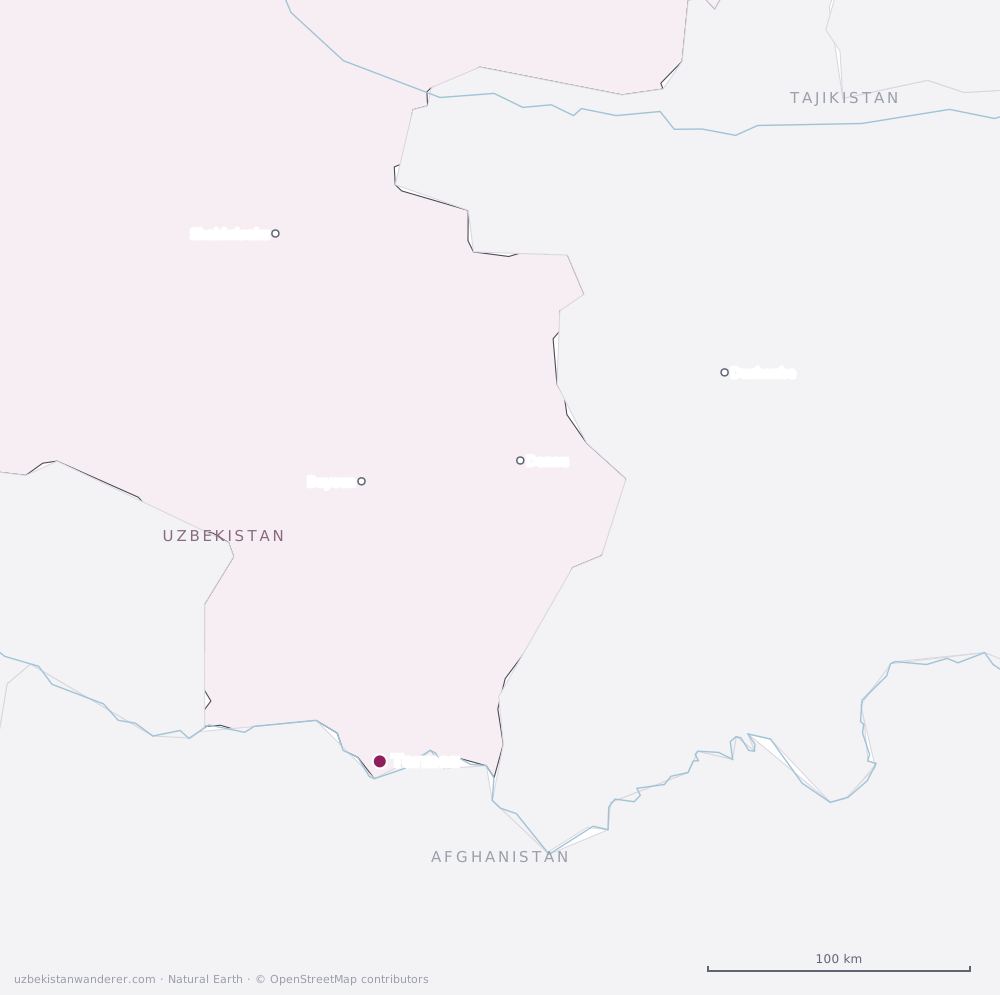
Almost nobody goes south. The standard Uzbekistan route runs Khiva, Bukhara and Samarkand, and stops there. Termez sits about as far south as you can go, pressed against the Amu Darya and the Afghan border, and it rewards the detour with something the Silk Road cities can’t offer: standing Buddhist monuments from a time before Islam reached Central Asia. This is where Bactria met the Kushan Empire, where monks carved cells into riverbank cliffs, and where a two-thousand-year-old stupa still holds its ground. If you want Uzbekistan without the crowds, Termez is the deep end. Here is how to visit it properly.
Why Termez is different
Termez is the capital of the Surkhandarya region and one of the oldest continuously settled places in the country, with roots going back more than two millennia. Before Islam, this stretch of the Amu Darya valley was part of ancient Bactria and later a heartland of the Kushan Empire, a crossroads where Greek, Indian, Persian and Chinese influences met. Buddhism flourished here for centuries, leaving monasteries and stupas that predate almost everything you’ll see further north. When Islam arrived, Termez became an important religious centre in its own right, producing scholars whose mausoleums still draw pilgrims. That layered past is exactly what makes the city worth the long journey. For the wider context of these trade routes, our Silk Road history guide sets the scene.
Termez is also a genuine border town. The Friendship Bridge across the Amu Darya links Uzbekistan to Afghanistan, and the frontier shapes daily life here in ways that matter for visitors, from checkpoints to photography rules. We cover the practicalities and sensitivities further down, because getting them right is the difference between a smooth trip and an awkward one.
The Buddhist sites
These are the reason to come. Nowhere else in Uzbekistan can you stand inside a Kushan-era Buddhist monastery, and the three main sites sit within a short drive of the city. The Buddhist sites guide goes through each one in detail, with the order to visit them in; what follows is the short version.
Fayaz Tepe
The most complete of the group: a monastery and stupa complex from around the 1st to 3rd centuries CE, with monks’ cells, courtyards and a refectory laid out clearly, and the original stupa sheltered under a modern dome. Entry was 30,000 som in an October 2023 visitor report, paid to the guard on site (last checked: September 2026).
Kara Tepe
A cave-and-surface monastery cut into the sandstone above the river, about half a kilometre from Fayaz Tepe and right against the Afghan border. Access has varied: older accounts describe a border-zone permit that took days or weeks to arrange, but since 2024 travellers on the Caravanistan forum report walking in after paying about 40,000 som to the guard at Fayaz Tepe, and 2025–26 posts describe local guides including it in a standard day tour. Don’t photograph towards the river, and ask at the Archaeological Museum before you go, since rules in a border zone can tighten again (last checked: September 2026).
Zurmala stupa
A 13–16-metre core of mud brick near the Old Termez site, about 10–12 km west of the modern city: the remains of a 1st–2nd century stupa and one of the oldest standing Buddhist structures in Uzbekistan. There’s little signage, and when archaeologists are digging it may be closed to walk-in visitors.
Kyrk-Kyz and Kampyr Tepe
Two more ruins usually go on a Termez day tour. Kyrk-Kyz, on the edge of the city, is a large square mud-brick building from the early Islamic centuries; a 2023 visitor found it undergoing heavy restoration and described it as essentially one big building, so it’s worth a stop on the way past rather than a trip of its own. Kampyr Tepe, a fortified Greco-Bactrian town on the Amu Darya sometimes linked with Alexandria on the Oxus, is further out, about 50–60 minutes’ drive west of Termez. The same visitor thought it interesting but not worth the time and money if you’re in a rush.
Kampyr Tepe: the Alexandria-on-Oxus question
Kampyr Tepe (Kampirtepa in Uzbek) lies about 30 km from Termez on the right bank of the Amu Darya, the river the Greeks called the Oxus. The national tourism portal, uzbekistan.travel, describes three phases of life here: a Hellenistic foundation in the late 4th century BCE, a Kushan-Yuezhi stage, and a peak under the Kushans in the 1st and 2nd centuries CE, roughly five hundred years in all. The layout described by the excavators is a citadel ringed by a moat, a lower town behind a towered wall and an unfortified suburb; burials and the remains of a Buddhist shrine have also been found. Most of it has been excavated and only a stretch of the citadel wall has been rebuilt, so the walls and street lines are mostly low and earth-coloured.
The famous claim is that this is Alexandria on the Oxus, a city named in ancient sources but never pinned down. The case was made by a team led by academician Edvard Rtveladze and was due to be presented at an international archaeological forum in Termez in August 2019, as UzDaily reported beforehand. Treat it as a strong argument from the excavator, not a settled fact. Ai Khanoum, in north-eastern Afghanistan, is the other long-standing candidate, and Caravanistan sums it up fairly: the evidence now leans towards Kampyr Tepe, without closing the debate.
Access is simpler than it used to be. The site was off limits for years because it sits right on the border; Caravanistan’s page says it can be visited again and that entry was free when it was written (2020). There is no public transport, so you need a driver. A 2023 traveller on the Caravanistan forum paid $40 for two people for the trip, combined with a distant look at the Afghan border bridge, with a homestay driver, and a 2025 post had it inside a $50 full-day guided tour. No separate permit is mentioned in these recent reports, but this is a border strip: keep your passport on you, and point your camera at the ruins, never at the river and the watchtowers beyond it (last checked: October 2026).
Seeing the Afghan border
You can’t walk up to the Friendship Bridge. Visitors who have tried report that guards turn cars around on the approach road about a kilometre short of it, and that drivers know other points where it can be seen from a distance. The river is visible from Kara Tepe and the Old Termez walls too, with military watchtowers along it. Treat all of it as look-but-don’t-photograph.
The Islamic monuments
Termez didn’t stop mattering when Buddhism faded. Two complexes in particular show the city’s later role as a centre of Islamic learning and dynastic power.
Al-Hakim al-Termizi Mausoleum
Set on the riverbank near the old walls of Termez, this complex honours Abu Abdullah Muhammad al-Hakim al-Termizi, a 9th-century Islamic scholar, mystic and prolific author regarded as a founding figure of a Sufi tradition. The site grew over centuries, from roughly the 10th to the 15th, and now includes the mausoleum itself along with a mosque, a guesthouse and cells for pilgrims. The finely carved marble cenotaph you might expect to see was moved to the Termez museum for protection; a modern replica sits in its place. It remains an active pilgrimage site, so visit with the respect you would give any working shrine.
Who was he? The Islamic scholar Bernd Radtke, in a study for the Ibn Arabi Society, places his birth around 820 in Tirmidh, as Termez was then called, and his death somewhere between 905 and 910. The national tourism portal and several travel guides put his death in the late 9th century instead (869 is the year often quoted), so dates on signboards may not match. He came from a family of religious scholars, made the pilgrimage to Mecca at about thirty, and afterwards turned to mysticism and wrote prolifically. His best-known book, now usually called the Sirat al-awliya (also known as Khatm al-awliya, “the seal of the friends of God”), deals with sainthood, and Ibn Arabi later wrote commentaries on it. “Hakim” is a title meaning “the wise”. Locally he is known as Termiz-ota, the father of Termez, according to the tourism portal’s page on the shrine.
The buildings came in layers. Caravanistan’s guide dates the mausoleum to the 10th century, the mosque to the 12th and the khanaka to the Timurid 15th century, when Shah Rukh added the carved marble tombstone. Underground cells in the compound are described as Sufi meditation retreats, and a 2023 forum visitor mentioned them too.
Pilgrimage etiquette at the al-Hakim shrine
- Expect crowds of local pilgrims at weekends; weekday mornings are quieter.
- On Wednesdays at lunchtime, pilgrims have traditionally cooked mutton in big cauldrons in the communal kitchen, and foreign visitors are often offered a bowl. Accept or decline politely; both are fine.
- Cover shoulders and knees, whatever your gender. Women should carry a scarf for the prayer spaces. Shoes come off wherever there is carpet.
- You will see people praying with open palms at the tomb, touching the railings or sitting in silence. Don’t photograph them without asking, and don’t walk in front of someone praying.
- The complex sits close to the Amu Darya and the border. Photograph the buildings, not the river.
Caravanistan listed a small entry charge in 2021 (13,000 som then); check the current amount at the gate. The general rules for visiting working sites are in our guide to Uzbekistan’s working mosques and shrines.
Sultan Saodat complex
Sultan Saodat is the grandest ensemble in Termez, a long courtyard lined with some seventeen mausoleums that formed the family necropolis of the Termez sayyids, a dynasty claiming descent from Ali whose power peaked in the 13th and 14th centuries. Built up in stages between roughly the 10th or 11th and the 17th centuries, the complex layers mausoleums, mosques and a khanaka along its perimeter, so a slow walk through it doubles as a walk through several hundred years of architectural style. It photographs beautifully in low light and is usually far quieter than the equivalent monuments in Samarkand.
The dates depend on whom you read, and the published accounts genuinely disagree. Orexca puts the main tomb in the 10th century and the last burials in the 17th; another detailed site history dates the two oldest domed mausoleums to the 11th or 12th century and the whole ensemble to the 11th–17th. The family story is more consistent. The founder of the line is taken to be Sayyid Hasan al-Amir, described by Orexca as a fifth-generation descendant of the Prophet through Fatima and Ali, said to lie in the main tomb. At the core are two square domed mausoleums with a passage between them; a tall iwan was raised in front in the 15th century, and in the second half of that century more tombs were added alongside. Later generations kept building next to their predecessors, which is why the courtyard reads like a street of tombs.
The sayyids mattered because descent from the Prophet carried religious prestige, and in Termez it came with real local power. Their necropolis is still a pilgrimage site, not a museum, so the same courtesies apply as at the al-Hakim shrine. It lies on the north-eastern edge of the city, and a 2023 forum visitor found a newer mosque next door worth a look too.
Termez Archaeological Museum
Make this your first stop. The Archaeological Museum of Termez is one of the best regional museums in the country and the key to understanding everything else you’ll see. Its galleries run from Bronze Age ceramics through the Greco-Bactrian and Alexander the Great periods to a superb collection of 3rd- and 4th-century Buddhist sculpture and painting recovered from the sites around town. Several standout objects, including the original cenotaph from the al-Hakim al-Termizi complex, live here for safekeeping. Spend an hour or two absorbing the timeline, and the ruined stupas outside will suddenly make sense. It’s also the practical hub for your visit: staff here are the people to ask about current access to Kara Tepe and other border-adjacent sites.
How to get to Termez
By air
Flying is by far the easiest option. Uzbekistan Airways operates direct flights from Tashkent to Termez International Airport, turning a long overland haul into a short hop of roughly an hour and a half. If your time is limited, this is the way to do it; book ahead, as seats on this route are finite and fill up. From the airport, local minibuses and taxis run into the city centre. Booking through the airline directly or a reputable agent avoids the markup you sometimes see on third-party sites.
By train
Overnight trains from Tashkent run daily, typically with two evening departures from Tashkent South, and take about fourteen hours (last checked: September 2026). It’s a slow but genuinely scenic way to reach the south, and a sleeper berth doubles as your accommodation for the night. The line runs via Samarkand and Karshi, so you can also board the same night trains at Samarkand: one 2023 traveller left Samarkand around midnight and reached Termez at 9:40. Tickets are best bought in advance through the official Uzbekistan Railways e-ticket platform at eticket.uzrailpass.uz, where tickets open about 60 days ahead and the current timetable is listed. Berth classes and what to expect overnight are covered in the night trains guide, and the rest of the country’s transport in the transport overview.
By road
Shared taxis and long-distance cars connect Termez with Samarkand and Bukhara, typically breaking the journey at Karshi. The drive crosses some dramatic mountain country but is long, so most independent travellers only choose it if they want to see the landscape or can’t get a flight. If you do drive, allow the best part of a day from Samarkand.
How many days do you need?
Two full days covers it. That gives you one day for the museum and the Buddhist sites (Fayaz Tepe, Zurmala and, if access allows, Kara Tepe) and a second for the Islamic monuments, the al-Hakim al-Termizi shrine, Sultan Saodat and a look toward the Friendship Bridge and the river. If you’re flying in and out, you could compress the highlights into a single very full day, but the sites are spread out and the pace is more pleasant with room to breathe. Local guides who drive visitors round the main sites charged about $50 for a full day in 2025 and 2026 forum reports, and one August 2026 group started at 6am to finish before the heat (47°C that day). If you’re deciding whether the south earns its place against the classic cities, the nationwide shortlist is a useful comparison.
Practical and sensitivity tips
Termez is safe and welcoming, but its border location calls for a little extra care. A few things to keep in mind:
- Don’t photograph the Friendship Bridge, the Amu Darya frontier, military posts or checkpoints. This is a live international border and cameras pointed the wrong way cause real problems.
- Carry your passport at all times. You may pass through checkpoints around the city, and registration slips from your accommodation are worth keeping.
- Confirm Kara Tepe access at the Archaeological Museum before travelling out to it. Recent reports say it’s open via the Fayaz Tepe guard, but border-zone rules can change.
- The south is hot. Summer temperatures are punishing, so spring and autumn are far more comfortable for wandering open archaeological sites with little shade.
- Dress modestly at the al-Hakim al-Termizi shrine and other religious sites, as these are active places of worship, not just monuments.
- Accommodation is limited compared with the tourist cities, so book ahead. Budget options mentioned in recent traveller reports include the Admiral Hotel (about $25 in 2025, with mixed reviews in 2026) and a family-run homestay popular with backpackers (about $20 for a private room in 2023); the country-wide accommodation guide explains how to judge guesthouses versus hotels.
Termez at a glance
| Detail | Information |
|---|---|
| Region | Surkhandarya, southern Uzbekistan |
| Best for | Buddhist heritage, off-the-beaten-path history |
| Getting there | Direct flight from Tashkent (~1.5 hrs) or daily overnight train (~14 hrs) |
| Suggested stay | 2 full days |
| Best season | Spring or autumn (summers are extremely hot) |
| Key sites | Fayaz Tepe, Zurmala, Kara Tepe, Sultan Saodat, al-Hakim al-Termizi, museum |
| Watch out for | Border photography rules; Kara Tepe access can change |
Frequently Asked Questions
Is Termez safe to visit?
Yes. Despite sitting on the Afghan border, the city itself is calm, and visitors are a rarity rather than a target. The main thing that separates it from elsewhere in Uzbekistan is the frontier presence: expect checkpoints, carry your passport, and never photograph the border, the bridge or any military installation. Follow those rules and a trip to Termez is straightforward.
Can I visit Kara Tepe?
Usually, on recent evidence. Kara Tepe lies directly against the border and used to need a permit arranged in advance, but since 2024 visitors report paying about 40,000 som to the guard at Fayaz Tepe and walking in (last checked: September 2026). It can still be closed at short notice. Ask at the Termez Archaeological Museum for the current situation before you head out, and have a flexible plan in case it’s closed on the day.
How do I get from Samarkand to Termez?
By night train: the Tashkent–Termez sleepers run via Samarkand, leaving there around midnight and arriving in Termez the next morning (check current times on eticket.uzrailpass.uz). The alternatives are a shared taxi or private car (a long drive via Karshi, most of a day) or backtracking to fly. Many travellers find it simplest to fly from Tashkent, since the direct flight there takes only about an hour and a half. If you’re already in the south, road transport via Karshi is the practical link.
What is the best time of year to go?
Spring (roughly April to May) and autumn (September to October) are ideal. Termez is one of the hottest places in Uzbekistan, and its archaeological sites offer almost no shade, so midsummer visits are genuinely uncomfortable. Cooler months let you explore the open ruins at a relaxed pace.
Is Termez worth the detour?
If you have a specific interest in Buddhist history, ancient Bactria or simply seeing an Uzbekistan almost no tour groups reach, absolutely. If your trip is short and focused on the classic Silk Road cities, Termez is a harder sell purely because of the distance. It’s a destination for travellers who value depth and rarity over convenience.
The bottom line
Termez asks more of you than Samarkand or Bukhara, a longer journey, a border to respect, sites that occasionally close without warning. In return you get the only Kushan-era Buddhist monasteries in the country, a first-rate archaeological museum and two major Islamic shrines, with very few other visitors. Two days, a night train each way or a flight, and a driver for the ruins is all it takes.