Ninety kilometres south of Samarkand, over a mountain pass and down into a green valley, sits the town where Amir Timur was born in 1336. Shakhrisabz, meaning “green city” in Persian, was Timur’s home turf, and he lavished it with monuments meant to rival anything in his imperial capital. Much of what he built is now ruined or gone, but what survives is genuinely worth the drive: the shattered, sky-high gateway of a palace so ambitious it was never fully finished, and a scatter of mosques and mausoleums that feel far quieter than the crowds at the Registan.
Most travellers do Shakhrisabz as a day trip from Samarkand, and that is the right call. The sights cluster together and can be seen in two or three unhurried hours, so the town works best as a half-day add-on rather than an overnight stop. Below we cover the monuments in the order you will likely walk them, how to get there over the Takhtakaracha Pass, what it costs, and how to fit it into a wider trip.
One honest note before you go: Shakhrisabz has been on UNESCO’s List of World Heritage in Danger since 2016, after a wave of demolition and modern construction cleared out much of the old medieval quarter to make way for a landscaped tourist park. The monuments themselves stand, but the historic streetscape that once connected them is largely gone. Knowing that changes how the place reads: you are visiting islands of Timurid grandeur set in a modern civic park, not a living old town.
Ak-Saray Palace: the White Palace ruins
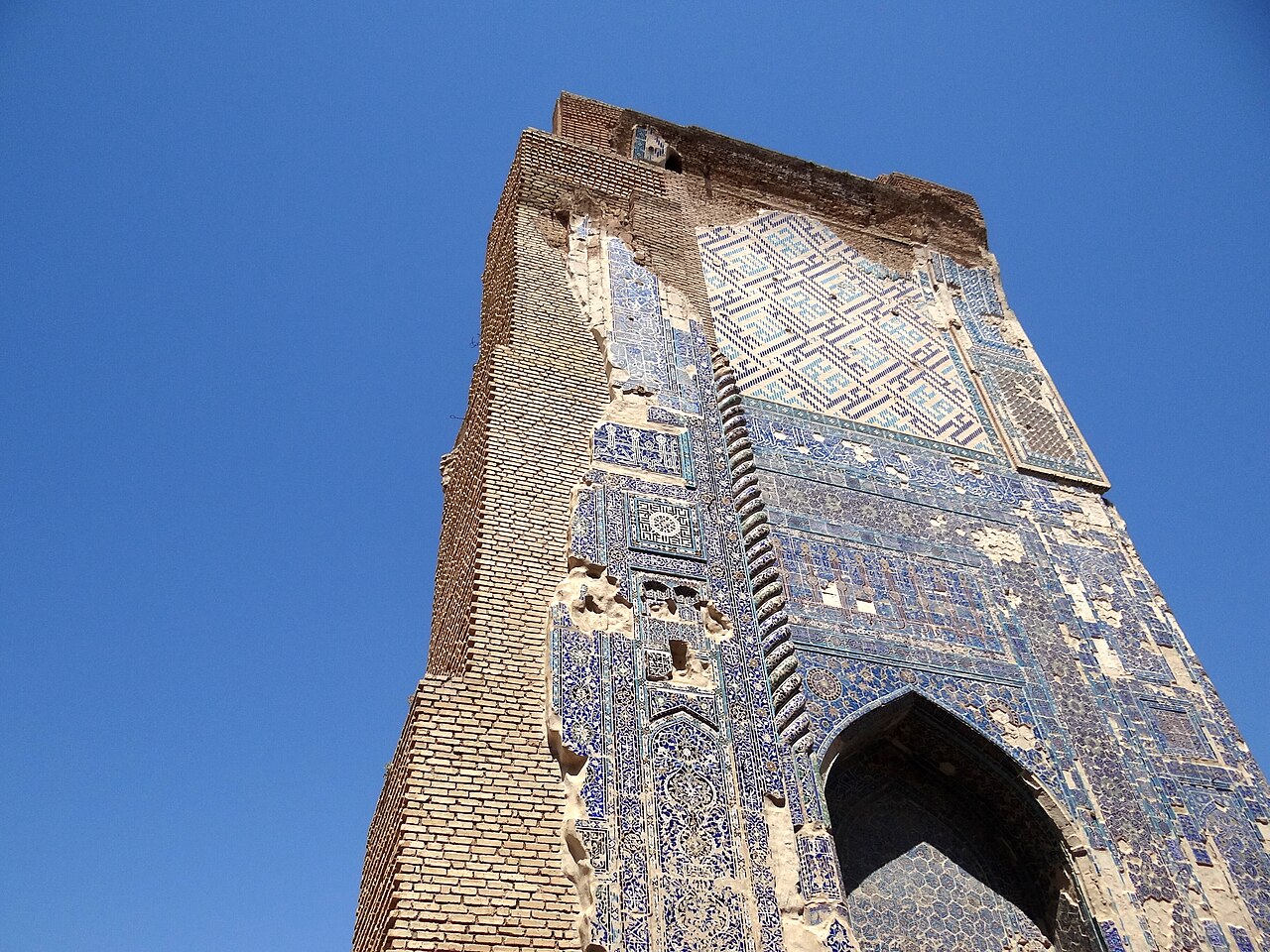
Ak-Saray, the “White Palace,” is the reason most people come. Timur ordered it built between 1380 and roughly 1404, intending it to be the grandest palace in his empire. What remains today are the two colossal flanking towers of the entrance portal, still soaring around 38 metres and covered in the intricate blue, white and gold mosaic tilework that was the Timurid signature. The gap between them, now open sky, was once a single arch; at full height the portal is thought to have reached 65 metres or more. An inscription on the palace reportedly read, in effect, that anyone doubting Timur’s power should look upon what he had built.
The scale is the whole point. Stand beneath the towers and the ambition of the man becomes physical in a way it rarely does at the more polished, restored sites elsewhere. Because the ruin is fragmentary, it also photographs beautifully, and there is a large statue of Timur in the park in front for the obligatory frame. Give yourself 30 to 45 minutes here.
Dorut Tilovat complex and Kok Gumbaz Mosque
A short walk south from the palace, at the far end of the central park, sits the Dorut Tilovat complex, meaning roughly “House of Meditation” or “House of Reflection.” This was a religious and educational heart of old Shakhrisabz and it still functions as a place of worship.
Kok Gumbaz Mosque
The dominant building here is Kok Gumbaz, the “Blue Dome” mosque, built in 1437 by Timur’s grandson, the astronomer-king Ulugh Beg, in honour of his own father Shah Rukh. Its wide turquoise dome and calm, tiled interior are the reason the complex is worth stepping into. It remains an active Friday mosque, so dress modestly and be respectful of anyone praying.
The mausoleums
Behind and beside the mosque are two mausoleums that form part of the same complex: the Gumbazi Seyidan (“Dome of the Sayyids”), a burial place for Ulugh Beg’s descendants, and the older Shamseddin Kulyal mausoleum, holding the tomb of a Sufi teacher who was spiritual mentor to Timur’s father. The tilework inside Gumbazi Seyidan is some of the finest small-scale decoration in town and easy to miss if you only glance at the mosque.
Dorus Saodat complex and the tomb of Jehangir
East of Kok Gumbaz stands the Dorus Saodat, the “Seat of Power and Might,” the dynastic mausoleum complex Timur built for his family. Its towering portal, though only a fragment of the original, hints at how enormous the complex once was. The most affecting part is the tomb of Jehangir, Timur’s eldest and favourite son, who died young; Timur reportedly intended to be buried here himself.
He never was. When Timur died in 1405 the pass to Shakhrisabz was snowbound, and he was instead laid to rest in the Gur-e-Amir in Samarkand. Nearby, reached by a short staircase, is a crypt containing a stone sarcophagus long believed to have been prepared for Timur, discovered empty in the 1940s. It is a quiet, slightly sombre counterpoint to the bombast of the palace, and a fitting note to end a walk through his hometown. To understand how these Timurid monuments fit into the wider story of the region, our overview of Silk Road history in Uzbekistan is a useful companion read.
How to get to Shakhrisabz from Samarkand
Shakhrisabz sits about 90 km south of Samarkand, but the road crosses the Takhtakaracha Pass (roughly 1,675 m), so the drive is slower and more scenic than the distance suggests. Count on 1.5 to 2 hours each way depending on traffic and how many switchbacks your driver enjoys. The mountain crossing, with its roadside stalls and valley views, is part of the appeal. Your realistic options:
- Shared taxi — the cheapest route. Cars fill up at informal ranks near the Registan or around Siyob Bazaar and cost only a few dollars per seat each way. The catch is the return: finding a shared taxi back from Shakhrisabz can be slow, and you may end up negotiating a private ride home.
- Private taxi / hired driver — the most popular independent choice. Agree a round-trip fare in advance (commonly in the region of $30–50 for the car, negotiable) and confirm the driver will wait while you tour the sights. This removes all the return-journey stress.
- Organised day tour — the easiest but priciest option, typically running 6–7 hours with a guide, pick-up at your hotel or the Registan, and historical context included. Expect to pay considerably more per person than a private taxi.
For a fuller breakdown of taxis, trains and shared rides across the country, see our guide to getting around Uzbekistan. Whichever way you go, agree the price before you set off and carry small som notes for the day.
Fees, timing and how to plan your visit
Entrance fees are modest and paid in Uzbek som at each site. Ak-Saray Palace charges roughly 20,000–40,000 UZS (about $2–3); the mosque and mausoleum complexes are often free, a small donation, or a similarly low ticket. Prices drift year to year and drop in low season, so treat these as a guide rather than gospel (last checked: July 2026).
| Detail | What to expect |
|---|---|
| Distance from Samarkand | ~90 km south, over Takhtakaracha Pass |
| Travel time | 1.5–2 hours each way |
| Ak-Saray entrance | ~20,000–40,000 UZS (about $2–3) |
| Other sites | Free, donation, or a small ticket |
| Time needed on site | 2–3 hours for all monuments |
| UNESCO status | Inscribed 2000; “in danger” since 2016 |
The monuments all lie within, or at either end of, one long central park, so touring is done on foot and is flat and easy. Two to three hours covers everything comfortably; add time if you want to linger over the tilework or stop for lunch. If you leave Samarkand mid-morning you will be back in the city by late afternoon, which is why Shakhrisabz slots so neatly into a longer trip. On a classic 10-day Uzbekistan itinerary it pairs well with your Samarkand days, and it earns its place among the country’s best things to do for anyone drawn to the Timur story.
Practical tips
- Start early. Beat both the midday heat and the tour-bus arrivals, and you will have the palace ruins largely to yourself.
- Carry cash in som. Fees, snacks and drivers all expect small notes; there is no reliable card infrastructure at the sites.
- Dress modestly. Kok Gumbaz is a working mosque; cover shoulders and knees, and women may want a scarf to hand.
- Wear comfortable shoes. Surfaces around the ruins are uneven, and you will cover the length of the park and back on foot.
- Sort your return ride first. If you came by shared taxi, ask your driver about getting back, or budget for a private return rather than assuming a car will be waiting.
- Set expectations. This is a compact collection of great monuments in a modern park, not a warren of old streets. Come for the Timurid architecture and the story, not an intact medieval town.
Frequently Asked Questions
Is Shakhrisabz worth a day trip from Samarkand?
Yes, if you are interested in Timur and Timurid architecture. The ruined Ak-Saray gateway alone justifies the drive, and the town is far quieter than Samarkand. If your time in Uzbekistan is very tight, though, and you have already seen the Registan, Gur-e-Amir and Bibi-Khanym, Shakhrisabz is a reasonable thing to skip.
How long do you need in Shakhrisabz?
Two to three hours on the ground is plenty to see Ak-Saray, Dorut Tilovat with Kok Gumbaz, and Dorus Saodat at a relaxed pace. Including 1.5–2 hours of driving each way, the whole outing runs about six to seven hours door to door from Samarkand.
Why is Shakhrisabz on the UNESCO danger list?
It was added in 2016 after large-scale demolition of the historic medieval quarter and the construction of modern tourist infrastructure, hotels and a park, which UNESCO judged to have caused irreversible damage to the site’s character. The monuments survive, but much of the surrounding old town does not, and the site remained on the danger list at the most recent committee reviews (last checked: July 2026).
Can you get to Shakhrisabz by train?
There is a rail line, but for a day trip from Samarkand road transport is far more practical: schedules are limited and the station is not central. Nearly everyone visits by taxi or organised tour over the Takhtakaracha Pass instead.
Is Timur actually buried in Shakhrisabz?
No. He built the Dorus Saodat complex as his family mausoleum and prepared a crypt for himself here, but when he died in 1405 the mountain pass was blocked by snow and he was buried instead in the Gur-e-Amir in Samarkand. His son Jehangir is entombed in Shakhrisabz, and an empty sarcophagus prepared for Timur was found in the crypt.
What should I combine Shakhrisabz with?
Because it is a half-day trip, Shakhrisabz pairs most naturally with your Samarkand sightseeing. Do your main Samarkand sights across two or three days and slot Shakhrisabz in as a change of pace, ideally before moving on to Bukhara.
Shakhrisabz rewards travellers who come for the story as much as the stones. Timur reshaped Central Asia from the saddle, but this quiet valley is where he began, and the fractured towers of Ak-Saray still carry the outsized ambition of the man better than almost anywhere else. Go early, keep your expectations honest, and let the scale of what he tried to build do the rest.
Featured image: Adam Jones from Kelowna, BC, Canada (CC BY-SA 2.0) via Wikimedia Commons.