Three days in Uzbekistan sounds like too little, and if you try to spread it across Tashkent, Samarkand and Bukhara it is. Spent in one place, it is a genuinely satisfying trip. Samarkand is the obvious choice: it holds the country’s most famous monuments within a compact, walkable core, it now has direct international flights, and it is close enough to two or three excellent day trips that the third day can go somewhere else entirely.
This itinerary is written for the long-weekend traveller — someone flying in from Istanbul, Dubai, Almaty or Moscow, or tacking a few days onto a work trip in Tashkent. It assumes two nights minimum, ideally three, and it does not ask you to change hotels once. Two days cover Samarkand’s Timurid core properly; the third is yours to spend on Shakhrisabz, the Urgut bazaar, the Konigil paper mill, or simply doing Samarkand again more slowly.
We have flagged the volatile details — fares, opening hours, entry prices — with the date we last checked them. If you find you can stretch to five days, our 5-day Uzbekistan itinerary adds Bukhara, and the 7-day plan adds Khiva.
Why Samarkand, and not Tashkent or Bukhara?
Tashkent is the easiest city to reach but the least rewarding to look at; it is a capital of parks, Soviet planning and good restaurants rather than monuments. Bukhara is the more atmospheric old town and a defensible alternative if you want one intact medieval quarter rather than a set of showpieces — our Samarkand versus Bukhara comparison makes that case honestly.
But for a first, very short visit, Samarkand wins on density and on impact. The Registan, Gur-e-Amir, Shah-i-Zinda, Bibi-Khanym and the Ulugh Beg Observatory sit within a few kilometres of each other, and UNESCO lists the whole city as Samarkand – Crossroads of Cultures. If you only ever see one Uzbek city, it should be this one.
The three-day plan at a glance
| Day | Morning | Afternoon | Evening |
|---|---|---|---|
| 1 | Arrive, settle in | Registan, Gur-e-Amir | Registan floodlit, dinner in the old town |
| 2 | Shah-i-Zinda at opening, Ulugh Beg Observatory | Bibi-Khanym, Siyob Bazaar, Afrosiyob Museum | Hazrat Khizr terrace at sunset |
| 3 | Day trip: Shakhrisabz, Urgut bazaar or the Konigil paper mill | Depart | |
Getting to Samarkand
Flying direct
Samarkand International (SKD) reopened with a new terminal in 2022 and now handles direct flights from Istanbul (roughly 4h25, served by Turkish Airlines, Uzbekistan Airways and Centrum Air), Dubai, and a rotating set of Gulf, Russian and CIS cities, plus frequent domestic hops from Tashkent. Flying straight in is what makes a three-day trip work — it saves the four hours the train would eat at each end. The airport is about 8 km from the centre; a taxi costs a few dollars.
Via Tashkent on the Afrosiyob
If you must route through the capital, the Afrosiyob high-speed train covers Tashkent–Samarkand in about 2h10–2h30 for roughly 310,000 UZS (about US$25) in economy (last checked: August 2026). Book at eticket.railway.uz as soon as seats open, typically 45–60 days out; peak-season departures sell out. The slower Sharq train takes about 3h30 and rarely sells out. Schedules and fares are tracked reliably at Seat 61. Land in Tashkent in the morning, take an afternoon train, and you still get a full first evening in Samarkand — see our Tashkent airport guide for the transfer.
Visas and entry
More than 90 nationalities — including EU, UK, US, Canadian, Australian, Japanese and Korean passport holders — enter visa-free for up to 30 days, at airports and land borders alike. Everyone else can apply for the US$20 e-visa, usually issued in two to three working days. Details and the current country list are in our Uzbekistan visa guide.
Day 1 — The Registan and Timur’s tomb
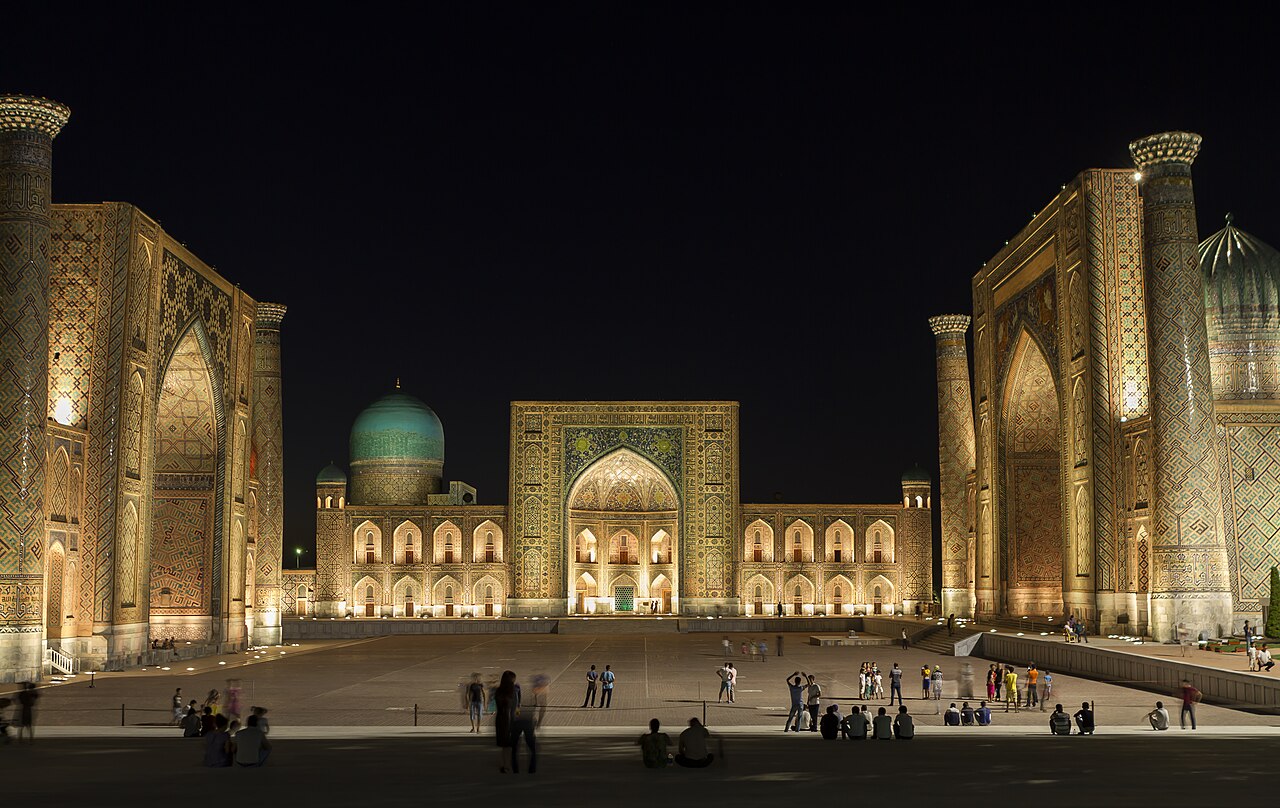
Assuming a morning or midday arrival, drop your bags and walk. The Registan is the reason you came: three madrasahs — Ulugh Beg’s from the 1420s, Sher-Dor with its improbable lion-suns, and the gold-domed Tilya-Kori — arranged around one plaza. Buy the combined ticket, which covers all three and the interior courtyards where craftspeople now sell miniatures and suzani. Allow two hours, more if a guardian offers to unlock a minaret staircase for a tip.
In late afternoon walk fifteen minutes southwest to the Gur-e-Amir, where Timur, his sons and his grandson Ulugh Beg lie under a fluted turquoise dome. The interior gilding is best in the last hour of daylight. It is a small building and half an hour is enough, which leaves time to eat before dark.
Then go back to the Registan. Floodlit after sunset, with the day crowds gone, it is a completely different building — and in summer months there is a light-and-sound show most evenings. This is the single strongest argument for staying within walking distance of the square rather than out by the station.
Day 2 — Shah-i-Zinda, Ulugh Beg and the bazaar
Be at Shah-i-Zinda when it opens, around 07:00. The avenue of tombs is a narrow corridor of blue-tiled mausoleums climbing a hillside, and it is genuinely transformed by emptiness; by mid-morning it is a shuffling queue and photography becomes hopeless. Entry runs around 40,000–50,000 UZS (last checked: August 2026). Give it 45 minutes to an hour, and walk up to the top for the view over the cemetery beyond.
A short taxi ride away is the Ulugh Beg Observatory, where the buried arc of a 15th-century meridian sextant survives in a trench cut into the rock. What is left is modest to look at, but the attached museum makes the case for why Ulugh Beg’s star catalogue — compiled here in the 1420s and accurate to a startling degree — mattered to astronomers for the next two hundred years.
Come back down for the Bibi-Khanym Mosque, Timur’s enormous and structurally over-reaching congregational mosque, then walk straight into Siyob Bazaar next door. This is where the trip stops being a monument tour: bread stacked in embossed towers, dried apricots and raisins by the sackful, halva, spices, and vendors who will hand you samples unprompted. Buy lunch here. Our Uzbek food guide and street food guide explain what you are being offered.
Afternoon options, choose one: the Afrosiyob Museum, built over the ruins of pre-Mongol Samarkand and holding a remarkable seventh-century wall painting of foreign ambassadors; the Hazrat Khizr Mosque, whose terrace gives the best free panorama in the city and whose grounds contain the mausoleum of Islam Karimov; or the Konigil paper mill, 15 minutes out of town, where mulberry-bark paper is still made on a working watermill.
Day 3 — Pick a day trip
If your flight leaves in the evening, day three is a real day. All three options below are comfortably done in six to eight hours with a hired car and driver, which costs roughly US$40–70 for the day depending on distance and bargaining (last checked: August 2026).
| Day trip | Distance | Time needed | Best for |
|---|---|---|---|
| Shakhrisabz | ~90 km (2h each way over a mountain pass) | Full day | Timur’s birthplace and the ruins of his Ak-Saray palace |
| Urgut bazaar | ~40 km | Half day (Sun–Wed best) | Suzani embroidery, antiques, an unpolished local market |
| Konigil paper mill | ~10 km | 2–3 hours | Silk-paper craft, a shaded river setting |
Shakhrisabz is the heavyweight choice. The drive crosses the Takhtakaracha pass with a roadside stop for melons and honey, and at the far end are the shattered 40-metre pylons of the Ak-Saray palace gate, a monument arguably more affecting as a ruin than it would be intact. The town’s central park was heavily and controversially redeveloped in 2015, so the setting is more manicured than atmospheric — go for the buildings, not the streets.
Urgut is the better pick if you want to buy things. The bazaar sprawls under huge plane trees and the suzani section is the best-priced in the country. Konigil is the shortest option and pairs neatly with a slow last morning in Samarkand if your flight is early.
Where to base yourself
On a three-day trip, location beats luxury. Stay in the old town between the Registan and Gur-e-Amir, or in the Boboxon and Islom Karimov street area, where small family-run guesthouses and boutique conversions put everything within a 15-minute walk. Avoid the newer hotels near the train station: they are cheaper, but you will spend an hour a day and several taxi fares getting to the sights. Expect roughly US$25–40 for a good guesthouse double and US$60–120 for a boutique hotel. Named options by budget are in where to stay in Samarkand.
What three days costs
Excluding flights, budget roughly US$55–85 per person per day at a mid-range level: US$30–50 for a room, US$12–18 for meals, US$10–15 for entry tickets, and a day-trip car on day three. Entry fees have climbed noticeably in the last two years — the Registan combined ticket now sits at roughly 100,000–150,000 UZS (last checked: August 2026) — and most monuments and taxis are cash-only, so keep som on you. See our Uzbekistan travel costs guide for a fuller breakdown.
Should you try to squeeze in Bukhara?
The Afrosiyob makes Samarkand–Bukhara a 1h30 hop, which tempts a lot of people into a day trip. We would not. Bukhara’s old town needs an evening and an early morning to make sense, and a day trip means five hours of travel and station transfers for four hours on the ground, most of them in the middle of the day when the light is flat and the heat worst. If Bukhara matters to you, add two nights and follow the 5-day itinerary instead — or read the Bukhara travel guide and save it for a second trip.
Practical tips for a short stay
- Use Yandex Go for taxis. Rides across Samarkand cost one to three dollars, and app pricing removes the haggling.
- Start early. Monuments open between 07:00 and 09:00 and the tour groups arrive around 10:00. On a three-day trip the first hour is worth two later ones.
- Keep your hotel registration slips until you have left the country.
- Go in spring or autumn. April–May and September–October have the best weather; July and August routinely pass 40°C. See the best time to visit.
- Cover shoulders and knees at religious sites. Head coverings are not required for women at general monuments.
Frequently Asked Questions
Is three days enough to see Samarkand?
Yes. Two full days cover every major monument at an unhurried pace, and the third gives you a day trip or a repeat visit to whatever you liked most. Samarkand’s sights are close together, which is exactly why it works as a short-trip base where a multi-city dash would not.
Can I fly into Samarkand directly, or must I go via Tashkent?
Direct international flights now serve Samarkand from Istanbul, Dubai and several Gulf and CIS cities, with frequent domestic connections from Tashkent. Routes and frequencies change seasonally, so check current schedules — but on a three-day trip, a direct flight is worth paying extra for.
Is Samarkand walkable?
The core is. From the Registan you can walk to Gur-e-Amir in about 15 minutes and to Bibi-Khanym and Siyob Bazaar in around 20, along a pedestrianised tourist boulevard. Shah-i-Zinda and the Ulugh Beg Observatory are better reached by a short, cheap taxi ride.
Do I need to book monuments in advance?
No. Tickets are sold at the gate, in cash, and there is no advance booking system for any of the major sites. The only things worth reserving ahead are your hotel and, if arriving overland, your Afrosiyob seat.
What if I only have two days?
Drop day three’s excursion and keep days one and two exactly as written. You will still see the Registan, Gur-e-Amir, Shah-i-Zinda, Bibi-Khanym and the observatory, which is the whole of Samarkand’s first rank. Two days is tight but not thin.
Is Samarkand safe for solo and female travellers?
Uzbekistan has very low rates of violent crime and Samarkand’s tourist areas are well policed and busy into the evening. Normal precautions apply — agree taxi fares or use an app, and keep valuables close in crowded bazaars. Our safety guide covers the topic in more depth.
A three-day trip to Samarkand is not a compromise version of a longer Uzbekistan holiday — it is its own thing, and one of the better long weekends available anywhere on this side of Asia. Book a room you can walk from, get to Shah-i-Zinda before seven, and leave the third day loose. For ideas on what to add when you inevitably come back, see our list of the best things to do in Uzbekistan.
Featured image: Benjamin Goetzinger (CC BY-SA 4.0) via Wikimedia Commons.