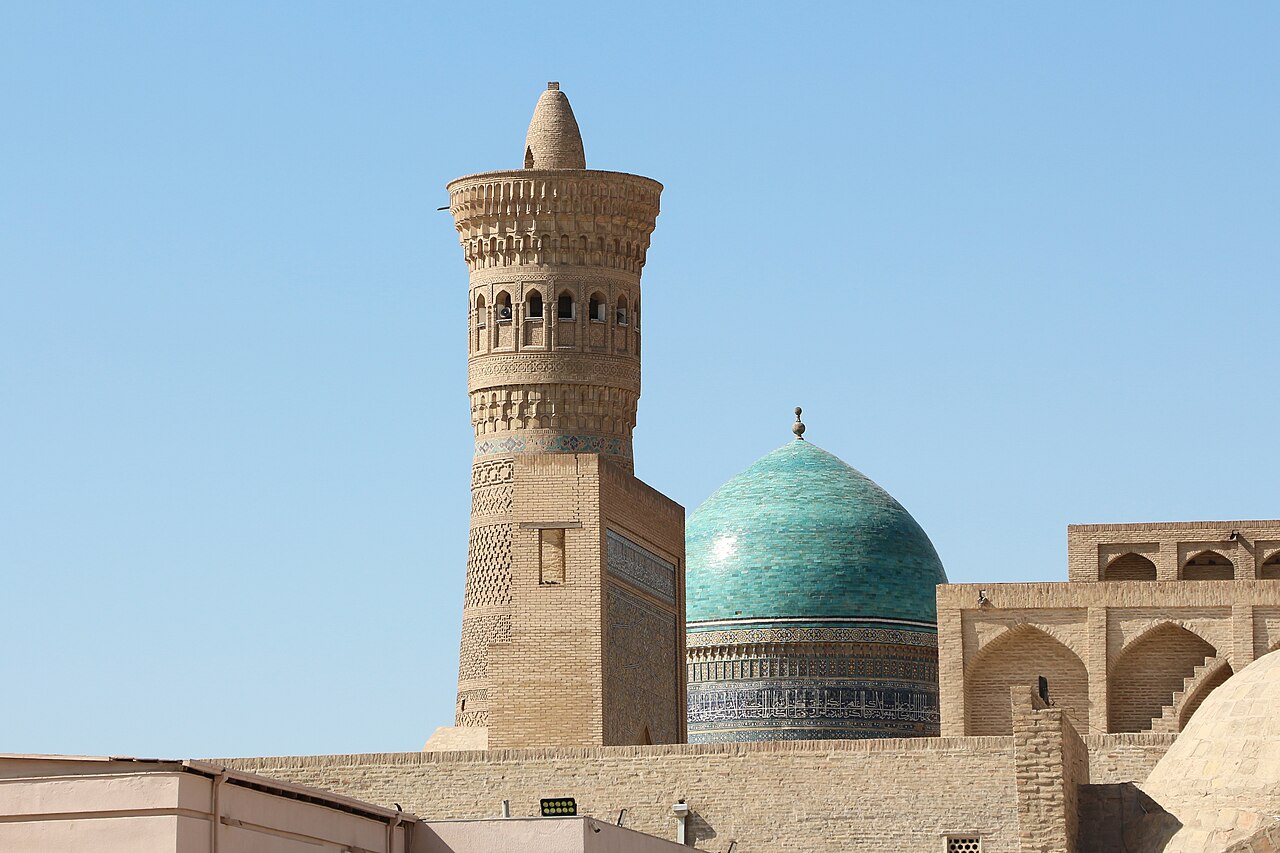
The Po-i-Kalyan complex is the beating heart of old Bukhara, and for most travellers it’s the single image they carry home: a soaring brick minaret flanked by two great portals, all glowing amber and turquoise in the late-afternoon light. The name means “the foot of the Great One,” a reference to the towering Kalyan Minaret around which the whole ensemble is arranged. Three monuments make up the group — the twelfth-century Kalyan Minaret, the sixteenth-century Kalyan Mosque, and the Mir-i-Arab Madrasah that faces the mosque across a wide paved square.
What makes Po-i-Kalyan special isn’t just the scale of each building but the way they talk to one another across nine centuries. The minaret survived the Mongol conquest; the mosque and madrasah were raised long after, deliberately framing the older tower. Stand in the square at sunset and you’re looking at one of the most coherent pieces of Islamic urban design anywhere in Central Asia.
This guide from the Uzbekistan Wanderer team walks through the history and architecture of each structure, then covers the practical details — tickets, opening hours, dress code and how to reach the complex — so you can plan a visit that does the place justice. It pairs naturally with our wider Bukhara travel guide if you’re mapping out several days in the city.
A Quick History of Po-i-Kalyan
Bukhara has been a centre of trade and learning on the Silk Road for well over two thousand years, and the ground beneath Po-i-Kalyan has held religious buildings for most of that time. The complex we see today grew in two distinct phases. The first was the construction of the Kalyan Minaret in 1127 under the Karakhanid ruler Arslan Khan, part of a Friday mosque that stood on this spot. That earlier mosque was destroyed during the Mongol invasion led by Genghis Khan around 1220, but the minaret itself was left standing.
The second phase came in the sixteenth century under the Shaybanid dynasty, when Bukhara became the capital of a powerful khanate. Ubaydullah Khan rebuilt the great congregational mosque in 1514, and his construction of the Mir-i-Arab Madrasah followed in the 1530s. Together these Shaybanid additions gave the square the symmetrical, portal-to-portal composition — known in Persian as a kosh arrangement, two buildings facing each other — that defines it today. The whole of historic Bukhara, Po-i-Kalyan included, is inscribed on the UNESCO World Heritage List.
The Kalyan Minaret
The minaret is the oldest and most remarkable part of the complex. Rising roughly 46 metres, it was designed by a master builder recorded only as Bako and completed in 1127. It’s built entirely of fired brick, tapering from about nine metres in diameter at the base to six metres at the top, and it’s crowned by a sixteen-arched rotunda from which the call to prayer was once given. For centuries it was the tallest structure in Central Asia and served as a landmark for caravans approaching the city across the desert.
The decoration is worth studying closely. Instead of coloured tile, the tower is ornamented with fourteen bands of geometric brickwork, each with a different pattern, so that the play of sunlight across the surface changes hour by hour. One narrow band near the top carries the earliest glazed blue tilework in Bukhara — a hint of the turquoise that would later dominate the city’s skyline.
The legends: Genghis Khan and the Tower of Death
Two stories cling to the minaret. The first says that when Genghis Khan reached Bukhara and tilted his head back to take in the full height of the tower, his hat tumbled off; impressed by a structure that could make a conqueror bow, he ordered it spared while the rest of the city burned. The tale is almost certainly embellished, but the minaret’s survival amid such destruction is genuine and remarkable.
The second, grimmer name is the “Tower of Death.” Into the early twentieth century, condemned criminals were reportedly sewn into sacks and thrown from the top gallery. Whatever the historical accuracy of the practice, the nickname has stuck and you’ll hear guides repeat it on the square. Note that the minaret isn’t open for climbing, so both legends are admired strictly from ground level.
The Kalyan Mosque
On the western side of the square stands the Kalyan Mosque, Bukhara’s main Friday mosque and the second largest in Uzbekistan after the Bibi-Khanym Mosque in Samarkand. Rebuilt in 1514 on the footprint of the mosque destroyed by the Mongols, it measures roughly 130 by 80 metres and was designed to hold as many as twelve thousand worshippers. The plan is a classic four-iwan courtyard: a vast open rectangle ringed by galleries carried on 208 pillars and covered by 288 small domes, with a monumental portal on each axis.
Step through the entrance and the sheer emptiness of the courtyard is the first thing you notice — a calm, sunlit expanse framed by arcades. Opposite the entrance, the main prayer hall sits beneath a blue-tiled dome that rises about thirty metres and is visible across the old town. Because the building is no longer in daily use as a working mosque, visitors are free to explore the courtyard and galleries at their own pace. If you’re building a broader plan, our roundup of the best things to do in Uzbekistan puts it in context alongside the country’s other headline sights.
The Mir-i-Arab Madrasah
Facing the mosque across the square is the Mir-i-Arab Madrasah, arguably the most beautiful of the three buildings for its tilework. Completed in the 1530s, it’s named after Sheikh Abdullah Yamani, known as Mir-i-Arab (“the Prince of Arabs”), a Sufi spiritual mentor to Ubaydullah Khan. Its two ribbed turquoise domes and richly patterned portal, covered in mosaic faience of blue, white and ochre, make it the visual counterweight to the plainer brick mass of the minaret.
The madrasah is more than a monument: it’s a living seminary. Reopened in 1945, it was for decades the only functioning Islamic college in the entire Soviet Union, and it continues today to train imams and religious scholars. Because it’s an active institution, the interior and courtyard are generally closed to tourists. You can admire the exterior, the portal and the domes from the square, and photograph the famous pairing of madrasah and minaret, but don’t expect to walk inside. Treat any open door as an invitation only if a caretaker waves you in.
Visiting Po-i-Kalyan: Tickets, Hours and Practicalities
Walking into the square itself and standing among the three monuments is free — this is a public space and one of the best spots in Bukhara simply to sit and watch the light change. You only pay to go inside the Kalyan Mosque. Prices are modest and set in Uzbek som (UZS); carry small cash notes, as card payment isn’t reliable at the ticket window.
| Detail | Information (last checked: July 2026) |
|---|---|
| Entry to the square | Free |
| Kalyan Mosque ticket | Around 20,000 UZS per adult (roughly USD 1.60) |
| Kalyan Minaret | Not open to climb; viewed from the square |
| Mir-i-Arab Madrasah | Active seminary; interior closed to visitors |
| Opening hours | Approx. 8:00 to 18:00 daily (mosque courtyard) |
| Photography | Freely permitted in the square and mosque courtyard |
Prices and hours shift from year to year, so treat the figures above as a guide and confirm at the gate (last checked: July 2026). Ticket revenue at the mosque is small, and buying one supports upkeep, so it’s well worth the entry.
Dress code and etiquette
Bukhara is relaxed compared with many religious sites, but Po-i-Kalyan is still a place of worship and study. Both men and women should cover their shoulders and avoid very short shorts or skirts; women may wish to carry a light scarf, though head covering isn’t strictly required in the mosque courtyard. Keep your voice down near the madrasah, where students are at their studies, and always ask before photographing people.
Best time to visit
Come early in the morning, before the tour groups arrive, for quiet and soft light, or return in the last hour before sunset when the brick of the minaret turns gold and the square empties out. Many travellers do both. The complex is beautifully floodlit after dark, so it also rewards an evening stroll. Spring and autumn are the most comfortable seasons overall — see our guide to the best time to visit Uzbekistan for month-by-month detail, as Bukhara summers can push past 40°C and there’s little shade in the square.
Getting there
Po-i-Kalyan sits in the heart of the old town, an easy walk from most of the historic guesthouses clustered around Lyabi-Hauz. From the Lyabi-Hauz pool it’s about ten minutes on foot through the covered bazaars and past the Ark. If you’re staying in the newer part of the city or near the train station, a short taxi or Yandex Go ride will drop you at the edge of the pedestrian zone for a few thousand som. For the bigger picture of trains, shared taxis and domestic flights between cities, see our overview of getting around Uzbekistan.
What to See Nearby
One of the joys of Bukhara is how densely packed its monuments are, and Po-i-Kalyan makes a natural anchor for a half-day on foot. A few minutes to the west stands the Ark of Bukhara, the vast mud-brick citadel that was the seat of the emirs. Just beyond it are the Bolo Hauz Mosque, with its slender wooden columns, and the Zindan, the old emir’s jail. Head the other way, back towards Lyabi-Hauz, and you pass through the historic trading domes where silk, spices and carpets are still sold.
To fit all of this into a wider trip, our 10-day Uzbekistan itinerary shows how Bukhara slots between Samarkand and Khiva along the classic Silk Road route.
Frequently Asked Questions
Is it free to visit Po-i-Kalyan?
Entering the square and standing among the minaret, mosque and madrasah is free. You only pay a small fee, around 20,000 UZS, to go inside the courtyard of the Kalyan Mosque. The Mir-i-Arab Madrasah interior is closed as it’s an active seminary (last checked: July 2026).
Can you climb the Kalyan Minaret?
No. Unlike some minarets in Uzbekistan, the Kalyan Minaret isn’t open for climbing, so it’s admired from the ground. Its interior staircase is closed to visitors for conservation and safety reasons.
Why is it called the Tower of Death?
The nickname comes from a tradition that, into the early twentieth century, condemned criminals were thrown from the top gallery of the minaret. Historians debate how common this really was, but the name has endured and you’ll hear it from local guides.
Can you go inside the Mir-i-Arab Madrasah?
Generally no. The madrasah is a working Islamic college that still trains imams, so the courtyard and rooms are off-limits to tourists. You can photograph and admire the magnificent portal and turquoise domes from the square outside.
How long should I spend at Po-i-Kalyan?
Allow around 45 minutes to an hour to take in the square, walk through the mosque courtyard and photograph the minaret from different angles. Many travellers return at sunset or after dark, when the floodlit monuments look their best, so it’s easy to spend longer.
Do I need to cover up to visit?
Modest dress is expected: cover your shoulders and knees. Women don’t strictly need a headscarf for the mosque courtyard, but carrying a light scarf is sensible and respectful, especially near the active madrasah.
Final Thoughts
Po-i-Kalyan distils everything that makes Bukhara extraordinary: a thousand years of history standing shoulder to shoulder, brickwork that survived the Mongols, and tilework that still stops travellers in their tracks. Give it time across the day — a quiet morning, a golden evening — and it becomes far more than a photo stop. For everything else in the city, from where to sleep to what to eat, dip back into our full Bukhara travel guide and start building the trip.
Featured image: Bgag (CC0) via Wikimedia Commons.