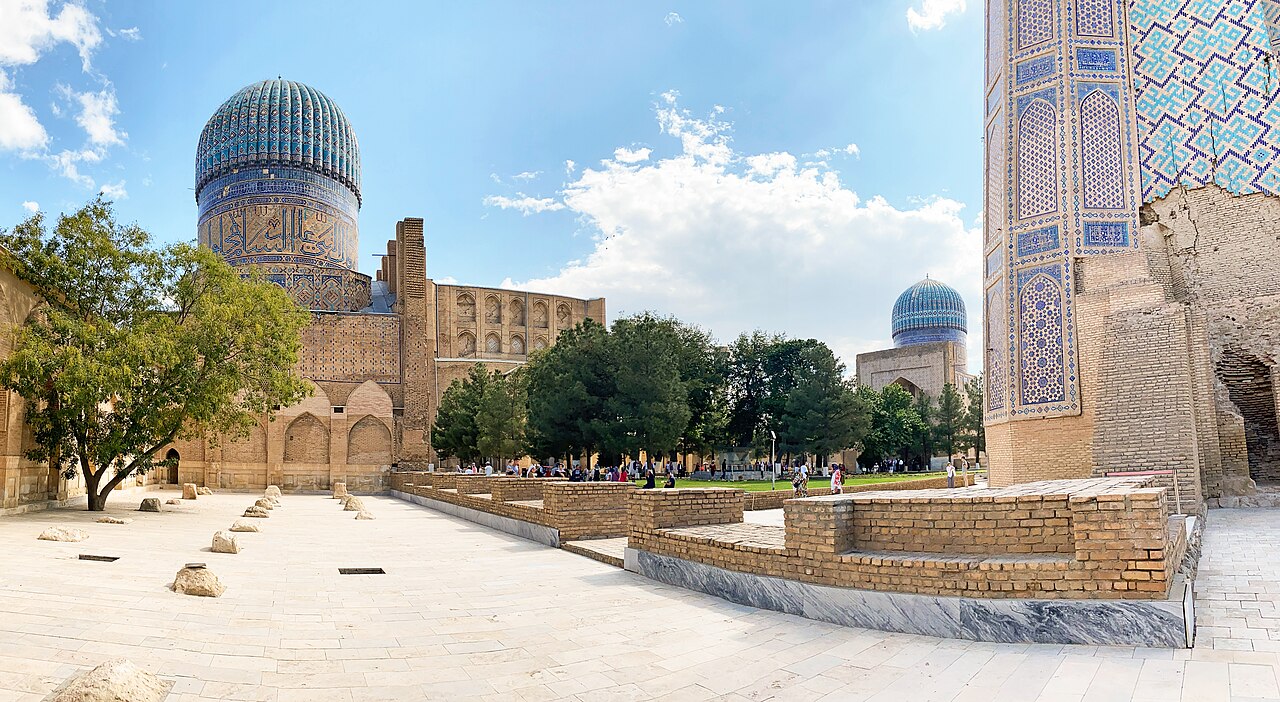
Few buildings in Central Asia carry as much ambition and myth as the Bibi-Khanym Mosque. Commissioned by Amir Timur (Tamerlane) after his 1398 campaign in India, it was meant to be the largest mosque in the Islamic world, a stone-and-tile boast that no rival capital could match. The scale is still staggering today: a courtyard roughly 167 by 109 metres, an entrance portal that once soared beyond 35 metres, and a main dome that reaches around 40 metres over the prayer hall.
But Bibi-Khanym is not a story of straightforward triumph. Timur pushed his architects and materials past their limits, and the building began shedding bricks almost as soon as it was finished. Centuries of neglect and a major earthquake reduced much of it to a romantic ruin, and what you walk through now is largely a 20th-century Soviet reconstruction. That layered history, part masterpiece, part cautionary tale, part rebuild, is exactly what makes it worth understanding before you go.
This guide from the Uzbekistan Wanderer team covers the legend behind the mosque, what actually happened to it, and the practical details, tickets, hours, and how to fit it into a Samarkand day, so you can visit with context rather than just ticking off another blue dome. For the wider city, pair this with our Samarkand travel guide.
A Mosque Built to Break Records
Construction began around 1399 and was declared complete by 1404, an extraordinarily fast timeline for a building of this size. Timur wanted it done while he was still alive to see it, and he threw the resources of a continent-spanning empire at the problem. Contemporary accounts describe craftsmen gathered from across the conquered lands and a workforce that reportedly included 95 elephants hauled back from India to move the heaviest loads.
The result was a congregational mosque on a scale the region had never attempted. Worshippers passed through a colossal pishtaq (entrance portal) into an open courtyard flanked by minarets over 50 metres tall, with the great domed prayer hall at the far end and smaller domed chambers along the sides. The surfaces were sheathed in glazed brick, carved marble, and the deep cobalt and turquoise tilework that has become shorthand for Timurid Samarkand.
That drive for record-breaking scale is the through-line of Timur’s capital. If you want to see how the ambition evolved into more refined, better-engineered work, compare Bibi-Khanym with the nearby Registan Square and the jewel-box Gur-e-Amir mausoleum, where Timur himself is buried. The story of how these monuments fit into the wider trade network is told in our overview of Silk Road history in Uzbekistan.
The Legend of Bibi-Khanym
The mosque takes its popular name from Timur’s senior wife, often identified as Saray Mulk Khanum, and a legend that Uzbek guides still love to tell. In the story, the queen orders the mosque built as a surprise for her husband while he is away at war. The empire’s finest architect takes the commission, but he falls hopelessly in love with her and keeps stalling, insisting he cannot finish until she grants him a single kiss.
Pressed for time before Timur’s return, she relents, but the kiss is so passionate it leaves a mark on her cheek. When Timur comes home and discovers the blemish and the story behind it, his fury is legendary. Depending on which version you hear, the architect flees to the top of a minaret and either escapes by sprouting wings or is thrown to his death, and Timur decrees that women should thereafter veil their faces so no man is ever tempted again.
It is folklore, not documented history, most of it took shape long after the events, but it is worth knowing before you arrive, because it colours the way the site is presented. A guide will point out the very minaret in question. Treat it as the poetic layer over the real architectural drama, which is arguably more interesting.
Decline, Collapse, and Restoration
The real weakness of Bibi-Khanym was structural. To achieve its record height and span so quickly, the builders leaned on daring, under-tested engineering, and the loads were simply too great for the techniques of the day. Bricks began dropping from the main arch within Timur’s own lifetime, and later rulers lacked the money or will to keep such a vast complex in repair. Over the following centuries it slid into decay, with the courtyard used at times as a market and even a stable.
A devastating earthquake in 1897 brought down much of what remained, leaving the great portal cracked and gaping, an image captured in haunting early photographs. For decades the mosque stood as a picturesque ruin. Serious reconstruction did not begin until the Soviet period, with major work from the 1970s onward, and it has continued in phases since. What you see today, the reassembled domes, the rebuilt facades, the re-laid tilework, is very substantially a modern restoration over the surviving core, rather than an untouched 15th-century original.
This is not a reason to skip it. Knowing the building is part reconstruction actually sharpens the visit: you can read the seams between old and new, appreciate the sheer scale that survived, and understand why Bibi-Khanym is included in Samarkand’s UNESCO World Heritage listing as a crossroads of cultures. UNESCO’s own Samarkand entry gives the official context, and Advantour has a useful architectural breakdown.
Visiting Bibi-Khanym Mosque: Practical Info
The mosque sits on Bibikhonim Street in central Samarkand, right beside the Siyob (Siab) Bazaar and roughly a 15-minute walk north from the Registan. The core of a visit is the courtyard, the towering main portal, and the domed prayer hall; there is also a large stone Quran stand (rahle) in the courtyard that features in local fertility superstitions. Allow around 45 minutes to an hour, more if you take a guide or linger for photos.
| Detail | What to expect (last checked: July 2026) |
|---|---|
| Ticket price | Around 50,000–75,000 som for foreign visitors (roughly US$4–6). Prices change often, confirm at the gate. |
| Opening hours | Approx. 8:00–19:00 April–October; 9:00–17:00 November–March. Slightly shorter in winter. |
| Time needed | 45–60 minutes |
| Location | Bibikhonim Street, next to Siyob Bazaar, ~15 min walk from the Registan |
| Best time of day | Early morning or late afternoon for softer light and thinner crowds |
| Dress code | Modest dress advised; shoulders and knees covered. A scarf is handy for women. |
Tickets and Hours
Entry is inexpensive but the exact figure is genuinely volatile, we have seen the foreigner rate quoted anywhere from about 50,000 to 75,000 som (last checked: July 2026). Bring small som notes, as change can be limited, and expect a separate small charge if you want to use a professional camera or hire a guide at the gate. Hours are seasonal, longer in the warm months and shorter in winter (last checked: July 2026), so aim to arrive well before the posted closing time rather than at the tail end of the day.
Getting There
Most visitors simply walk. From the Registan, head north along the main pedestrian axis and you will reach the mosque in about 15 minutes, passing cafes and souvenir stalls on the way. If you prefer to ride, the Yandex Go app is the cheapest and most transparent option for a taxi and usually costs only a dollar or two across the centre; agree a price first if you flag down a car on the street instead. For the bigger picture on trains, shared taxis, and city transport, see our guide to getting around Uzbekistan.
What to Combine It With
Bibi-Khanym is perfectly placed for a half-day cluster. Directly across the road stands the Bibi-Khanym Mausoleum, the tomb linked to Timur’s wife, and immediately behind it is the lively Siyob Bazaar, the best place in Samarkand to try fresh non (bread), dried fruit, and local sweets, our Uzbek food guide explains what to look for. From the bazaar it is a short ride or walk to the tiled necropolis of Shah-i-Zinda. Slot the whole area into a wider plan using our 10-day Uzbekistan itinerary.
Tips for a Better Visit
- Go early or late. Midday light flattens the tilework and the courtyard offers little shade in summer, when Samarkand can push past 35°C.
- Look up and look closely. The contrast between weathered original brickwork and crisp restored tile is easiest to spot on the main portal and the flanks of the prayer hall.
- Consider a guide for 30 minutes. The legend, the engineering failures, and the restoration story land far better with someone pointing out the details than from a signboard.
- Combine, don’t isolate. With the mausoleum and bazaar next door and Shah-i-Zinda close by, it is inefficient to make a special separate trip.
- Carry cash. Card acceptance at monument gates is unreliable, and you will want small notes for the bazaar afterwards.
Frequently Asked Questions
Is Bibi-Khanym Mosque still an active place of worship?
Primarily it functions as a museum and monument rather than a working congregational mosque, and tourists visit freely with a ticket. Prayer does take place in Samarkand’s other mosques. Dress modestly out of respect, but you do not need to plan your visit around prayer times here.
How much time should I spend at the mosque?
Around 45 minutes to an hour is enough for the courtyard, the great portal, and the prayer hall. Add extra time if you take a guide, photograph seriously, or cross to the Bibi-Khanym Mausoleum opposite. Many travellers roll it into a two- to three-hour loop with the neighbouring Siyob Bazaar.
How much does it cost to enter?
The foreigner ticket has recently been in the region of 50,000–75,000 som, about US$4–6 (last checked: July 2026). Prices at Samarkand’s monuments are revised fairly often, so treat any figure as a guide and confirm the current rate at the ticket window. Bring small som notes, as change can be scarce.
Is the building original or a reconstruction?
It is substantially a modern reconstruction. The original suffered structural failures from the start and was largely wrecked by the 1897 earthquake, and major rebuilding took place from the Soviet 1970s onward. Enough of the historic fabric survives to make the scale real, but you are looking at a restored monument, not an untouched 15th-century one.
Can I walk from the Registan to Bibi-Khanym?
Yes, easily. It is about a 15-minute walk north along the main pedestrian route, mostly flat and lined with cafes and stalls. If it is very hot or you are short on time, a Yandex Go taxi across the centre costs only a dollar or two.
When is the best time of year to visit?
Spring (April–May) and autumn (September–October) offer the most comfortable weather and good light for the tilework. Summers are hot and the open courtyard has little shade, while winter is quieter but colder with shorter opening hours. See our guide to the best time to visit Uzbekistan for a full seasonal breakdown.
Bibi-Khanym rewards travellers who arrive knowing its double story, the empire that willed a record-breaking mosque into existence in five years, and the flawed engineering and centuries of ruin that followed. Stand under that vast portal, spot the joins between the ancient and the rebuilt, then step across to the bazaar for warm bread. It is one of Samarkand’s most human monuments precisely because it never quite behaved, and it remains a highlight on any list of the best things to do in Uzbekistan.
Featured image: Bgag (CC0) via Wikimedia Commons.