Most cities hide their subway underground and hope you never look too closely. Tashkent did the opposite. Beneath the Uzbek capital sits one of the most extravagant metro systems on earth: marble halls, glass chandeliers, ceramic mosaics of cotton flowers and Soviet cosmonauts, each station designed as a small palace. For decades you were forbidden from photographing any of it, because the metro doubled as a nuclear shelter. That ban is gone, and today a single tap of a card buys you a self-guided tour through what is genuinely one of Tashkent’s best free attractions. Here is how to see it properly.
Why the metro is a sightseeing attraction
The Tashkent Metro opened in 1977, making it the first metro in Central Asia and, for a long time, the only one. Like the famous stations of Moscow and Kyiv, it was built to double as public transport in peacetime and a civil-defence shelter in an emergency. That second role is exactly why photography was banned for 41 years: the stations were officially strategic infrastructure. In 2018 the government finally lifted the restriction, and the vaults that Uzbeks had ridden through unremarked for a generation suddenly turned up in National Geographic and The Guardian.
What makes the stations special is the deliberate collision of two visual languages. Soviet-era themes of space travel, industry and labour sit alongside the domes, arabesques and cobalt-and-emerald tilework of Uzbek craft tradition. No two stations look alike, and unlike a museum, the whole thing costs less than a bus ticket and runs from dawn to midnight. If you’re already working through our Tashkent travel guide, treat the metro as an attraction in its own right rather than just the way you get between the others.
The most beautiful stations
There are 29 stations across the three original underground lines, and honestly most repay a look. But if your time is limited, these five are the ones we would build a route around.
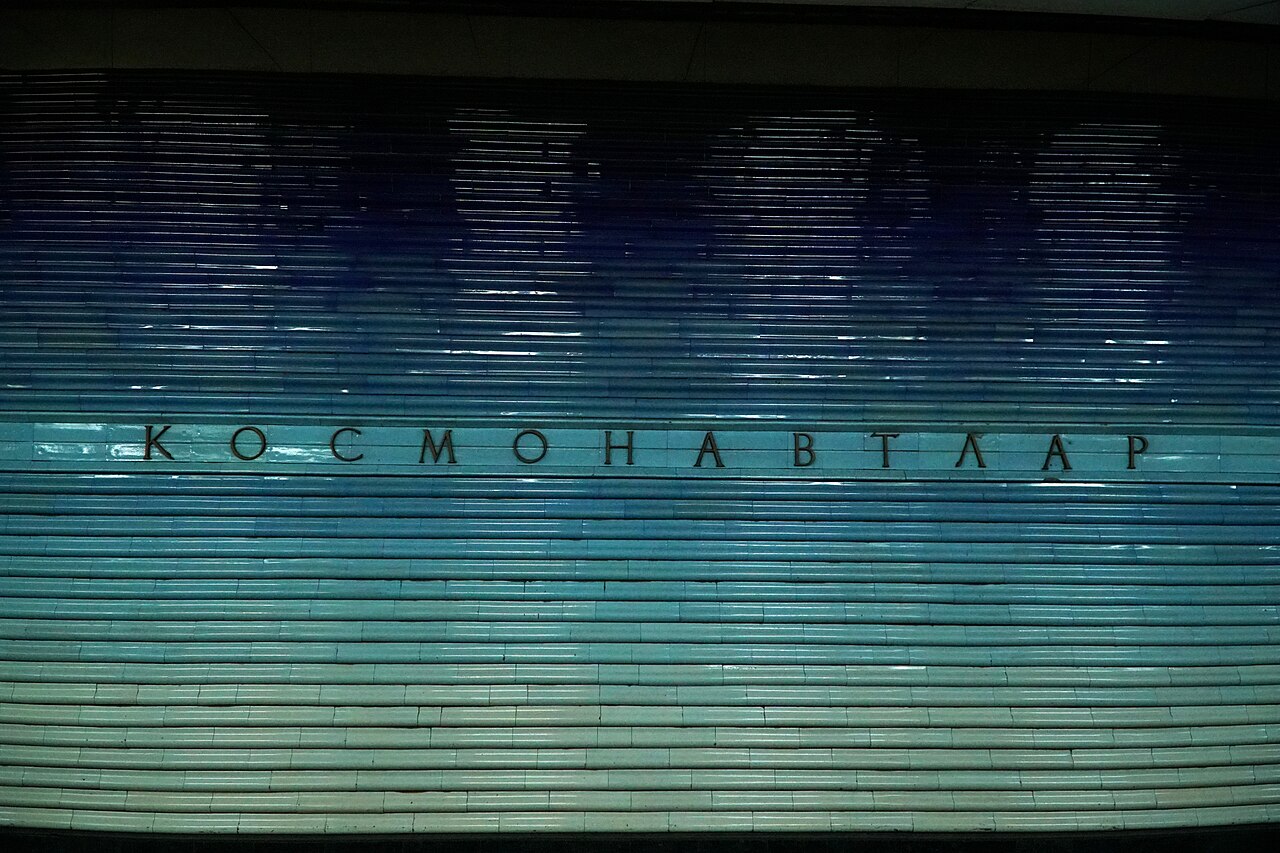
Kosmonavtlar (Cosmonauts)
The showpiece. Opened in 1984 in honour of Soviet spaceflight, Kosmonavtlar is styled as a journey through the cosmos: a deep-blue colonnade studded with glass “stars” that evoke the Milky Way, lined with ceramic medallion portraits of space figures. You’ll spot Yuri Gagarin and Valentina Tereshkova alongside the medieval Uzbek astronomer Ulugh Beg and, with a wink, Icarus. It’s the single most photographed station on the network, and rightly so.
Alisher Navoi
Named for the 15th-century poet regarded as the father of Uzbek literature, this station feels like stepping inside a mosque. A run of ribbed turquoise domes lines the platform ceiling, and the corridors and staircases carry tilework illustrating scenes from Navoi’s poems. It’s the most overtly “Uzbek” of the major stations and the easiest to photograph well because the domes frame the shot for you.
Mustaqillik Maydoni (Independence Square)
One of the very first stations, opened in November 1977, and built almost entirely from marble quarried in the Kyzylkum desert. The columned hall, glass chandeliers and coffered ceiling give it the air of a ballroom rather than a train platform. It sits directly beneath Independence Square, so it’s a natural start or finish for a walking day in the centre.
Pakhtakor (Cotton Picker)
Pakhtakor means “cotton picker,” and the walls celebrate the crop that dominated Uzbekistan’s Soviet economy. Green and blue mosaics of flowering cotton plants run the length of the platform in a bright, folk-art style that is completely different in mood from the solemn marble halls nearby. It’s also a key interchange, which makes it easy to fold into any route.
Bodomzor
The modern outlier. Opened in 2001 on the newer Yunusobod line, Bodomzor swaps chandeliers for clean geometric ceiling patterns and sculptural lighting, giving it an almost science-fiction feel. It’s worth the ride north to see how the metro’s design language evolved after independence, and it pairs well with the nearby TV tower and Minor Mosque.
How to ride the Tashkent Metro
The system is simple once you know the basics. There are four lines: the red Chilonzor line (the original, 1977), the blue Oʻzbekiston line (1984), the green Yunusobod line (2001), and the newer elevated Circle line (2020) that rings the outer districts above ground. Signs are in Uzbek Latin script, often with Cyrillic, and increasingly with English. Trains are frequent, and stations are clean, staffed and safe.
Fares are flat: you pay once to enter and can travel as far as you like and change lines as many times as you need on a single journey. The old brass tokens were retired back in 2020. Today you either tap a reusable card or a contactless bank card, or buy a single-use paper QR ticket for cash. Note the government now deliberately prices the cash fare higher to push people onto cards (last checked: July 2026).
| Payment method | Fare per journey | Notes |
|---|---|---|
| ATTO card (tap) | 1,700 soʻm | Reusable; also works on city buses |
| Contactless bank card / phone | 1,700 soʻm | Visa, Mastercard, Uzcard, Humo tap straight on the turnstile |
| Cash (paper QR ticket) | 3,000 soʻm | Single use; bought at the station kiosk |
For a stay of more than a day or two, buy a blue ATTO card at any metro ticket office. It costs a small deposit, works on the metro and city buses alike, and tops up from the ATTO app or Uzbek payment apps like Payme and Click. If you only need a ride or two, just tap your own contactless bank card on the turnstile and you pay the cheaper electronic fare automatically. Trains run roughly 05:00 to midnight on the three underground lines, with the Circle line finishing a little earlier.
A self-guided station-hopping route
You can see the highlights in about 60 to 90 minutes for the price of a single fare, because you never leave the paid area. The trick is to ride to a station, step off, admire it, photograph it, then re-board the next train without exiting through the turnstiles. Here is a route that strings the best five together with minimal backtracking:
- Start at Mustaqillik Maydoni on the Oʻzbekiston (blue) line, under Independence Square.
- Ride one stop to Pakhtakor, the cotton-mosaic interchange with the red Chilonzor line.
- Change here and continue to Alisher Navoi for the turquoise domes.
- Backtrack via Pakhtakor and cross to the Yunusobod (green) line for Kosmonavtlar, the cosmic showpiece.
- Carry on north to Bodomzor for the modern finale, then surface for the TV tower and Minor Mosque.
If you would rather not track line changes yourself, download an offline metro map before you go, and remember that every interchange is signed in the station. This kind of self-powered exploration is exactly what makes Tashkent easy for independent travellers, and it slots neatly into a wider look at getting around Uzbekistan by rail and shared taxi.
Tips for visiting the metro
- Go off-peak. Mid-morning or early afternoon on a weekday gives you emptier platforms and cleaner photos. Rush hours (roughly 08:00–09:30 and 17:30–19:00) are busy.
- Photography is fine, tripods aren’t. Handheld shots are welcome since the 2018 ban was lifted, but a tripod still officially needs a permit. Be discreet and let commuters pass.
- Carry a little cash as backup. Contactless usually works, but a few small soʻm notes cover a paper ticket if a reader is down.
- You can hop stations on one fare. As long as you stay inside the turnstiles you pay once, so there’s no reason to rush any single station.
- Bring a light layer. Deep platforms stay cool even in Tashkent’s fierce summer, a welcome break from the heat above ground.
- Budget nothing, basically. At well under US$0.25 a ride, the metro is the cheapest sightseeing in the city; see our breakdown of Uzbekistan travel costs to see how it fits your day.
Frequently Asked Questions
Is it really allowed to take photos in the Tashkent Metro now?
Yes. The decades-long ban was lifted in 2018, and handheld photography is now permitted throughout the system. The only real restriction is tripods, which still officially require a permit. Use common sense, keep out of commuters’ way, and you’ll have no trouble (last checked: July 2026).
How much does a metro ride cost?
It’s a flat fare regardless of distance: 1,700 soʻm if you tap an ATTO card or a contactless bank card, or 3,000 soʻm for a single-use paper ticket bought with cash. That’s around 13 to 24 US cents per journey, and you can change lines freely on a single entry.
Do I need to buy a special card as a tourist?
Not necessarily. If you have a contactless Visa or Mastercard you can simply tap it on the turnstile and pay the lower electronic fare. If you’re staying several days or plan to use city buses too, a reusable ATTO card is convenient and works across both networks.
Which stations are the most beautiful?
Kosmonavtlar (the cosmonaut station) is the standout, followed by Alisher Navoi with its turquoise domes, the marble ballroom of Mustaqillik Maydoni, the cotton mosaics of Pakhtakor, and the modern geometry of Bodomzor. All five are easy to string together on a single fare.
How long does it take to see the highlights?
Allow roughly 60 to 90 minutes to hop the five best stations without leaving the paid area. It fits comfortably into a half-day in central Tashkent alongside Independence Square, Chorsu Bazaar and the old city, and it costs just one fare.
Is the metro safe and easy to navigate?
Yes on both counts. Stations are staffed, clean and secure, trains are frequent, and signage increasingly appears in English alongside Uzbek. An offline metro map on your phone makes interchanges effortless.
The bottom line
Few cities let you tour a working art collection for the price of a bus fare. The Tashkent Metro does, and now that the cameras are allowed out, there’s no reason to treat it as mere transport. Set aside an hour, tap in, and ride through the underground palaces before joining the rest of the best things to do in Uzbekistan above ground.
Featured image: Adam Harangozó (CC BY-SA 4.0) via Wikimedia Commons.