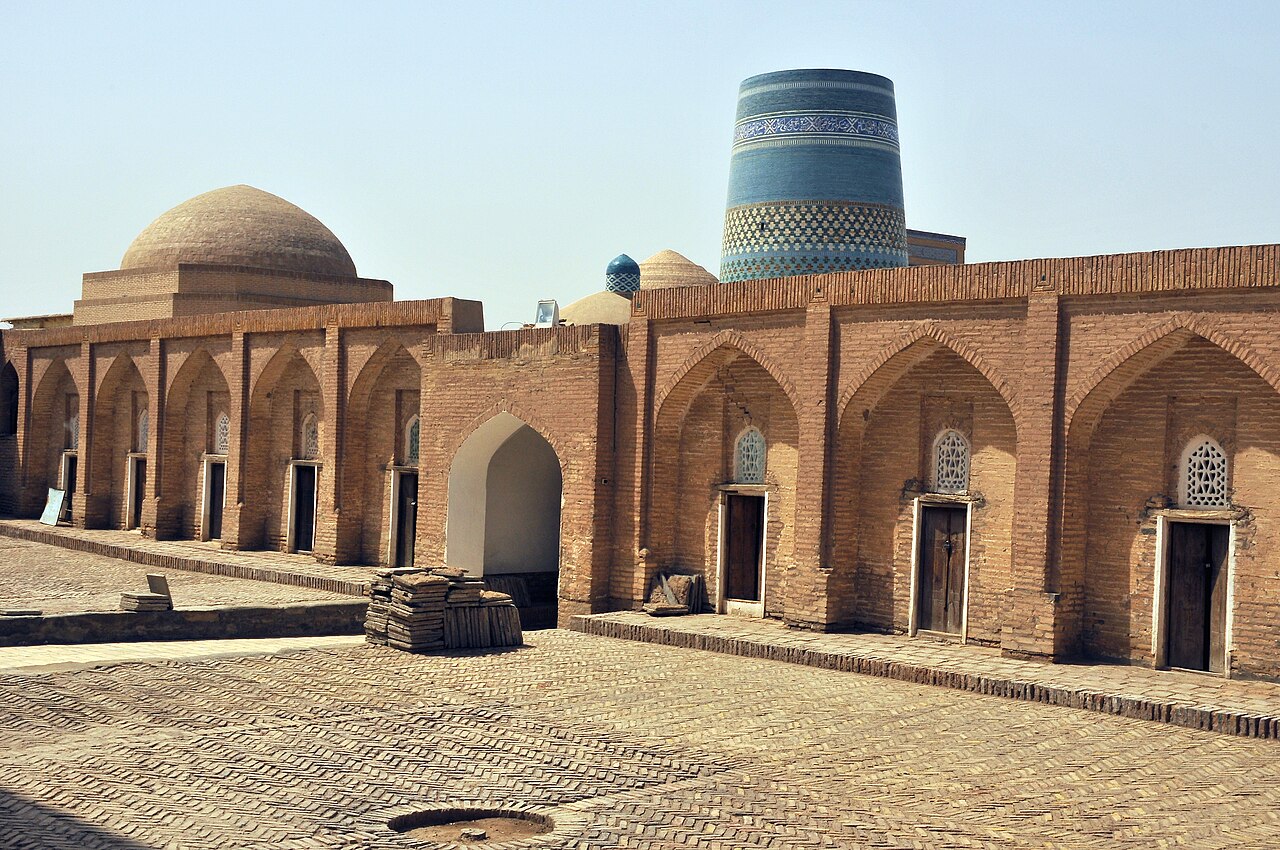
A double room inside a restored 19th-century madrasah in Khiva runs about €70 a night, breakfast included. That single fact reframes what a honeymoon in Uzbekistan can be. For the price of three forgettable nights in a Mediterranean resort, a couple can sleep in a scholars’ cell behind a mud-brick wall, wake up under a turquoise minaret, and still have budget left for a private driver.
Uzbekistan is not an obvious honeymoon country, and we won’t pretend otherwise. There is no beach. Nightlife is thin outside Tashkent. Alcohol exists but is not the point. What the country does offer is a kind of romance that photographs badly and lives well: long evenings on tiled courtyards, sun going orange on a minaret, tea that keeps arriving, a driver who insists on stopping so you can buy melons. Couples who want to be entertained will find it slow. Couples who want to be together somewhere extraordinary will find it close to perfect.
This guide is built for two people travelling together for the first time as a married couple, or as any couple wanting a slower, more indulgent version of the standard Silk Road circuit. It covers timing, a ten-night route that never asks you to change hotel more than four times, the rooms genuinely worth paying up for, the set pieces that earn their reputation, and the practical details — bed types, registration slips, public affection — that other guides skip.
Is Uzbekistan actually a good honeymoon destination?
Yes, with conditions. The case for it is strong: the country is safe, extremely affordable at the mid-to-high end, visa-free for most Western passports, and small enough that a two-week trip doesn’t feel rushed. Hotels in the historic cities are largely small, family-run conversions of merchant houses and madrasahs, which means courtyards, roof terraces, and eight-room properties rather than lobbies full of tour groups. Service is warm without being rehearsed. Newlyweds are, frankly, a category Uzbeks understand and celebrate loudly — you will see local wedding convoys everywhere, horns blaring, and being told tabriklayman (congratulations) by a stranger at the Registan is a very likely thing to happen to you.
The case against: this is a sightseeing country. The days involve monuments, museums and heat. If your idea of a honeymoon is fourteen mornings of nothing, you will need to build the nothing in deliberately, because the itinerary will otherwise fill itself. Spa culture is developing but uneven. And the two of you will spend meaningful hours in cars and trains between cities — pleasant hours, but hours.
Our honest read: Uzbekistan suits couples who already travel well together and who like a trip with content in it. It is a poor choice for a first-ever trip abroad together, and an excellent second or third one. If you’re weighing it against the region’s other options, our overview of a clear-eyed look at what there is to actually do here is a fair sanity check before you commit.
When to come — and the two weeks to avoid
Timing matters more for a honeymoon than for a normal trip, because heat destroys romance faster than anything else. Uzbekistan’s summer is severe. July and August routinely push past 40°C in Bukhara and Khiva, and a courtyard hotel with no shade at 3pm is not a place you will want to linger.
The two windows we’d book are mid-April to late May and mid-September to late October. Spring gives you green mountains, roses in the madrasah courtyards and long light. Autumn gives you the fruit — grapes, pomegranates, melons stacked at every bazaar — and slightly emptier sites. Both hold daytime temperatures in the low-to-mid 20s°C with cool evenings, which is exactly what you want for late dinners outside.
Two dates to plan around. Navruz (21 March) is spectacular and the country is in a good mood, but hotels in Samarkand and Bukhara book solid and domestic travel gets tight. The other is the tail of March itself, which can still be grey and cold, with several major sites under maintenance before the season opens. Winter is a real option for a certain kind of couple — Khiva under snow is startling, and rooms are half price — but be clear-eyed that many rooftop terraces and garden restaurants simply close. Our full breakdown of how each season actually feels on the ground goes month by month.
A ten-night route built for two
The standard circuit moves Tashkent → Samarkand → Bukhara → Khiva. We’d keep that spine and change the rhythm: fewer hotel changes, two full days doing nothing in particular, and one night that isn’t in a city at all.
Nights 1–2: Tashkent, gently
Land, sleep, and don’t schedule anything for the first morning. Tashkent is the least romantic stop on the route and the most useful — it’s where you get a SIM, change money, and adjust. Spend an afternoon on the metro, which is genuinely a sightseeing activity, eat plov at a proper plov centre, and use the evening for a good restaurant meal, because the capital has the country’s best dining by some distance. The capital rewards low expectations and an early night.
Nights 3–5: Samarkand
Take the Afrosiyob high-speed train; it covers the run in a little over two hours and business class is worth the upgrade for the space. Three nights in Samarkand sounds like a lot and isn’t. The monuments here are enormous and demand two separate visits each — once in morning light, once at dusk — and the third day gives you a day trip or a lie-in without guilt.
The Registan is the set piece. Buy the combined ticket, which was 65,000–100,000 UZS (roughly US$5–8) per person and allows same-day re-entry, then use that re-entry properly: go once at opening when the courtyards are empty, and again after dark (last checked: August 2026). There is a light-and-sound projection show on the madrasah facades most evenings from around 9pm, though the schedule shifts with sunset and is not reliably published — ask your hotel that morning. Our detailed walk-through of the Registan explains which of the three madrasahs to spend real time in.
Nights 6–7: Bukhara
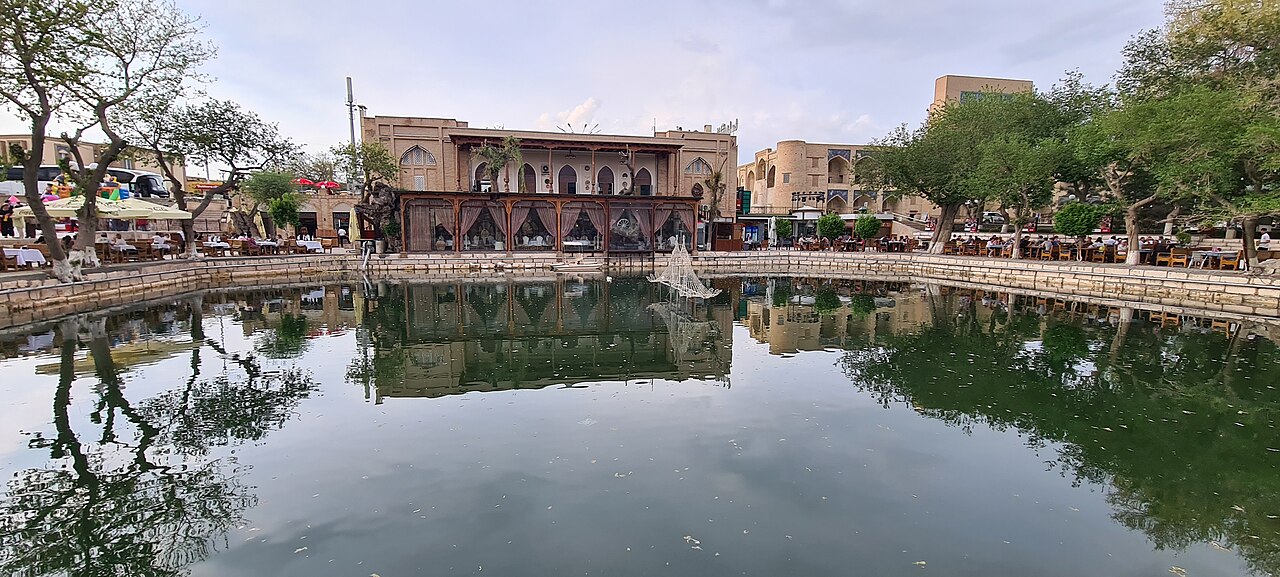
Bukhara is the one most couples end up loving most, and the reason is scale. Where Samarkand overwhelms, Bukhara is walkable, low-rise and lived-in: a compact old town of trading domes, a pool surrounded by mulberry trees, and dozens of small hotels tucked into lanes barely wide enough for a car. You can eat dinner at Lyabi Hauz, walk ten minutes, and be at your door. Two nights is the minimum; three is better if you want a hammam afternoon.
Night 8: the desert
This is the night that turns a good trip into a memorable one. Break the long journey between Bukhara and Khorezm with a stay at a yurt camp near Lake Aydarkul or in the Kyzylkum near Yangikazgan. Expect around US$30–45 per person including all meals and usually a short camel ride, which tells you these are simple places, not luxury glamping. Bring a good torch. The point is the sky — there is no light pollution for a very long way, and dinner is eaten outside around a fire with whoever else is staying. Read our fuller account of what a night in a Kyzylkum yurt camp is really like before you book, because expectations matter here.
If neither of you sleeps well in shared, basic accommodation, skip it without regret. An extra night in Bukhara is never wasted.
Nights 9–10: Khiva
Khiva ends the trip well. The walled inner city, Itchan Kala, is pedestrian-only, small enough to cross in fifteen minutes, and almost entirely emptied of day-trippers after about 5pm. That evening emptiness is the whole argument for sleeping inside the walls rather than outside them. Climb a watchtower or take a rooftop table for sunset; the mud-brick turns the colour of apricot jam and the minarets throw long shadows across the roofs. Which sites you enter matters less here than most places; the walled city works as one object.
Fly home from Urgench, 35 minutes away by taxi, either direct to Tashkent or onward. Couples with two extra nights should consider adding them in Samarkand rather than anywhere new — the extra days redistribute best across the monuments you have already met.
Where to stay: the rooms worth paying up for
Uzbekistan’s accommodation market has an unusual shape. The gap between a $30 room and a $90 room is enormous; the gap between $90 and $250 is small. Which means the honeymoon strategy here is not to book the most expensive thing — it’s to book the most interesting thing, and then spend the difference on drivers, guides and long lunches.
Three property types are worth knowing. Converted madrasahs put you inside a monument: thick walls, tiny windows, a courtyard, and rooms in the old hujras (student cells) that are small by design. Merchant-house boutiques are the sweet option for most couples — 19th-century family homes around a courtyard, carved doors, plaster niches, ten rooms at most. Modern resorts exist mainly in Samarkand, where the Silk Road Samarkand complex north of the centre offers full-service hotels, two spa centres and a manufactured old-town attraction called the Eternal City; it’s polished, comfortable and completely unlike the rest of the country.
| City | Property | Why it suits a honeymoon | Rough double, per night |
|---|---|---|---|
| Khiva | Orient Star Khiva | Inside the 1850s Muhammad Amin Khan madrasah, at the foot of Kalta Minor; rooms in former scholars’ cells, courtyard and roof terrace | from ~€70 |
| Bukhara | Marhaba Boutique Madrasah | Restored 15th–16th-century madrasah, quiet planted courtyard with a mulberry tree, terraces on the rooms | from ~US$60 |
| Bukhara | Kukaldosh Boutique Hotel | A minute from Lyabi Hauz, own restaurant, good for couples who want to walk everywhere | from ~€70 |
| Samarkand | Silk Road Samarkand (incl. Savitsky Plaza) | Resort-standard rooms and spa treatments; ~20 minutes from the monuments, so pair it with a driver | upper mid-range to luxury |
| Samarkand | Small boutiques near Gur-e-Amir | Walking distance to the mausoleum and Registan; family-run, breakfast on the terrace | ~US$50–90 |
One booking mechanic that catches couples out: ask explicitly for a double bed. Many Uzbek hotels default to twins, and “double room” in the local listing sense often just means a room for two people. Write it into the booking notes and email the property directly to confirm. Boutique hotels here answer email quickly and are happy to accommodate; they simply won’t guess.
Second mechanic: request an upper-floor or courtyard-facing room in the small properties. Ground-floor rooms in converted houses sit directly on the courtyard where breakfast is served at 7am, and sound carries across tiled surfaces beautifully. Our city-by-city breakdowns of where to base yourself in Bukhara go into which lanes are quiet.
The romantic set pieces that earn it
Not every advertised “romantic experience” here is worth your money. These are the ones we’d actually build a day around.
Sunrise at the Registan, before anyone else
Gates open early and for roughly the first forty minutes you may have three of the world’s great madrasahs to yourselves. No queue, no tour flags, low gold light hitting the tilework at exactly the right angle. It costs nothing extra if you’re using the same-day re-entry. It requires only that you get up.
A hammam afternoon in Bukhara
Bukhara’s historic bathhouses have been in continuous use for centuries, and an hour of steam, scrub and a ginger-oil massage costs a fraction of what a hotel spa charges. Note the practicalities before you romanticise it: the traditional baths run separate men’s and women’s hours or separate buildings, so this is usually a parallel experience rather than a shared one, and the massage is vigorous rather than soothing. Some private operators do offer couples’ slots by arrangement. We’ve written up what actually happens inside an Uzbek hammam, etiquette included.
Dinner on a roof
Rooftop restaurants are the country’s quiet luxury. In Bukhara several sit above the old trading domes with the Kalyan Minaret lit in the middle distance; in Khiva, terraces inside Itchan Kala look straight onto tiled minarets. Book for around 7pm in shoulder season so you’re seated before sunset. Food quality on roofs is usually decent rather than exceptional — you are paying for the view, and it is worth it.
A balloon over Samarkand
Hot-air balloon flights operate over Samarkand in the calm early morning, typically with hotel transfers, breakfast and a certificate at the end. Flight times vary with the wind, and cancellations for weather are common, so book it for your first morning in the city rather than your last, and treat it as a bonus rather than a plan. Prices shift with operator and season; get a written quote before paying (last checked: August 2026).
Buying something together that lasts
The most durable souvenir of a honeymoon here isn’t a photograph. Margilan’s silk workshops, Rishtan’s ceramic studios and the suzani embroidery sold across Bukhara all produce things you’ll live with for decades. Buy one good piece rather than five small ones, watch it being made if you can, and haggle politely — a smile and a counter-offer of about two-thirds is normal and expected.
Eating and drinking as a couple
Uzbek food is generous, meat-heavy and built for sharing, which suits two people well — order three dishes between you rather than two mains. Plov is a lunch dish and is genuinely better at a dedicated plov centre than at a tourist restaurant. Somsa from a tandoor at 9am costs under a dollar and is one of the best breakfasts in Central Asia. Vegetarians will need to work harder; salads, non bread, dairy and pumpkin somsa carry the load, and small boutique hotels will cook to request if you ask the night before.
Wine deserves a mention because it surprises people. Uzbekistan has been making wine since Soviet times and continues at scale; the reds are heavy and sweet-leaning by European standards, but a bottle at dinner costs very little and several Samarkand and Tashkent producers run tastings. Alcohol is sold openly in shops and served in most tourist-facing restaurants, though not in every teahouse. The national tourism board lists festivals and harvest events worth timing a dinner around.
One small ritual to adopt: green tea after every meal, poured back into the pot three times before serving. Someone will show you. Let them.
Practical things that matter more for two people
Registration. Foreign visitors must be registered while in the country, and hotels handle this automatically through the E-Mehmonxona electronic system, giving you a slip for each stay. Keep every slip — physical or photographed — until you leave. The rule allows 72 hours after arrival before your first registration, which matters if you plan a night in a homestay or yurt camp; reputable camps register guests, but confirm when booking rather than on arrival. The US Embassy’s registration page is the clearest official summary.
Marriage documents. You don’t need them. Hotels used to foreign guests do not ask couples for proof of marriage, and booking a double room presents no difficulty. If you’ve recently changed your surname, however, make sure the name on your passport matches the name on your flight and hotel bookings exactly — that is a far more likely source of trouble than anything cultural.
Affection in public. Uzbekistan is relaxed by regional standards and no one will comment on hand-holding. Kissing in public is uncommon and reads as conspicuous, particularly outside the big cities. Inside working mosques, mausoleums and shrines — and Bukhara and Samarkand have several that are places of pilgrimage rather than museums — keep it to nothing at all, cover shoulders and knees, and follow what local visitors are doing. Watching first and acting second is the whole rule.
Money. Cards are accepted in city hotels and better restaurants and refused almost everywhere else. Carry cash in som, take US dollars in clean, undamaged notes as a backup, and expect to hold a comically thick wad of banknotes. Tipping is not obligatory; rounding up, or 10% for a guide or driver who has done well, is generous and normal.
Getting between cities. Book the fast trains as early as you can — Afrosiyob seats on the Tashkent–Samarkand–Bukhara corridor sell out weeks ahead in season, and a honeymoon is the wrong trip on which to end up in a shared taxi at 6am because the train was full. For the long desert stretch to Khiva, weigh the train against a private car with a driver; the car costs more, takes longer, and lets you stop at the old Khorezm desert fortresses, which is exactly the sort of trade a honeymoon budget is for. The practicalities are laid out in our guide to trains, taxis and internal flights.
Health and pharmacies. Stomach upsets are the main complaint; drink bottled water, be sensible with dairy in high summer, and note that pharmacies are everywhere, well stocked and cheap. Travel insurance that covers a medical evacuation is worth having, as the best hospitals are in Tashkent and nowhere else.
What we’d skip
A few things sold to honeymooners here don’t repay the effort. Long “cultural show” dinners with folk dancing aimed at tour groups are loud and rushed; a quiet rooftop is better. Packing in the Fergana Valley on a ten-night trip forces two extra travel days for craft workshops you can partly see elsewhere — save it for a second visit. The Aral Sea and Moynaq are genuinely important and genuinely bleak; they belong on a serious travel itinerary, not a honeymoon. And booking a full guided group tour is the single easiest way to spend your honeymoon with eleven strangers. Hire private guides for half-days in each city instead — usually US$30–60 for the morning — and keep your own pace the rest of the time.
The version of this trip that works is unhurried. Fewer sites, longer meals, a room you actively look forward to returning to, and at least two mornings with nothing written down. Uzbekistan rewards that far more than it rewards efficiency — and the country’s habit of feeding, congratulating and generally adopting visiting couples will do the rest.
Featured image: BeshevI (CC BY-SA 4.0) via Wikimedia Commons.