Most travellers to Uzbekistan trace a tidy line between Khiva, Bukhara and Samarkand and never look south. Termez sits about as far south as you can go, pressed against the Amu Darya and the Afghan border, and it rewards the detour with something the Silk Road cities cannot offer: standing Buddhist monuments from a time before Islam reached Central Asia. This is where Bactria met the Kushan Empire, where monks carved cells into riverbank cliffs, and where a two-thousand-year-old stupa still holds its ground. If you want Uzbekistan without the crowds, Termez is the deep end. Here is how to visit it properly.
Why Termez is different
Termez is the capital of the Surkhandarya region and one of the oldest continuously settled places in the country, with roots going back more than two millennia. Before Islam, this stretch of the Amu Darya valley was part of ancient Bactria and later a heartland of the Kushan Empire, a crossroads where Greek, Indian, Persian and Chinese influences met. Buddhism flourished here for centuries, leaving monasteries and stupas that predate almost everything you will see further north. When Islam arrived, Termez became an important religious centre in its own right, producing scholars whose mausoleums still draw pilgrims. That layered past is exactly what makes the city worth the long journey. For the wider context of these trade routes, our Silk Road history guide sets the scene.
Termez is also a genuine border town. The Friendship Bridge across the Amu Darya links Uzbekistan to Afghanistan, and the frontier shapes daily life here in ways that matter for visitors, from checkpoints to photography rules. We cover the practicalities and sensitivities further down, because getting them right is the difference between a smooth trip and an awkward one.
The Buddhist sites
These are the reason to come. Nowhere else in Uzbekistan can you stand inside a Kushan-era Buddhist monastery, and the three main sites sit within a short drive of the city.
Fayaz Tepe
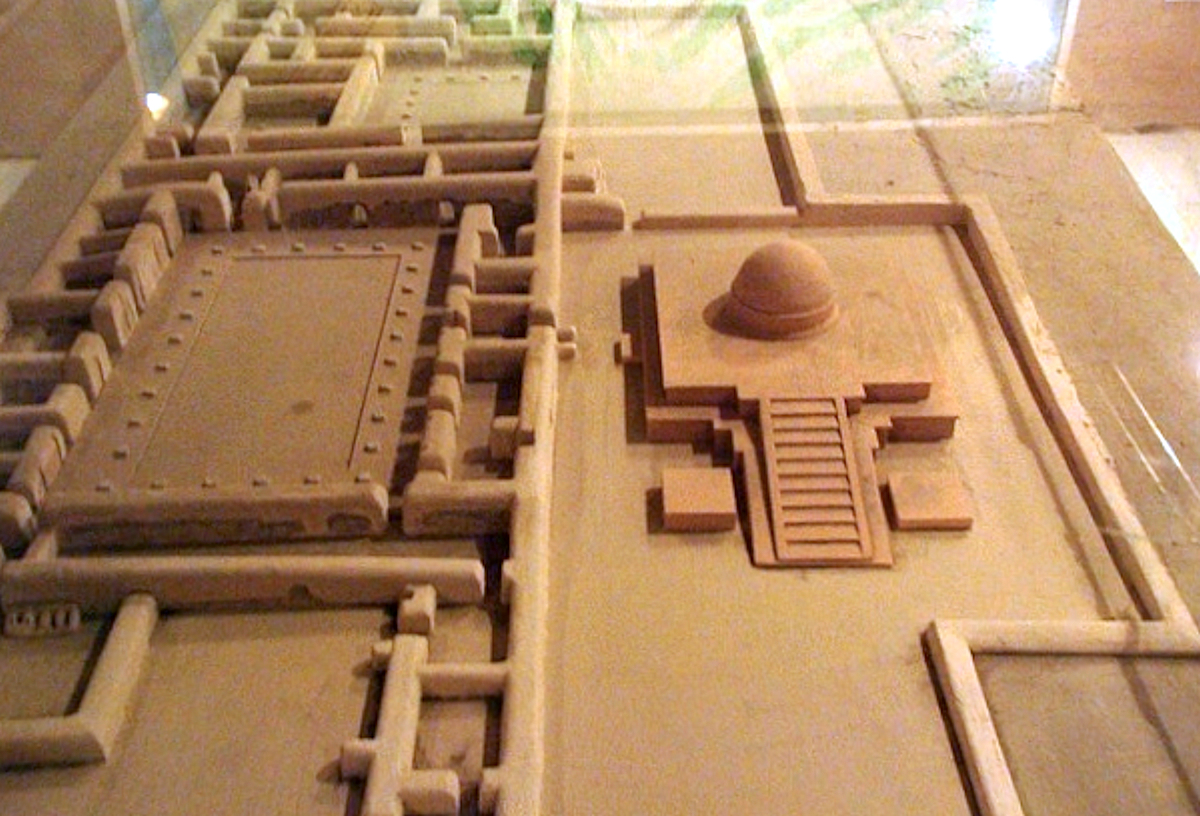
Fayaz Tepe is the highlight and the most complete of the group. It is a Buddhist monastery and stupa complex on the Termez oasis, with foundations reaching back to around the 1st century CE under the Kushans and its fullest development in the following centuries. Archaeologists working here have recovered wall paintings and sculptures spanning the first three centuries of our era, and the site is famous for a small original stupa now sheltered beneath a modern protective dome. The monastery’s monks’ cells, courtyards and refectory are clearly laid out, so it is easy to read how the community lived. Entry is very cheap, usually well under a dollar, and is often included with your Archaeological Museum ticket; expect a small extra charge for photography.
Kara Tepe
Kara Tepe is the more atmospheric and the more complicated to visit. It was a cave-and-surface monastery cut into the soft sandstone above the river, made up of several groups of monks’ cells and small stupas, active from around the early 2nd century and largely abandoned by the late 4th. The catch is location: Kara Tepe sits right against the Afghan border, and access is frequently restricted. Some travellers have wandered it freely, while others have needed a permit arranged in advance, and obtaining one can take several days. The situation genuinely changes, so treat Kara Tepe as a bonus rather than a guarantee, and ask at the Archaeological Museum in town for the current status before you set out.
Zurmala stupa
Zurmala is the quiet one, and arguably the most remarkable. This 16-metre brick tower, standing alone in farmland outside the city, is the surviving core of a colossal Buddhist stupa built in the 1st to 2nd century CE. Stripped of its original stone cladding and decoration long ago, what remains is a weathered mound of ancient brick, and it may well be the oldest standing structure in Uzbekistan. There is little signage and nothing to buy a ticket for; you simply come, stand at the base of something two thousand years old, and appreciate that it is still here at all.
The Islamic monuments
Termez did not stop mattering when Buddhism faded. Two complexes in particular show the city’s later role as a centre of Islamic learning and dynastic power.
Al-Hakim al-Termizi Mausoleum
Set on the riverbank near the old walls of Termez, this complex honours Abu Abdullah Muhammad al-Hakim al-Termizi, a 9th-century Islamic scholar, mystic and prolific author regarded as a founding figure of a Sufi tradition. The site grew over centuries, from roughly the 11th to the 15th, and now includes the mausoleum itself along with a mosque, a guesthouse and cells for pilgrims. The finely carved marble cenotaph you might expect to see was moved to the Termez museum for protection; a modern replica sits in its place. It remains an active pilgrimage site, so visit with the respect you would give any working shrine.
Sultan Saodat complex
Sultan Saodat is the grandest ensemble in Termez, a long courtyard lined with some seventeen mausoleums that formed the family necropolis of the Termez sayyids, a dynasty claiming descent from Ali whose power peaked in the 13th and 14th centuries. Built up in stages between roughly the 11th and 17th centuries, the complex layers mausoleums, mosques and a khanaka along its perimeter, so a slow walk through it doubles as a walk through several hundred years of architectural style. It photographs beautifully in low light and is usually far quieter than the equivalent monuments in Samarkand.
Termez Archaeological Museum
Make this your first stop. The Archaeological Museum of Termez is one of the best regional museums in the country and the key to understanding everything else you will see. Its galleries run from Bronze Age ceramics through the Greco-Bactrian and Alexander the Great periods to a superb collection of 3rd- and 4th-century Buddhist sculpture and painting recovered from the sites around town. Several standout objects, including the original cenotaph from the al-Hakim al-Termizi complex, live here for safekeeping. Spend an hour or two absorbing the timeline, and the ruined stupas outside will suddenly make sense. It is also the practical hub for your visit: staff here are the people to ask about current access to Kara Tepe and other border-adjacent sites.
How to get to Termez
By air
Flying is by far the easiest option. Uzbekistan Airways operates direct flights from Tashkent to Termez International Airport, turning a long overland haul into a short hop of roughly an hour and a half. If your time is limited, this is the way to do it; book ahead, as seats on this route are finite and fill up. From the airport, local minibuses and taxis run into the city centre. Booking through the airline directly or a reputable agent avoids the markup you sometimes see on third-party sites.
By train
There is an overnight train from Tashkent, running roughly every other day, that leaves in the evening and arrives the next morning after around fourteen hours. It is a slow but genuinely scenic way to reach the south, and a sleeper berth doubles as your accommodation for the night. From Samarkand there is no convenient direct service, so most rail travellers route through Tashkent or connect via Karshi. Tickets are best bought in advance through the official Uzbekistan Railways e-ticket platform at eticket.railway.uz, where you can check the current timetable, which does shift seasonally. For the bigger picture on moving around the country, see our guide to getting around Uzbekistan.
By road
Shared taxis and long-distance cars connect Termez with Samarkand and Bukhara, typically breaking the journey at Karshi. The drive crosses some dramatic mountain country but is long, so most independent travellers only choose it if they want to see the landscape or cannot get a flight. If you do drive, allow the best part of a day from Samarkand.
How many days do you need?
Two full days is the sweet spot. That gives you one day for the museum and the Buddhist sites (Fayaz Tepe, Zurmala and, if access allows, Kara Tepe) and a second for the Islamic monuments, the al-Hakim al-Termizi shrine, Sultan Saodat and a look toward the Friendship Bridge and the river. If you are flying in and out, you could compress the highlights into a single very full day, but the sites are spread out and the pace is more pleasant with room to breathe. Termez is not a place to rush; half its appeal is the sense of standing somewhere few outsiders reach. Once you have planned the south, our overview of the best things to do in Uzbekistan helps you slot it into a wider itinerary.
Practical and sensitivity tips
Termez is safe and welcoming, but its border location calls for a little extra care. A few things to keep in mind:
- Do not photograph the Friendship Bridge, the Amu Darya frontier, military posts or checkpoints. This is a live international border and cameras pointed the wrong way cause real problems.
- Carry your passport at all times. You may pass through checkpoints around the city, and registration slips from your accommodation are worth keeping.
- Confirm Kara Tepe access at the Archaeological Museum before travelling out to it, and be prepared for it to be closed or to require a permit that takes days to arrange.
- The south is hot. Summer temperatures are punishing, so spring and autumn are far more comfortable for wandering open archaeological sites with little shade.
- Dress modestly at the al-Hakim al-Termizi shrine and other religious sites, as these are active places of worship, not just monuments.
- Accommodation is limited compared with the tourist cities, so book ahead; our notes on where to stay in Uzbekistan cover the regional options.
Termez at a glance
| Detail | Information |
|---|---|
| Region | Surkhandarya, southern Uzbekistan |
| Best for | Buddhist heritage, off-the-beaten-path history |
| Getting there | Direct flight from Tashkent (~1.5 hrs) or overnight train (~14 hrs) |
| Suggested stay | 2 full days |
| Best season | Spring or autumn (summers are extremely hot) |
| Key sites | Fayaz Tepe, Zurmala, Kara Tepe, Sultan Saodat, al-Hakim al-Termizi, museum |
| Watch out for | Border photography rules; Kara Tepe access restrictions |
Frequently Asked Questions
Is Termez safe to visit?
Yes. Despite sitting on the Afghan border, the city itself is calm, and visitors are a rarity rather than a target. The main thing that separates it from elsewhere in Uzbekistan is the frontier presence: expect checkpoints, carry your passport, and never photograph the border, the bridge or any military installation. Follow those rules and a trip to Termez is straightforward.
Can I visit Kara Tepe?
Sometimes. Because Kara Tepe lies directly against the border, access is inconsistent: some travellers walk it freely while others need a permit arranged days in advance, and it is occasionally off-limits altogether. Ask at the Termez Archaeological Museum for the current situation before you head out, and have a flexible plan in case it is closed on the day.
How do I get from Samarkand to Termez?
There is no convenient direct train from Samarkand, so your realistic choices are a shared taxi or private car (a long drive via Karshi, most of a day) or backtracking to fly. Many travellers find it simplest to fly from Tashkent, since the direct flight there takes only about an hour and a half. If you are already in the south, road transport via Karshi is the practical link.
What is the best time of year to go?
Spring (roughly April to May) and autumn (September to October) are ideal. Termez is one of the hottest places in Uzbekistan, and its archaeological sites offer almost no shade, so midsummer visits are genuinely uncomfortable. Cooler months let you explore the open ruins at a relaxed pace.
Is Termez worth the detour?
If you have a specific interest in Buddhist history, ancient Bactria or simply seeing an Uzbekistan almost no tour groups reach, absolutely. If your trip is short and focused on the classic Silk Road cities, Termez is a harder sell purely because of the distance. It is a destination for travellers who value depth and rarity over convenience.
The bottom line
Termez asks more of you than Samarkand or Bukhara, a longer journey, a border to respect, sites that occasionally close without warning. In return it gives you something they cannot: the chance to stand inside Uzbekistan’s Buddhist past, on the edge of the country, where the Amu Darya slides toward Afghanistan and two thousand years of history are still visibly holding on. For the traveller willing to go the extra distance, the south is where Uzbekistan gets truly rare.
Featured image: Nicoletta Stofkoper (CC0) via Wikimedia Commons.