Spend a week in Uzbekistan between September and November and you will run into a wedding whether you plan to or not. A convoy of ribboned cars pushes through Tashkent traffic with the horns going. A restaurant in Samarkand shakes with amplified drums until it stops abruptly at eleven. At six in the morning in Bukhara, an entire street of men is sitting down to rice. None of it is staged for visitors: it is the ordinary machinery of family life, running at full volume.
The Uzbek wedding — to’y, or more precisely nikoh to’yi — is not a single event. It is a sequence that can stretch over months, involving two extended families, several hundred guests, a religious rite, a state registration, and a set of named rituals. Some are ancient, some are twentieth-century Soviet grafts, and some were invented recently by a hospitality industry that now employs tens of thousands of people.
What follows is a traveller’s guide to reading what you see, plus practical notes if you are invited — which happens more often than you would expect. One caveat: customs differ substantially between Tashkent and the Ferghana Valley, between city and village, and between families of different religiosity. Treat the details below as common patterns, not rules.
Before the wedding: matchmaking and the engagement
The wedding you might attend is the visible end of a process that started much earlier and much more quietly.
Sovchilik: the matchmaking visit
Sovchilik is the practice of sending representatives — sovchi, usually senior women from the groom’s family, to the bride’s household to open discussions. In its traditional form the couple had limited say. Today, especially in Tashkent, couples very often meet on their own and the sovchi visit ratifies a decision already made; in more conservative rural settings the older pattern carries more weight. Both realities exist in the same country, sometimes in the same family.
Fatiha to’yi: the engagement
Fatiha to’yi (also fotiha to’y, from the opening chapter of the Qur’an) is the engagement ceremony, usually held at the bride’s home a month or more before the wedding. Elders give a blessing, the families agree on arrangements, and gifts move between households — traditionally white fabric for the dress, a scarf, and sweets such as parvarda handed round to mark the agreement.
Accounts of the older form often mention a symbolic bride payment. How much survives, and in what form, varies enormously; in many urban families it has collapsed into an exchange of gifts and a negotiation over who pays for what. It is not a subject to raise with people you have just met.
Once fatiha to’yi is done, the couple is publicly committed, and breaking it off afterwards is a serious social matter.
The wedding day itself
Nahor oshi: the morning plov
This is the one most travellers accidentally witness. Nahor oshi — morning plov, also written oshi nahor — is a mass breakfast of plov served roughly between 6am and 9am, hosted by one side of the family and attended overwhelmingly by men. It is fast: ninety minutes at most, tables cleared and reset in waves as guests eat and leave for work.
The cooking is a male domain and starts the night before, when the carrots are cut and duties are assigned by the older men. Prayers are read; musicians may play at the door. At the end, honoured guests are sometimes presented with a chapan, the quilted national coat, draped over the shoulders.
Morning plov is not exclusive to weddings, the same format is used for memorial gatherings, circumcisions, and other major family events. If you see a queue of men outside a choyxona at dawn, you are looking at a life event, but not necessarily a happy one. Read the mood before assuming. For the dish rather than the ritual, see our Uzbek food guide.
Nikoh and state registration
Two separate things make a marriage here. The nikoh is the religious rite, conducted by an imam who recites prayers and sets out the spouses’ obligations. Legally, what counts is registration at the civil registry office, the ZAGS — an institution inherited from the Soviet period, and one reason Uzbek weddings feel simultaneously Islamic and post-Soviet. Most couples do both, usually close together. The nikoh is listed on Uzbekistan’s national intangible cultural heritage register.
The bride’s farewell and arrival
The emotional centre of the day, and the part outsiders least expect, is the farewell. Before leaving her parents’ home the bride says goodbye to her family, surrounded by friends singing traditional farewell songs — yor-yor and, in some regions, ulanlar. These are not celebratory songs. They are laments, meant to make people cry, and guests expecting uncomplicated joy are often startled by how heavy this stretch is.
At the groom’s family home the mood flips. The bride is walked in over a white cloth runner, the poyandoz — bows at the threshold in a gesture often called ostona salom, and is showered with sweets and coins: a sweet life, a prosperous one. Details vary by region, and some families skip parts of this entirely.
The banquet: scale, sound, and those car convoys
The evening banquet is what most people picture. Purpose-built halls in every city seat several hundred under chandeliers, with a stage, a live band, an MC who never stops talking, and a volume that makes conversation across a table genuinely difficult. Food arrives continuously and in quantities nobody can finish. Dancing is near-continuous, and guests approach the couple’s table to offer congratulations, often with cash.
Between ceremonies the wedding party moves by car — a convoy trimmed with ribbons and flowers, horns blaring, stopping at monuments and parks for photographs. In Samarkand and Bukhara that means wedding parties posing against the same Silk Road monuments you came to photograph. Traditional instruments — karnay horns, surnay, doira and nagora drums, often play the party in for the last stretch on foot.
The scale has become a matter of public policy. Because the expected size of a wedding pushed many families into debt, the government has legislated repeatedly to cap it — limiting guest numbers, restricting events to a single day within set hours, and capping the size of car processions. Enforcement and the exact figures have shifted more than once, and reporting on current thresholds is inconsistent (last checked: July 2026). The underlying tension is not in doubt: many Uzbeks themselves think weddings have become too expensive, and say so freely. RFE/RL has covered the debate in some depth.
After the wedding: kelin salom
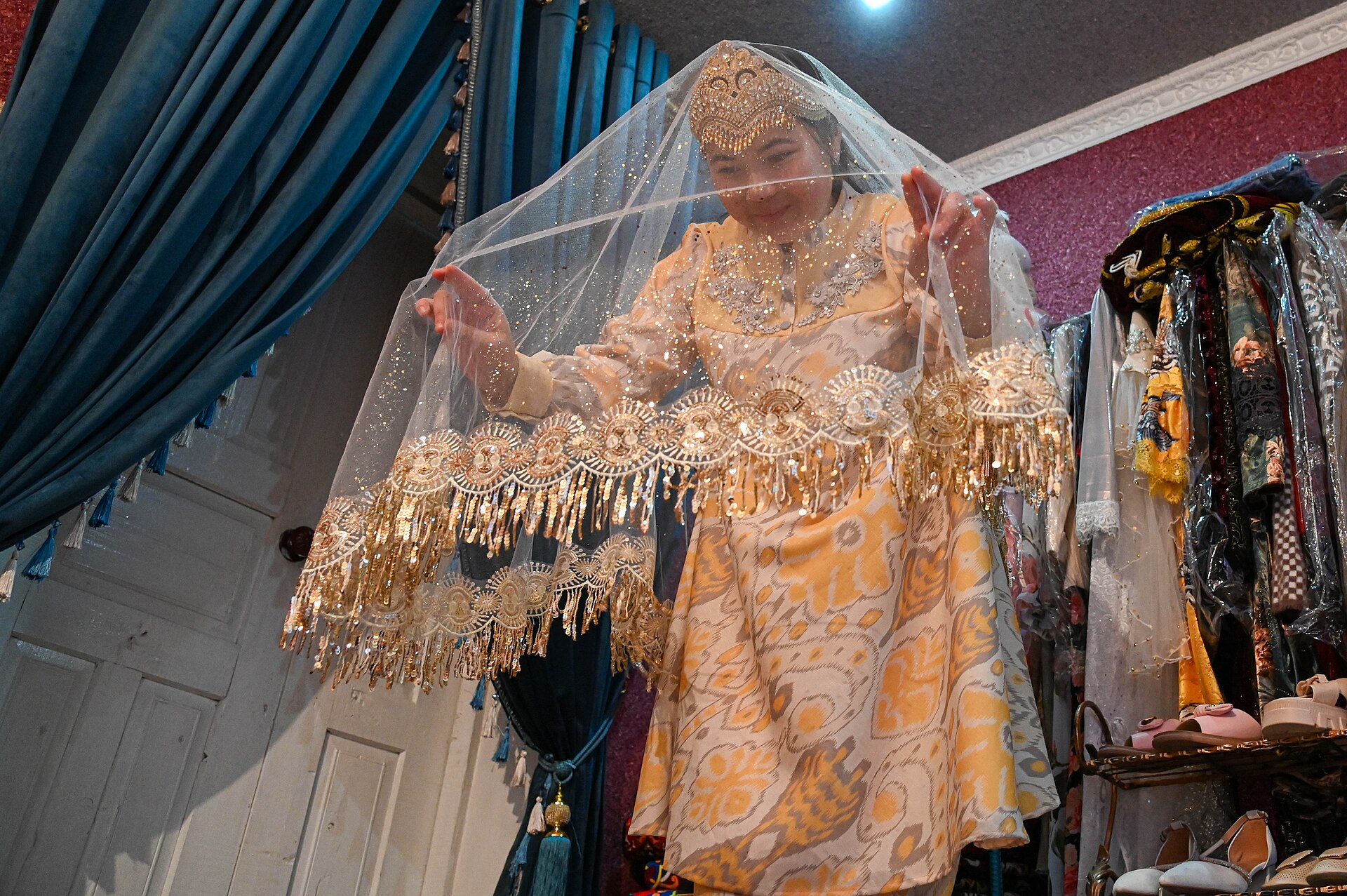
Kelin salom — “the bride’s greeting” — usually takes place the morning after the main celebration, at the groom’s family home. The new kelin (daughter-in-law), dressed traditionally and often veiled, is formally introduced to her husband’s extended family, bowing to each relative in turn. Women of the household sing the kelin salom song, listing the relatives and their claims on her respect; she stays silent throughout. In return she receives gifts and blessings.
It is striking to watch, and it is also the ritual most likely to make foreign visitors uncomfortable, because it dramatises a hierarchy that many find hard to sit with. Uzbek attitudes are not uniform either: some families keep it in full, some shorten it to a few minutes, and young women themselves are divided between finding it moving and finding it dated. If you are present, watch quietly and keep your opinions for later.
If you’re invited: etiquette for foreign guests
Invitations to travellers are common and usually sincere, a guesthouse owner, a driver, a shopkeeper’s cousin. A foreign guest is a small point of pride for the host. Accept if you can, then get the basics right.
- Dress up, not down. A jacket or smart shirt for men; a dress or smart trousers for women, with shoulders and knees covered. Nobody is ever embarrassed by being slightly overdressed at a to’y.
- Bring cash, in an envelope. This is the standard gift. Amounts depend on your relationship to the family; ask whoever invited you what is normal, and they will tell you honestly.
- Arrive on time and follow your host. You will be seated somewhere specific, probably somewhere honoured. Do not wander off to find a better table.
- Eat something at every stage. Refusing food reads as a rejection of hospitality. Small portions are fine; empty plates are not.
- Toasts are real speeches. If asked to say something, stand, keep it to thirty seconds, wish the couple health and children, thank the parents.
- Alcohol varies by family. Vodka flows freely at some weddings and is entirely absent at others. Follow the table, and never press a drink on anyone.
- Dance when invited. Competence is not expected. Participation is.
Our broader guide to Uzbek culture and etiquette covers the surrounding conventions — greetings, shoes, seating, the right hand, that apply here as they do everywhere else.
Photography courtesy
Weddings are photogenic, which is exactly the problem. At a wedding you have been invited to, photograph freely once you have asked the host, but stay out of the professional’s way and do not shoot during the nikoh or the farewell without explicit permission. At a wedding you have come across outside a monument, ask before pointing a camera at the couple — most will say yes and several will pull you into the frame, but the asking is the point. Stop immediately if anyone looks uneasy, and avoid posting recognisable faces online without a clear yes.
Frequently Asked Questions
When is wedding season in Uzbekistan?
Autumn, roughly September through November — is the traditional peak, when the weather has cooled and produce is cheap. Late spring is a secondary season. Weddings happen year-round, but in October you may see several a day. That overlaps with the best weather for everything else worth doing in the country.
How many people attend a typical Uzbek wedding?
Several hundred is normal, and the morning plov can draw more people than the evening banquet. Regulations have set caps on guest numbers to reduce costs, but the specific limits have been revised more than once, so treat any figure you read as provisional.
Can I attend a morning plov without an invitation?
In practice, often — nahor oshi is semi-public and hosts are famously reluctant to turn anyone away. But “they won’t refuse” is not the same as “you’re welcome”, and the same format is used for funeral commemorations. Ask a local contact to bring you, or ask the organisers, rather than simply sitting down.
Are men and women seated separately?
It depends on the family and the region. Morning plov is essentially male. Evening banquets are usually mixed, though tables often sort themselves informally by gender and generation, and separation is stricter in conservative households. Watch where your host puts you and stay there.
What is a chapan and why is it draped over people?
The chapan is a quilted, often brightly striped coat. Placing one on a guest’s shoulders is a formal honour. If you receive one, wear it for a while rather than folding it away.
Are wedding customs the same across Uzbekistan?
No. Khorezm, the Ferghana Valley, Bukhara, Samarkand and Karakalpakstan each have distinct songs, dishes, and ritual sequences, and there are further differences between Uzbek, Tajik, Karakalpak and Korean-Uzbek families. The framework in this article is a common core, not a universal template. Regional variation shows up in Navruz and other festivals in much the same way.
A last note
The most useful thing a traveller can bring to an Uzbek wedding is patience and a willingness to be out of place for six hours. You will not understand the toasts, you will be fed past capacity, and someone will make you dance. Somewhere in the middle you will watch a family absorb a new member in public, in front of four hundred witnesses, which is what all of it is for.
Featured image: Sinchalak Musulmon (CC BY-SA 4.0) via Wikimedia Commons.