Shashlik is the everyday backbone of eating out in Uzbekistan. Plov gets the ceremony and the UNESCO paperwork, but shashlik is what actually feeds the country at lunch, at dinner, at the bus station, at the wedding, and on the shoulder of every mountain road. It’s charcoal-grilled skewered meat, sold by the skewer, cooked in front of you on a narrow trough grill called a mangal, and eaten with bread, raw onion and tea. The only thing standing between you and a very good meal is knowing which words to say and roughly what to pay.
That matters more than it sounds, because “shashlik” on an Uzbek menu is a category, not a dish. Depending on the place you might be choosing between seven or eight things — cubed lamb, cubed beef, ground and hand-moulded kiyma, liver wrapped in caul fat, chicken, pure blocks of fat-tail dumba, sometimes fish or vegetables. They cook differently, they cost differently, and ordering “one shashlik” gets you whatever the grill man decides.
This guide covers the types, the marinade and the mangal, how ordering and paying actually works, table etiquette, approximate 2026 prices, and where to eat well in Tashkent, Samarkand, Bukhara and at roadside stops. For what else is on the table, start with our Uzbek food guide.
Shashlik, kabob, kebab: sorting out the words
Across Central Asia, the Russian-derived word shashlik (шашлык) is what everyone uses for skewered charcoal-grilled meat. In Uzbek you’ll also see kabob on signs and menus, and the two are more or less interchangeable. One trap: kazan-kabob isn’t shashlik at all. It’s meat and potatoes fried in a cast-iron kazan, no skewer, no charcoal — an excellent dish, but a different one, and travellers order it by accident all the time. You’ll also meet lyulya-kebab for ground meat moulded onto a flat skewer; the local name is usually kiyma kabob, and both get you the same thing.
The types of shashlik
Lamb and mutton (qo’y go’shti)
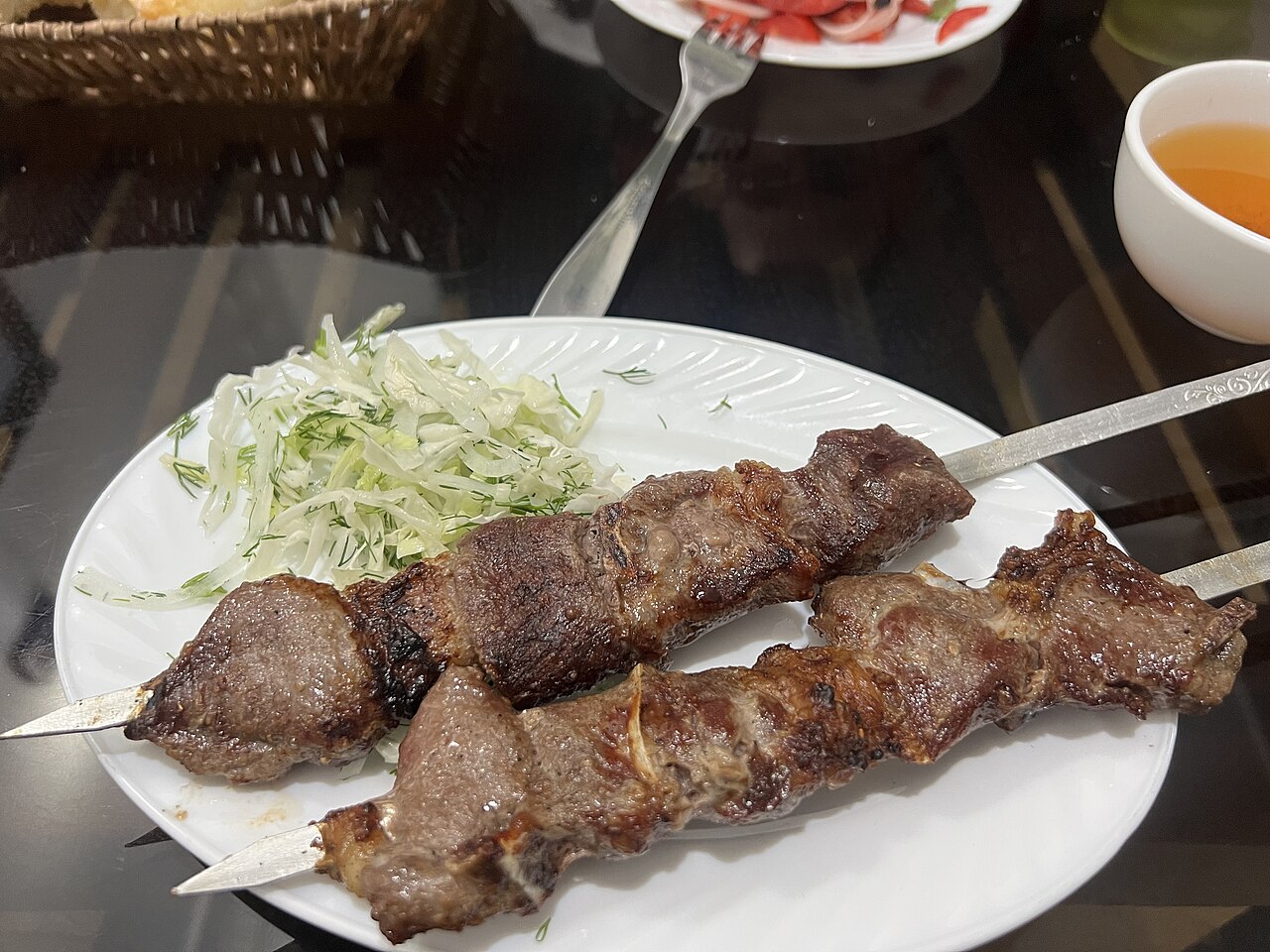
The benchmark. Cubes of lamb or mutton threaded onto a metal skewer, traditionally with a piece of tail fat last so it renders down over everything below it. Good lamb shashlik is pink-edged and juicy with a crisp exterior; mutton from an older animal is stronger, gamier and more of an acquired taste. If a place is famous locally, this is almost always why.
Beef (mol go’shti)
Often the default in cheaper cafés and roadside stops, and usually a little less expensive than lamb. Beef cubes are alternated with fat for the same reason — lean beef dries out fast over open charcoal. Milder and more familiar than mutton.
Kiyma / lyulya (ground meat)
Minced beef or lamb, worked with onion, salt and spices until sticky enough to cling to a flat skewer, then moulded by hand into a long sausage. No binder, no breadcrumbs — the texture comes from the kneading. Soft, heavily seasoned, and the safest bet for anyone who finds whole-muscle mutton too assertive.
Jigar (liver)
Cubes of lamb liver, very often wrapped in a lacy sheet of caul fat (charvi) so the liver bastes itself instead of turning to chalk. Cooked properly it’s rich, faintly sweet and startlingly good; cooked badly it’s grainy and bitter. It’s a good order at a busy grill with genuinely fresh meat and a bad one anywhere slow. Locals often take a jigar skewer as an opener before the lamb arrives.
Chicken (tovuq)
Ubiquitous in cities, less common at traditional roadside mangals. Usually thigh meat, sometimes wings, marinated more lightly than the red meats. The cheapest option in most places and the one families order for children — perfectly good, rarely the reason a shashlik house has a reputation.
Dumba (fat-tail fat)
Cubes of fat from the tail of the fat-tailed sheep, grilled until the outside crisps and the inside goes translucent. This is a delicacy, not a garnish — think Central Asian pork crackling. One skewer between three or four people, eaten with raw onion and vinegar to cut it, is the right amount. Ordering a full portion to yourself is a rookie error you’ll feel all evening.
Fish, vegetables and the rest
Fish shashlik, usually carp or trout, appears mostly around the Charvak and Aydarkul reservoirs. Vegetable skewers — whole tomatoes, peppers, aubergine, sometimes potato — are standard at bigger restaurants and the practical fallback for vegetarians, though the grill is shared with meat. Quail and “gul” (a rose-shaped roll of meat wrapped around dumba) turn up occasionally.
| Type | Local name | What it’s | Good for |
|---|---|---|---|
| Lamb / mutton | Qo’y kabob | Cubed lamb with tail fat | The benchmark order |
| Beef | Mol kabob | Cubed beef with fat | Milder, usually cheaper |
| Ground | Kiyma / lyulya | Hand-moulded minced meat | Soft texture, easy entry point |
| Liver | Jigar | Lamb liver, often in caul fat | Rich starter skewer |
| Chicken | Tovuq kabob | Thigh or wing pieces | Kids, cautious eaters |
| Fat | Dumba | Pure fat-tail cubes | Sharing one skewer, not more |
| Fish | Baliq kabob | Carp or trout | Lake and reservoir areas |
Marinade and the mangal
Every grill cook guards a marinade recipe, but the structure is simple: a great deal of sliced raw onion, salt, black pepper and cumin (zira), often coriander seed, sometimes vinegar or a splash of mineral water. The onion does most of the work, tenderising the meat over several hours or overnight, while the cumin supplies the smell you’ll come to associate with the whole country. Uzbek marinades are drier and less acidic than yoghurt-based Turkish or wine-based Caucasian versions.
The mangal is a long, narrow trough of charcoal with no grate. Skewers rest on the rims, so the meat sits a few centimetres above the coals and is turned by hand — and fanned. That constant fanning with a piece of cardboard isn’t showmanship: it drives the heat up in bursts and stops dripping fat flaring into flame. Good cooks burn fruitwood charcoal such as apricot or vine prunings, one real reason a village grill can outperform a smart city restaurant.
How to order, and what arrives with it
Shashlik is priced and ordered by the skewer, not by the portion. Say the type and the number: “ikkita qo’y kabob” (two lamb), “bitta jigar” (one liver). At many local places, especially in Samarkand, you choose raw skewers from a chilled display case at the front and they go straight to the grill — point and count on your fingers.
What lands on the table almost automatically:
- Non — round flatbread, torn by hand, used to slide meat off the skewer. See our guide to Uzbek bread and non for why you never place it face-down.
- Raw onion rings with vinegar — sometimes dusted with sumac. This isn’t decoration; it’s the intended acid to cut the fat and you should eat it.
- Green tea (kok choy) — the default drink, usually charged per pot. Black tea (qora choy) is more common in Tashkent.
- Achichuk salad — tomato, onion, chilli, sliced thin. Ordered separately, worth it.
Bread, tea, salad and sometimes a per-person cover charge are billed as extras almost everywhere, so a “cheap” skewer becomes a much larger bill fast. That’s normal, not a scam.
Approximate prices per skewer
Rough ranges for mid-2026, when the som traded around 12,000 to the US dollar (last checked: July 2026). Inflation has moved prices noticeably, so treat these as orientation, not quotes — our Uzbekistan travel costs breakdown has the wider budget picture.
| Where | Per skewer (approx.) | In USD | Notes |
|---|---|---|---|
| Bazaar and roadside grills | 12,000–25,000 som | ~$1–2 | Cash, no menu, chicken cheapest |
| Neighbourhood shashlik cafés | 20,000–35,000 som | ~$1.70–3 | Printed menu, tea extra |
| City restaurants, Tashkent | 35,000–60,000 som | ~$3–5 | Table service, cover charge likely |
| Tourist-facing old-town terraces | 45,000–80,000 som | ~$4–6.50 | You’re paying for the view |
Table etiquette
Shashlik is informal food, but a few conventions help. Slide the meat off the skewer with bread or a fork rather than eating straight off the metal. Emptied skewers are stacked at the edge of the table and counted for the bill, so don’t tidy them away. The eldest person is served first and usually pours the tea, with the first cup poured back into the pot two or three times to brew it. If you’re hosted, expect to be over-fed and expect any attempt to split the bill to be waved off; our Uzbek culture and etiquette guide covers the wider rules of hospitality. Beer with shashlik is normal in Tashkent, but rural chaikhanas and family-run grills near mosques often serve no alcohol at all — don’t assume, and don’t bring your own without asking.
Where to eat shashlik well
Tashkent
The capital has both ends of the range. The grill counters at Chorsu Bazaar are the cheap, fast, atmospheric version — meat cooked in front of you under the domed market, eaten at plastic tables, no English. At the sit-down end, Shashleek near Ecopark is a long-running specialist carrying the full spread including liver, kiyma and potato skewers, while Afsona is the more polished Uzbek restaurant visitors are most often pointed towards (last checked: July 2026). Between those extremes, almost any neighbourhood place with a smoking mangal and a queue of taxi drivers is a good bet.
Samarkand
Samarkand leans on the choose-from-the-fridge format: inspect the raw skewers, pick, pay, watch them cook. Karimbek, in the Iranian mahalla, is the best-known large traditional restaurant with several shashlik types on a full national menu (last checked: July 2026). Simpler cafés around the bazaar and on residential streets away from Registan generally give better meat for half the price.
Bukhara
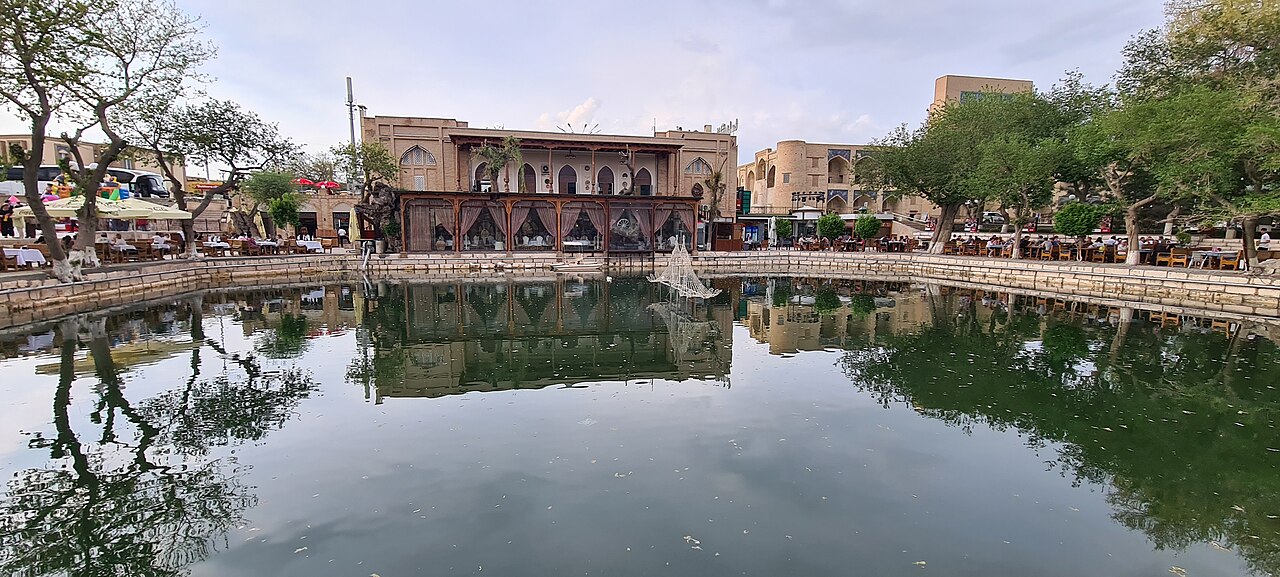
Bukhara’s most photographed dining is around the Lyabi-Hauz pool, where several terrace restaurants grill shashlik beside the water. Pleasant, and priced accordingly. For better value, walk ten minutes out of the old town in any direction and eat where the mangal is out on the pavement.
Roadside grills
Some of the country’s best shashlik is eaten at unmarked roadside stops — the mountain road to Chimgan and Charvak, the Tashkent–Samarkand highway, the passes towards Fergana. The rule for choosing one is turnover: a full car park and a grill that never stops means fresh meat. Drive past anywhere empty with skewers sitting warm. Cash only, small notes.
Frequently Asked Questions
How many skewers should I order per person?
Two to three for a normal appetite, plus bread and a salad to share. Skewers vary a lot in size — a bazaar skewer can be half the weight of a restaurant one — so order two, see what arrives, and add more. Nobody minds a second round; that is how the whole system is designed to work.
Is shashlik safe to eat from street grills?
Generally yes, provided the place is busy and the meat goes from the fridge or display case onto the coals in front of you. Charcoal grilling at that temperature is an effective cook. The things to avoid are skewers that have been sitting cooked and lukewarm, and liver at a slow venue. Standard travel advice applies to the raw onion garnish if you’re being cautious about washed produce.
What is the difference between shashlik and kazan-kabob?
Shashlik is skewered and grilled over charcoal. Kazan-kabob is meat and potatoes fried in a cast-iron kazan with no skewer and no grill. Both are excellent, but if you want the smoky skewer, say “shashlik” or “kabob” rather than “kebab”, which in Uzbek usage often points at the kazan version.
Can vegetarians eat at a shashlik house?
Thinly. Vegetable skewers, achichuk salad, bread and sometimes fried potatoes are usually available, but they come off the same grill and the same kitchen. Vegetarians generally do better at street-food stalls selling samsa and non, or at the growing number of modern cafés in Tashkent and Samarkand. Fully vegan eating outside the big cities takes planning.
Which type should I try first?
Order one lamb and one kiyma — the benchmark and the crowd-pleaser — and add a single jigar if the grill looks busy. That combination tells you almost everything about a kitchen for the price of one meal. For how shashlik sits beside the other national dish, read our plov guide.
Before you go
Shashlik rewards curiosity rather than research. Learn four words — qo’y, mol, kiyma, jigar — carry small som notes, follow the smoke and the queue, and eat the onions. The best skewer of your trip will almost certainly come from somewhere without a sign or a website, and it will cost less than a coffee at home. For further background, see Advantour’s overview of Uzbek dishes.
Featured image: Muharramxon (CC BY 4.0) via Wikimedia Commons.